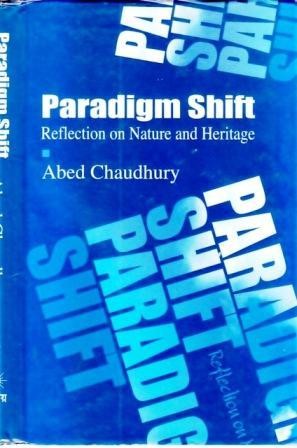
Paradigm Shift
Reflection on Nature, Heritage and Islam
………………………………………………………
Abed Chaudhury
Peering through gilded glass
This year marked half a century since the discovery of DNA. It is also the year when the overall human genome sequences were described with clarity and with all the gaps filled. It is also roughly sixty years since the atomic bomb came to be part of politics, of life in general. For a person who is around sixty now, a lot has happened in his lifetime. In the time scale of the civilised history of human beings, thought to be at most 60,000 years if we include the Palaeolithic hunter- gatherers, it is a mere wink of an eye. In one thousandth blink of elapsed time of our civilised history we have travelled from a sense of self-cognition to a form of molecular self knowledge; and we have also have taken a leap from being stone throwing hordes to thermonuclear sophisticates. If 60,000 years ago we could only crack a few skulls in our anger, now we can potentially destroy everyone and that too a hundred times over. However, we still carry in us that same primeval skull, that same hate-lust-fear-curiosity infested mind. Suddenly we are beyond gradual and incremental steps and a defined future; now we are being fast-tracked in milliseconds of history in a direction the nature of which we cannot even comprehend.
This exhilarating journey of the human species is a given condition now. It has been a result of many accidents, many events that were unique and salubrious, while others were reprehensible and loathsome. Many fine minds are involved in cataloguing and thinking through these calamitous changes that shape us.
Nevertheless, we as a nation do not have this luxury. In order to keep pace with the rest of the world and prosper, we, the 140 million members of the 6-billion member human community, must find a formula for cohesive, peaceful and prosperous existence.
My own point of view is informed by a science-based optimism, a belief in human ingenuity. I believe that a nation of 140 million is potentially very strong by definition. Intelligence being randomly distributed in human species irrespective of lineage and race, we have a huge pool of talented individuals amongst our nation. Our challenge is to their future unfettered from the assorted mixture of negative traits such as poverty, conflict, and a lack of vision. We have no option but to make our politics very simple. We have no choice but to be optimistic, driven by a tradition that harnesses the past but one that is at the same time informed by science and a set of pragmatic skills that will quickly help realise the potentials of our people.
These are not idle or vague or general statements. For Bangladesh, this
incantation of the obvious is indispensable. Just a cursory look at our political landscape will convince even the most mellow of observers that our politicians and ruling elite are not interested in taking even the first steps. A platform of national consensus comprising core values and intent is missing. The very fabric of national existence is woven every few years; we are like year-to-year spiders spinning transient cobwebs, never wanting a home, an edifice that will endure time. We are shy of boldly proclaiming who we are.
Bangladeshis are a unique brand of people distinguishable partly by their language and ethnicity, but also by their religion and unique history. They are a people comprising the aborigines of the timeless alluvial delta but made hybrid through transmigrations through the millennia. A people informed by streaks of animist, Buddhist and Hindu ideas but then modified and reinvented through a Sufi syncretic version of Islam. And in this modern era a people that are creative, poetry-infused, spiritual, tolerant and democratic. We do not need to be inspired any more by the urban anglophilic Bengal Renaissance of Raja Ram Mohan Ray and Bankim Chandra; the core values of that movement do not resonate with the people of east Bengal with their peasant heritage; we do not need to endlessly pay homage to those pathfinders, important though they were in that historic epoch. For they advocated a kind of urban, occident-inspired exclusiveness and intellectual snobbery that is still rampant in our educated class and is in fact an obstacle to the true democratisation of our society. It branded the traditions of our villages as “Gramyo” caricatured and lampooned our wise elders of both religions and it nucleated a version of xenophobia against Islam that has not served us well. Our nationalistic educated class still does not have the courage to say that we reject those traits and assumptions totally and categorically, that we have fashioned a set of newer assumptions, which serve us better. We do not yet have the courage to say that we carry in us the legacy of what happened in Sylhet and Chittagong, Comilla and Narsingdi and Barisal and Pabna. We have not learnt yet that the history of those places together is our history; the events that resonated through those places through the millennia are our fountainhead of inspiration. Thirty-two years of independence and our intellectual classes are still giving us the old hackneyed doctrine of the Bengal renaissance, the First Light that dazzled our eyes for the first time. We are still like poor peasants looking through gilded glass into a house where history is taking place; where we are mere vicarious spectators encountering our enlightenment through others’ eyes.
It has been a long time since the world moved from this kind of second-hand experience and learned to accept every place as a valid unit of history. In European countries, every village, every hamlet is celebrated for its unique contribution to the nation’s history. In the USA, every small town is celebrated
for its uniqueness. In Bangladesh, we make no such attempt. Our school students memorise lore of Ibrahim Lodhi or Vasco da Gama; our university students wax lyrical about Ram Mohan Roy and yet we do not know or study why our cities are named the way they are; we do not know the history of our villages, the stories behind the ancient parganas. No acceptable intellectual investigations are ever made of these things. Somehow they are devoid of glory, they are only our history, and therefore not important. We still behave like colonised people where our history comes bottled from somewhere else. We copy others history and pass them as our own.
Of course we celebrate our war of independence as uniquely ours. We pretend as though we did not exist as people before 1971; that suddenly out of nothingness we came into being through this war. We pretend that we only existed as agents of struggle before that forever marching, chanting slogans. We have turned ourselves into cardboard caricatures of history. In reality, for millennia there were creativity in our land, our people were shaped by ancient ideas that proliferated in the landmass of what is Bangladesh. Old primal animist ideas mingled with those of Buddhism, Hinduism and then were transformed and incorporated by the Sufi version of Islam. In agricultural innovations, artistic pottery and craft, maritime ventures people of this delta have left a legacy. They bred better crops, were custodians of the genetic heritage of our flora and fauna. And through their actions they have left behind names of our villages and towns, sometimes enormous reservoirs of water that celebrate their name and they have left us, carriers if those hybrid genes and those songs poems and stories that enrich our mental lives. If the conglomerations of that legacy cannot be my renaissance then I do not want one borrowed from Florence or Kolkata.
Science and technophobia
There exists among social scientists, liberal activists, and other workers and thinkers trained in the humanities a form of technophobia that has its origin in western romanticism. This attitude has been nurtured through millennia as a form of rebel resistance against the machine, often fed by dreams of a utopian arcadia devoid of material wants or machine derived gains. Both the technophobia and the inchoate poetic melancholia that triggers it are human conditions with their genesis hidden deep in our psyche. Loving machines certainly is an acquired taste.
In the old hunter-gatherer society, or even as late as the sixties in the bulk of what is described as ―developing‖ countries, technologies were not significantly visible, especially in the villages. I recall growing up in a rural hinterland amidst breathtaking sceneries but without electricity or running water. There were giant ponds, often celebrating the names of some personality of local history and we swam and bathed with great gusto in those ponds any time we wanted. For more enfeebled ones there was always bathing with warm water poured with a mug, the ―bath of a crow‖, as it used to be described derisively. At night giant vistas of adjoining rice fields used to scintillate with fireflies and inside our houses we studied diligently in feeble light lit by kerosene lanterns. During full moon the whole village used to glow in a form of light-shadow routine, that in memory, even now brings a chill to my spine. Years later, images of those nights would be rekindled in me by the haunting song of Cat Stevens, ―I am being followed by a moon-shadow…‖ Somehow, somewhere, it seems that that inner-London music sophisticate had encountered something that I encountered in the bucolic village of Kanihati.
But poetic memories of rural arcadia aside, what are we to do with technology? Villages are now routinely lit with electricity and the moonlit nights of howling jackals have receded into the deep obscure hinterlands of our psyche. Instead of being gripped by the twinkling stars at night kids ogle the flickering electronic light shadow of TV screens, deriving vicarious sensations from faraway lands. The passive insemination of easy technology has certainly occurred in all walks of life. The giant high-tension electrical poles resembling miniscule Eiffel Towers dot our rural landscape with as much matter-of-fact visage as the undulating betel-nut palm. But has technology entered our attitude in a way that we can be
masters of technology? Or has technology remained for us as enigmatic as the mystical moonlight of the bygone era?
In 1895, a Bangali by the name of Jagadish Chandra Basu demonstrated the effect of radio waves in full view of the British administrative elite in the city of Kolkata. That was virtuoso discovery of a technology that would later change the world; thought up by a Bengali. But instead if getting credit for it, Basu today languishes in obscurity, overshadowed by Marconi, who made the same discovery a year later. In a recent extravagant biography of Marconi, Basu gets a one line cursory reference. That was the first and probably the most dramatic event of someone from our lands making a technological breakthrough.
Today, in spite of all the paraphernalia of technology around us, Bangladesh remains a technology-averse nation. While Rabindranath, a contemporary of
Basu, has kept us mesmerized for a whole century, Basu‘s memory has faded or is often linked with his work with plants. In the hundred years since 1895, no discovery of that magnitude has ever been made by a Bangali. In the Pakistan days no significant attempts were made to inculcate a love of science and technology (S&T) in the population. S&T remained, and still remains, soiled by the image of a form of boring obscurity, an arena occupied by nerds and geeks. Bright students gravitate towards subjects such as economics, or commerce, or medicine where the sole motive often is not to conquer new vistas of human physiology and preventative medicine, but simply to mint money as quickly as one can hold a stethoscope. The whole cultural space of the nation, containing its loftiest goals, dearest images and all its pious visions are consummated with songs, dance and poetry. For science there is only a hard shell of ennui, or a grudging acceptance on the grounds of a better life.
What we need to culture instead is what I would like to describe as the ―Jagadish syndrome‖, after the great scientist, J.C. Basu (JCB). To JCB, science was not a drab, difficult topic eliciting boredom; it was rather like poetry and music. In fact, the same impetus that causes us to understand poetry and music also could propel us to understand science, not as rote calculations but as a sense of wonder about nature. Somehow in our education system that wonder and the consequent mental energy are allowed to be dissipated.
What causes this form of subtle animus that makes us resistant to the true spirit of science? I believe that in Bangladesh we nurture a brand of Luddite technophobia that has become a part of the mythical lore of the nation. In that view poetry, dreaming, love, etc., are pitted, in subtle ways, against a genuine appreciation of nature through mental tools of science. Part of the problem is that technology did not develop from within. If we had known radio waves through the poetry-infused writings of JCB, rather than the radio-sets that came from
England, maybe we would have looked at electromagnetic radiation differently. In a way that is not appreciated widely, colonialism robbed us of an attitude towards science that in my opinion is the only way of implementing science successfully. And that is to see it as an extension of our organic self, as a valid and inevitable expression of our inner creativity. We have to re-invent that attitude. We have to love science like we love poetry and music.
I believe that it can be done. It has to begin very early in our villages where six- year-old girls look at butterflies with dreamy eyes. It has to begin in our village maktabs where toddlers oscillate their bodies with chants of the Koran that they are memorizing — where sylvan rice-paddocks with storks and kingfishers flying above look like yet another poem waiting to be written.
In that nature-infused world, we have to sow the seed of science as a form of wonder about nature, about water, about insects and about the paddy that is growing everywhere. We have to take very basic ideas of genetics, numbers, chemistry, and physics to those kids whose minds have just blossomed and will soon wither. It is about as challenging as instilling poetry and music all over the nation. It will need love and creativity more that it will need number-crunching zeal.
Will he or will he not?
I recently had a meeting with Professor Norman Borlaug, father of green revolution, wheat breeder par excellence and eminent laureate of Nobel Peace Prize. A few of us scientists talked to him one by one, and later he singled me out for further exposition of my own work on seed production, about which he showed great interest. Later he described his own work spanning well over half a century culminating in the huge increase in wheat production all over the developing world including what had become known as the “hunger belt” of South Asia including vast areas of India. Today India, Pakistan, and Bangladesh are self-sufficient in food grains and any prevailing hunger is not due to an absolute shortage of grains in these countries. In spite of all the criticisms directed at the Green Revolution, its ability to increase the level of production of food grains can never be doubted. Professor Borlaug, and to some extent Professor Swaminathan of India, deserve full credit for that. In Bangladesh, eminent rice breeders such as Dr. Hasanuzzaman and Dr. Mortuza Chowdhury, among others, have played very important roles in making us self-sufficient in rice. From the famine-prone years of early 1970’s to the end of millennium our population has increased by 60-80%, and yet from a chronic short-fall of several million tons in the 1970s we have now become a totally self-sufficient, even a marginally food-surplus nation. This remarkable progress has been made possible by elegant work on rice breeding, good agricultural extension and the talent of our rice producers. I have asked both Prof. Borlaug and Prof.
Swaminathan about this miracle and whom they thought were the post important people behind this awesome improvement. Both scientists put very high importance on the ingenuity of our farmers and breeders — people who remain nameless and largely unappreciated.
Indeed it is the genius of the Neolithic farmers that gave us the first agricultural revolution. Since that time people who were never formally trained in genetics or breeding science but clearly understood the cardinal principle of improvement through selection have selected plants meticulously for better and better traits.
Through millennia better-selected crops have been accumulated in many countries. Called land-races, these lines became the raw materials that were used to create new combination of traits through breeding; lines that ushered in the green revolution. The green revolution did not create anything fundamentally new; it simply combined pre-existing traits in a more intelligent way, producing lines that did not lodge and shed its grains prematurely, or ones that used fertilizer better. The individual traits that made these combinations possible were there through millennia, selected and maintained by our farmers, who were often women. The genetic endowment of crops, a noble heritage and wealth of
humankind, is owned by the farming women of the world, including the women of Bangladesh. As we celebrate the arrival of the high performing grains most of these original innovators remain unknown to us.
A large part of the problem of why science has not become an integrated part of our culture in Bangladesh is a failure of understanding the process by which technology, in particular breeding technology, has survived over millennia. This has led to a very low status accorded to our farmers and also formal scientists who study plant sciences. The disdain meted out to our farmers finds its parallel in the way we treat our agricultural scientists and extension workers. In the matrix of social position they often enjoy a low acclaim. While we shower acclaim on our poets and painters and politicians and visionaries, we shower the scorn of neglect on our plant breeders, our veterinarians, our horticulturists.
Surely an act of creative ingenuity that increases food production by even one percent is hugely more laudable than the most sublime poetry imaginable. Yet name me one person whose work on producing more food grains comes even close, in the scale of national adulation, to fame enjoyed by our poets or painters or musicians. The mental habit and cultural assumptions that have created this science-averse atmosphere in our nation are many and their eradication even more problematic. But those changes are minimal preconditions of any genuine improvement of our nation. A major problem is a lack of people in the higher decision making echelons who understand anything about science themselves, or even have any interest in being informed about science by an adviser. We have a Minister of S&T but does he advise the Prime Minister on Science? In many countries including Australia, the PM has a scientific adviser. In developed nations there are learned bodies such as Academies of Science, think tanks, and universities that are linked to farming communities. In neighbouring India, eminent scientists have access to the PM directly without the need to go through intermediaries. In our country the old-guard bureaucratic mandarins, often products of totally science-less education, make sure that technocrats become “desciencitized” before they become politically influential. Or somehow the process of reaching the stratospheric heights of national leadership causes them to forget that they once were and still could be scientists. After watching a few scientists turned politicians, that is my humble conclusion.
So we do have a systemic problem on our pathway of becoming a S&T savvy nation? Already these systemic problems have caused us to pay dearly. The lack of adequate IT infrastructure related to a faulty decision regarding under-ocean cable network has already been talked about widely but it is not clear that any remedial thinking is in place regarding these mismanagements. In life sciences, encompassing agro and veterinary and horticultural sciences as well as medicine and molecular sciences we now have a huge gap even by South Asian or regional
yardsticks. In scientific productivity as evidenced by publication records in eminent journals, we languish somewhere between Afghanistan and Upper Volta even though we have produced people like JC Basu and SN Basu, of Boson fame. The later Basu was a professor of Dhaka University physics department, the alma mater of our current Minister of Science and Information technology. A life scientist is now President of the Republic. As a ceremonial icon of the nation he could become a highly visible champion of science in Bangladesh. Will he, or will he not? That is now the question.
In search of Maulavi Abdul Ghani
Following is what General Colin Powell the US secretary of State said inter alia
regarding his recent trip to Bangladesh.
―In the course of my meetings in Bangladesh, I spoke with the Minister of Science and Information and Communications Technology, Dr. Ahmed Moyeen Khan, and he‘s putting all government services on-line: E-government, e- business. But more importantly, he is determined to make sure that every town and village in Bangladesh — that poor country, a country with such a large population, such desperate need — he is going to make sure that every village and town in Bangladesh has access to the Internet, has access to that marvellous store of knowledge and information up in the ether, waiting to be brought down, waiting to be brought down to educate youngsters, to provide opportunities, to bring in the knowledge of the world to help the most desperate people in the world.
It is a seductive image, to bring knowledge down from mere ether for the
―desperate‖ people, and although the ether theory has been discredited, the metaphor lingers on and feeds the imagination of developmentwalahs. In reality though, information is stored in real computers, often a world away, and while it is available through Internet, everyone, poor peasants of Bangladesh included, must access it through an Internet service provider, a decent computer and above all, stable supply of electricity, commodities not in ample supply in rural Bangladesh. And even after all that there are caveats; for instance, ten times as much garbage than genuine information clutter the cyberspace, and unless our rural folks are discriminatory and judicious users of internet, they could be misled in their search for information as innocuous as how to grow better onion.
While I hesitate to take a stand that might dampen the national enthusiasm for the cyber era, I would like to point out a few realities of our villages that have occurred to me during my recent frequent trips to a particular Bangladeshi village. And that village happens to be the one that I grew up in the sixties.
While much has changed since then the issues related to development education literacy etc have remained fairly similar in spite of the cyber era.
From the age of four till I turned nine I was taught, in a village, by a man named Maulavi Abdul Ghani who was my teacher of the Quran, arithmetic, Bangla, Social Studies and English. Early in the morning he used to arrive, often walking briskly, from a neighbouring village. In winter months we would see him
materialize, suddenly from thick fog that used to accumulate in the plain. In the following several hours he would teach me and my cousins and other rural kids rudimentary Arabic as well as how to read the Quran, and then after a break would change into being the teacher of the local primary school. Our learning tools included the conventional black board, chalk and a duster, and a healthy supply of dried tamarind seed with which we wrote both Bangla and English on the dirt floor of the school.
We often collected mud from the neighbouring fishpond and made model cars, sculptures etc with that mud. We used to collect flowers and rubbed soda and alkali on them seeing how flowers changed colours which gave us basic ideas of dyes and PH. It was learning through interacting with the elements of nature and with materials available from the local area.
Maulavi Abdul Ghani was a demanding taskmaster without a shadow of any sense of inferiority about the humble school of which he was the only teacher. Rather, he would often invite us to measure ourselves against people like Ghandhi, Jinnah and Suhrawardi.
A seed was planted in me in that bucolic hinterland of a village; a seed of daring curiosity, a home-grown pride, and learning so intimately linked to nature and elements that it became an organic part of my self. Looking back and many universities of world calibre later, I still remember those dew-soaked mornings of learning rapid-fire mental arithmetic, those tamarind seeds that taught me how to write Bangla and English alphabets and the sticky mud of the flood plains of Sylhet that taught me how to carve a shape out of clay.
All the ingredients of good education was there for me then in that village and it is there now for the kids who are now learning in that village. However, what is Missing is Maulavi Abdul Ghani. A man with intellectual rigour, simplicity, prides and punctuality all parcelled in a deceptively humble and incredible chutzpah-filled personality. That inability, a failure to produce teachers like him has become the biggest problem of our rural education.
I recently met the state Minister of Education who was visiting Australia along with a high-powered delegation from the ministry of education. I met them surrounded by important people representing Australian Government, our High Commissioner to Australia, and many other dignitaries. It was not an atmosphere congenial for debate on the strategy of our education but I did mention the bit about Maulavi Abdul Ghani, and the tamarind seeds to the Minister. I also told him that we in Bangladesh always had a healthy tradition of primary and secondary education that our improvement must flow organically from what we had before and anything new, particularly anything from a culture
as different as Australia will invariably lead to teething problems. There are fundamental differences in how teachers are looked at and treated in Bangladesh compared to western countries for example. I do not think I made a good impression with my love of the ancient Bangladeshi ways. An atmosphere of uncritical technophilia and hype has been generated around Internet and technology and expectations have been raised through publicity in a way that perhaps cannot be fulfilled.
In this clamour it is often forgotten that there is no real substitute for actual cognitive changes through education, changes that need emotion-laden attentiveness, a genuine love and close encounter with the learning material, and development of sensory faculties through patience, guidance and actual interaction with nature. These basic human aspects of learning are immutable and cannot be substituted by any cyber experience. Internet mediated learning is simply a tool, like the printing press was a tool and is not a substitute for actual thinking and learning.
Thus in our head -long fascination for the cyber era we should not forget the good old primary school teaching, of mud-strewn sculpturing, mental arithmetic learnt through rote chanting, and language learnt through actual descriptions of nature experienced through our senses. Along with these essentials our kids can also learn how to download information from ―cyber-space‖ and how to use Internet search engines to find the desired information, and even how to make a web page of their school.
Let us let our village kids learn, if we indeed can afford to so, how to use internet based virtual education, but only as an adjunct to, and not as a substitute of the real earthy education that we already have in place in our schools. And in our newfound fascination for computers let us not forget that we need more teachers like Maulavi Abdul Ghani.
And by the way, General Powel, our villages might appear poor seen through American eyes, but believe me, there is more resourcefulness there than there is desperation.
Science and technology: Hoping for a miraculous cognition
Technological breakthroughs are reported with a dizzying frequency these days. Hardly a week goes by without us hearing of yet another wonder discovery occurring somewhere. The human genome has been sequenced, gene therapy is about to become common, cloned animal are routine, cloned babies are just round the corner, and genetically modified food will end poverty and hunger for food. These claims, though with a degree of substance in them, also contain the usual hyperbole and are often described without appropriate consideration being made of the timing, extent and context.
Yes human genome has been sequenced and we know of our genetic blueprint at the level of DNA, the macromolecule that defines life. But going from this discovery to therapeutic molecular medicines for every human malady is still a long journey. The spin-offs coming out of the sequencing has given rise to a huge industry, but mostly it is outside the reach of countries like Bangladesh. Cloning is often described as a hyped-up caricature, stoking the popular imagination and almost turning it into a spectacle of science fiction. It is often not reported that cloning is inherently an error-prone process generating a lot more sick and nonviable organisms than successful identical subjects, although the latter category generates the publicity.
The wastefulness of the process could well be temporary; and successful viable cloning could become routine in near future. But clearly, even a low level of impaired and sub-optimal success would create a huge ethical dilemma for human cloning. Genetically modified organisms, or GMOs have become a tinderbox in dialogues that are occurring in developing countries. The debate is often confused with other equally important issues such as monoculture in agriculture with consequent loss of biodiversity, the increasing control by multinational corporation of agriculture and food production system and a fair- go for the developing countries in the world trade organization (WTO) regime.
Technology is intrinsically tied to the power structure of the world and this creates enormous problem on the path of a clear-headed pragmatic dialogue about the utility of vital technologies for the alleviation of poverty. Many development activists, left-leaning personalities working with the poor, and liberal opinion makers without a detailed knowledge of technology often take a stand that is directed against a particular encroachment, arrogance and monopolization by an entity wielding unjustifiable power. But these objections, and the activisms that accompany it often take an anti-technology position.
Perhaps unwittingly, technology itself gets branded as a problem through default and an anti-technology Luddite platform gets strengthened.
In reality there is no reason why technology must remain the handmaiden of the rich and the powerful. Countries with strong socialistic ethos such as China and Cuba have made technology a major focus of their development. In China GM organisms have been released with no official objection leading to huge boost in the production of cotton. Vietnam has made technological adaptation a bedrock of their rural development. In Cuba Fidel Castro himself takes keen interest in technology including biotechnology. In countries with a free-market economy, technology is often touted and applied by private-enterprise organizations; and while global monopolization has occurred in many sectors leading to suspicion and distrust, the technology itself is available for any country that might want to make use of it.
However for resource poor countries such as Bangladesh, non-investment in R&D has been a huge shortcoming. While immaculate houses are built or rented for Ministers, ambassadors, and while huge delegations peregrine the globe in mere talk fests, virtually no money is available for Science and Technology or strengthening the country‘s infrastructure. Bangladesh could easily have participated in the international efforts of sequencing of the genome of rice, a plant of national importance, by simply curtailing the excesses of some our diplomatic missions. That participation and the resultant intellectual property would have given us enormous clout in the arena of agricultural science. The same thing could be said of research on malaria, use of genomics in medicine, or the whole new field of research on molecular and genomic biology of plants and animals. Having a national lab of consequence in these areas will not need a huge amount of money. While Bangladesh is not an affluent country it can tighten her belt and obtain that kind of fund easily. What is needed is a national will and a belief in our ability as a nation. If necessary, a national levy similar to one instituted for the Jamuna Bridge should be initiated to raise the critical seed fund for targeted research and development of national importance.
We need to obtain funds by reducing our expenses. Our national leaders, top bureaucrats, diplomats do lead a life of profligate spending. I have visited residences of ambassadors of Bangladesh in Europe, USA and Australia; there is plenty of scope of reducing their expenditure and saving money. One room less in the ambassadorial residence in every country where our missions exist would not reduce convenience too much and yet it might generate enough money for a functional laboratory of molecular genetics for the nation. While it is important for our missions to uphold the dignity of the nation and appropriate funding should be made available to them, it is equally important for our missions to be
national outposts of dignified thrift, efficiency without ostentation, and places where ideas and technologies can the gathered, discussed and then disseminated back home. I am not aware of any diplomatic service officer who has even a cursory interest or background in science and technology. Regarding the facilities and performance of diplomatic missions our benchmark should be countries such as Vietnam, Costa Rica, ad Sri Lanka and not countries like Norway, or USA.
We can obtain part of this crucial fund by simply moving our diplomatic premises to less expensive locales in the expensive capitals of the countries of Europe and USA. Countries with a focus on national performance and goal rather than national pomp and prestige (e.g., Vietnam) often save money this way for crucial endeavours. We have to remember that our prestige as a nation will come from our strength in Science, Technology and other creative endeavours and not from the size, splendour or locales of our ambassadorial mansions.
Part of this money can be obtained in Bangladesh itself by sacrificing some of the facilities that our VIPs enjoy, like cars driven by chauffeurs taking their families in running numerous errands or shopping, by reducing the size of the houses and constructing enclaves with apartments where secretaries and even Ministers could live. It is a sorry site to see Ministers who are hardly ever value for the huge sum of money they extract from the treasury living in such profligate excesses while the brightest scientists of the nation commuting in crowded buses and not having a decent apartment for their families. This lop-sidedness lead to brain-drain, causing our brightest mind to become victims of despair and cynicism and looking for greener pastures even before they have had a decent chance in Bangladesh. In Bangladesh it is always the big fat unproductive top that is destabilising the precarious bottom; we have a perpetually unstable, perennially fragile inverted pyramid of a nation.
For the sake of the nation I invite the rich, the powerful, the wise and the senior to think of this problem for a moment. I would like to invite them to come out of the obfuscation, the self-importance and the grandiose posturing and look at what is happening intently directly and without hubris. Anybody with an iota of sincerity would immediately see that we have constructed a very unfair system through which we are failing to invest, appropriate and marshal resources for our future. And through this slothful cowardice we have become dependent on outsiders who are now ordering us around. This dependence and the consequent humiliation is a result of our failure of making hard choices based on pragmatism, courage and a belief in our own abilities.
That self-discovery is the seemingly unsurmountable challenge that we now face. While I sometimes fear for the worst, I am often tempted to believe in a new cognition that might dawn on us all soon. I believe in miracles.
Our intellects only for hire?
I was invited to a dinner in Canberra where I found myself sitting between a senior but retired Australian parliamentarian and a visiting senior member of the Bangladesh parliament, a man of precise manners and quiet dignity. The Australian parliamentarian at one point turned to the honoured guest from Bangladesh and asked: ―So, Excellency, what are your plans for the future of your country? How can we help?‖
It was one of those expansive dinner-table questions, sufficiently vague and partly rhetorical and so did not really require a precise answer.
But the leader from Bangladesh was animated. With voice becoming almost strident in his genuinely felt enthusiasm, he replied, ―We want to export our manpower to your country, please help us‖. The lady, a past doyenne of the Australian parliament, looked at me and asked; ―So what do you think about that?‖
Even though I was sandwiched between two kind soft people, I felt like I was stuck between the proverbial rock and a hard place. ―Exporting manpower‖, the avowed and endlessly repeated national motto, is one of those slogans that sound patriotic and dynamic back in Dhaka, but here at this table, where we were all pretending to be genteel and equal, it sounded like a cruel joke. ―Why do you want to export our valuable people?‖ I found myself muttering feebly, crying my heart out and at the same time making it virtually inaudible so as not to dampen the obvious spirit of the guest.
Indeed, as I asked many others and myself many times after that dinner, why do we want to export our people, our ―manpower‖, with lesser compunction than exporting natural gas? What the leader from Bangladesh seemed to be suggesting was that Australia should be ready to accept a limitless number of educated trained work-force from Bangladesh with a great deal of enthusiasm for the foreseeable future.
Indeed it would be a great thing for Australia. In recent years much of the educated and trained work force in the field of agriculture, aviation, and marine science has migrated from Bangladesh to Australia thereby offering to Australia skilled migrants for which Australia made no investment. But each of these people represents literally hundreds of thousands of dollars of investment from Bangladesh, starting from their publicly funded early education to their subsequent training and higher education often in developed countries such as the USA, Canada and Australia. Often this higher education and targeted training was funded by money earmarked for the development of Bangladesh. Instead, these crucial people opted to take up jobs in Australia, Canada and other developed countries depriving Bangladesh the opportunity of their services.
Bangladesh government, instead of lamenting this unacceptable situation and taking remedial measures, in fact welcomes it, and lobbies hard in foreign capitals so that more such people can get employment outside the country with the lame excuse that there are no jobs for them back home.
So what is our national vision statement, if there is one, regarding our skilled work force? That they will get educated in Bangladesh using public money and then will be exported overseas where they will stay and send money back home! Apparently, Bangladesh simply needs foreign cash for her survival, she doesn‘t need homegrown ideas, nor does she want educated local boys and girls to come back and make the country a vibrant competitive place in science technology, trade and commerce. It seems to me that Bangladeshi planners have aspirations for the country to be like a family where one foreign currency earner living abroad finances the well being of those who live back home. It somehow seems easy, this scheme, where the national energy, vibrancy and intellect can be sold for easy cash. It is justified by saying that we have too many people, that we need them more to make money for the country overseas than we need them back home.
To some extent that may be true regarding a work force involved in construction, peacekeeping, or domestic help. But what about aviation engineers, agronomists, horticulturists, doctors, teachers, economists, and accountants? Do we have them is such large supply that we make a blanket policy of exporting them without any regard to the national need?
I did a brief anecdotal survey of Dhaka University based on people I knew mainly in the science faculty, engineering and architecture. More than 90% of the bright students that I knew in each of these disciplines now live overseas in a way that they have become virtually invisible from the point of view of
Bangladesh‘s needs. Not only are they not in Bangladesh, there is no evidence that they are engaged in a substantial way in any activities that relate to
Bangladesh. I personally know some of these absolutely brilliant people; together, they represent a whole generation of intellect of our struggling nation. They often yearn to do something for the country, but it seems that the country wants them out.
One of course hears the usual litany from our leaders; it is dispensed in expatriate gatherings, urging people to work for the welfare of the nation, warning them against ―information terrorism‖ and exhorting them to uphold the image of the nation. There is a theatre of the absurd going on in many foreign capitals where Bangladeshis, in a zeal as complex as a psychodrama, re-enact the vendetta-prone desi politics of the homeland in overseas capitals. I am not talking about that saga involving our expatriate politicians that generates huge publicity. Rather, I am talking about harnessing the genuine talent of the best brains of several generations which is now lost to the country forever unless these people are given a robust chance to participate in nation building.
The government should do several things to stem the tide by which we are being deprived of these talents that belongs to Bangladesh. There should be a national assessment of skills that we need in the country, skills that are critical for our technological survival and improvement and the government and private sector should coordinate and try their best to lure good people back home. China and India have done that successfully. Our visiting dignitaries should scout foreign countries for ideas and potential collaborations and joint enterprises rather than simply offering the services of our people everywhere. We should never say that we want to ―export our manpower‖. That terminology itself displays callousness to one‘s own people. A more sophisticated slogan or intent should be searched for and utilized instead of this archaic and rude jargon.
Why not invite some of our best technical minds on sabbatical leave to local institutions? There used to be a program run by UNDP called TOKTEN, to bring technical experts of the ―south‖ to come back to ―south‖ for a brief period. Our governments, NGOs and private sector could start something like that. Our embassies, consulates, high commissions are sadly inactive in this potential venture. With important exceptions, Heads of our Missions overseas are sometimes caught up in either shenanigans reinforcing their pomposity and self- importance, or are busy playing hosts to the endless stream of dignitaries and their relatives from Dhaka. Our missions in New York, Washington, London, and Paris are often glorified travel agencies and hotels for our elites from Dhaka. There is precious little time left on the part of our diplomatic service people after hosting the VIPs and their families that keep coming.
Our embassies should become outposts of pro-active strategic thinking regarding our development. Thomas Jefferson, one of the founding fathers of USA and a
man of colossal intellect made it obligatory that each US ambassador brought seeds of crops, fruits etc back from whichever country they were posted to.
America evolved from a country of only one or two indigenous crops to a nation of diverse and plentiful crops and mighty in agronomy and crop cultivation. All thanks to the progressive policy of Jefferson. I have seen many suave, well- dressed and sophisticated ambassadors of Bangladesh in many foreign capitals. I am not aware of any who ever contemplated carrying a few seeds back home when they went there during vacation. In my ten years in USA I have never heard of a Bangladeshi ambassador ever visiting a major scientific establishment of that country.
We, a nation of awesome problems, stunning challenges and needs, unfortunately have very callous and cavalier elite. And to keep the soft and lazy option alive these ruling elite are bartering away our people, rather than positioning them through leadership in a network of vision and enterprise.
Incapable of fashioning a challenging course of national will and action, our
leaders have found it convenient to simply pawn our brightest people‘s talent at the door of the highest bidder. It is a system-loss of generational intellect, and our barren future will surely testify to this crazy folly.
Time to know the process, not only the content
For some reason all the expectations and hype for the new millennium seem to have died now. Since our species discovered time, events are packaged, demarcated, analysed and pondered over in neat packages. We call them days, weeks, years, decades, centuries and millennia. This delineation is a human activity; actual time is of course fluid and seamless. But the seamless primordial fluidity of time inevitably brings discrete changes in objects both celestial and living: the earth, the moon, the trees and human bodies. We recognise these changes and call them seasons; they define circadian rhythms and diurnal biological clocks. Time, both the primordial time that changes us and the constructed cerebral time of digital watches and yearly calendars, influences us, makes us dream, instils in us a belief in idealised events that one day may come and redeem us. We call that notion optimism. We are lucky, we tell ourselves, that we are alive to see a new millennium begin. Such colossal transition of demarcated time is seen to be a holy episode in its own right.
However, these enthusiasms do not last long. Soon we realise that even a sublime realisation of time‘s august transition cannot change human nature. We realise that we harbour in us an entity that is primal and to a large extent immutable, an entity comprising hubris, selfishness, apathy in one extreme and naïve dreaming, expectant yearnings and a craving for love on the other. Human nature, that grandiose concept that engages the minds of great philosophers, remains eternally embedded in this complex destiny defined by biology and environment. Millennium or not, we go on being just the same old self we have always been — part angel, part demon, but always so refreshingly human.
Why are we the way we are? In this cloudy morning in Canberra an appetite for introspection grips me. It is not the subjective analysis of the personal self, but a scientific self-assessment of what I consider to be the human condition. A condition partly defined by the biological apparatus of the grand continuum of organisms, and partly by the presumptive higher faculties that define the lofty human traits. So what is our unique legacy as a biological organism, and what is our signature as an entity that might have transcended biology and become something greater?
These are grand questions of philosophy and have engaged the minds of the greatest thinkers of all times. Humbled though I am by these questions, I think it is time that they become topics to be discussed by ―common men‖. For I think that behind the bulky bodies of these seemingly grandiose questions are hiding the answers of many of our problems. Answers those are common to all people
because they are distilled from an understanding of the human condition, answers that might allow us to make a better society for all of us.
For most of the time that humanity has been self-aware, these questions have engaged our minds. In fact, it is through these questions that we define our higher consciousness that separates us from other organisms. But intriguing and old though these questions are, they have mostly been dealt with at the level of their contents and never at the level of their processes. So when we think something, we are aware of what we are thinking about, but we never worry about how it is that we are thinking the thought that we are thinking. When we like someone we are aware of it and know the mental image that the feeling of that liking brings, but we never think or know the process by which this adoring image and feeling is being mediated. We take the autonomy and presence of our feelings as a given condition, almost like an objective reality. We seem to think that just like the sun, the moon and the stars exist, just like my hands; my feet and my body exist, so exist these feelings of mine.
In fact we can read such explicit proclamations of love in literature. A pubescent girl in the rapture of amorous love for her beloved might proclaim, ―If this moon and this star exist, so exists my love for you.‖ This explicit proclamation linked with objective reality is important; it shows how certain and definite we are of our feelings. Feelings are not nebulous entities — to us they are potent manifestations of our very existence. Similarly, with regard to all our other non- amorous feelings such as grief, hate, jealousy, and fear, we dwell on the content but almost never on the process. There exists a biological screen by which the processes are hidden from us.
As we can digest food without being aware of the acids in our stomach, sing without knowing how songs make sound waves that travel, and speak without knowing anything about our vocal chords, so it is that we can feel anger, fear, hate and hubris without knowing how it is that we have those feelings and precisely what happens to our bodies when we have them. It is the content of those feelings that engages our minds and our actions. It has been our legacy as a biological organism to just know the content and never the process. Nature has constructed us in such a way that we know only what we ―need to know‖. But in the course of human history that ―need to know‖ idea has changed. Just like modern medicine has enlightened our mind so that we can now fix our digestive maladies, or surgically fix our kidney, or transplant our blood-pumping heart, so it is that we now need to know the process of how we think in order to truly know ourselves, and if necessary to change it.
For almost all the known times of human history the search for the mechanics of the human mind has been the domain of just a few. We call these few the
philosophers, gurus, maharishis, savants. In more recent times civilisation has produced the psychologists, the psychiatrists, the tele-evangelists, or even the executives of the advertisement industry. Armed with a little knowledge of the human mind they have explored us and manipulated us, and sometimes even enlightened us. But the accumulated knowledge of all these people is little compared to what is needed to understand the human mind. It is almost like the way Physics was in the days of Aristotle or Chemistry was in the Middle Ages.
If I were allowed to name this new millennium, I would call it the millennium of the mind. For the first time in human history we have a real chance to decipher the mechanics of the human psyche. Armed with knowledge of all the genes that encodes and define our brain, and very fast imaging techniques such as MRI to look at the brain in real time as thoughts occur, cognitive neurobiologists are trying to understand the neuronal architecture, and linkages that define mental traits. In the parlance of neurobiology these thought-related neuronal changes are called the ―neural correlates‖ of a thought. It is the total ensemble of exchanges, all electro-chemical, that occur in the brain when we have a simple feeling like wanting a glass of water, or when we see a rose. So for the first time there will be an opportunity to know in physiological terms how the process of a thought works.
Will this knowledge make us wiser, nobler, or more loveable? Will it end in wars, starvation and aggressive zest for domination? Or will it lead to a flowering of a new renaissance, a renewed affirmation of creative humanity?
It is too early to tell. But I think it should make us more respectful of our spectacular but ultimately fragile human condition. When we realise how thoughts, ideas, dreams, and poetry are created from neuronal firings of globules of cerebral fat, when we appreciate how amazing it is that one hundred billion neurons with their thousands of linkages create a world of connections whose number is greater than the number of all the particles in the universe, surely then we will learn how precious a human being is. Surely we will understand the absurdity of killing people for the sake of a thought, a belief, a world view, a global scheme, no matter how intensely felt or cherished it is by us. Seen from the theatre where thoughts are made out of fat and neurons, it just might dawn on us that killing others is not homicide but autocide, a criminal killing of our own self. It is possible that out of the explicit study of the neural processes a new non-violent way of thinking might emerge.
As our Sufis and Bauls said long ago, a human being is like a universe. A universe is manifested in her mind through the neuronal processes, the body. Thus what she knows, what she perceives, what she yearns to become, is ultimately vested in her body. That realisation, so modern in the annals of
developing neuroscience through work of people like Damasio, is also strangely similar to the Baul songs of Deho-totto, where the body is described as the repository of all knowledge.
Whether we are inspired by Baul metaphysics, or whether we derive our inspirations from cognitive neurosciences, a time has now come for a grand synthesis of ideas. It will be part science, part arts and totally and grandly human. It will be at once analytical and spiritual. It is the deep spirituality of the biological cognition with the realization of how time‘s unswerving arrow has finally created self-knowledge out of the wanton nihilism of colliding molecules. If we are lucky, this syncretic amalgamation of the mind and the heart might occur through the understanding of the brain. If it does, it will become the mother of all renaissances. Just the sort of thing one expects to happen in a new millennium.
Pure science must be prioritised
Arts and sciences are two different pathways to truth. The first is subjective and belongs to the realm of the mind and of aesthetics. The second, often thought to be the preserve of the few, deals with the objective reality, which is terrestrial and celestial at once.
In making a choice between these two different intellectual enterprises, we in Bangladesh have somehow neglected the study or pursuit of science and mathematics — the latter being the pivot of any scientific inquiry.
It is curious that it has turned out like this. Two civilisational and intellectual heritages of the world — those of the greater Indian and the Islamic — have had glorious traditions in the development of science and mathematics. Greater
India‘s emphasis on mathematics led to the discovery of the zero, one of the most important contributions to the basic discipline of mathematics. The Indian and the Arab Muslim scholars together created the modern numbering system. In more recent times, India has produced mathematicians of great genius like Ramanujam. Several scientists like C.V. Raman, Chandrasekhar, Jagadish Chandra Bose, Meghnad Saha, Abdus Salam also are from South Asia.
Islamic civilisation was at its height in the Middle Ages or even before produced great scientists and mathematicians. In fact much of early contributions to astronomy, chemistry and mathematics were made, and scientific pursuits flourished, when the Islamic civilisation and the society were syncretic. But the contemporary Islamic world, despite its economic riches, particularly the oil-rich West Asia, has demonstrated little inclination towards scientific pursuits and attainments. Is the chronic decline of science in Bangladesh stemming from a deep-seated cultural aberration?
Bengalis, particularly those from Bangladesh, have never valued science and mathematics. And the only local scientist of whom we know in recent times is the late Dr. Qudrat-e-Khuda. This poverty in the study and pursuit of scientific knowledge and mathematics stems from our cultural values, which we need to change urgently. I know of social or cultural groups who value science as much as the arts. It is enshrined in the religio-cultural value system of the Jewish people, for instance. They hold, almost as an article of faith, that learning has to be based on the acquisition of knowledge in science and mathematics on a higher plane of excellence. This cultural attribute has resulted in a disproportionate number of scientists turning out to be Jewish. The Talmudic exhortation for knowledge is something that puts a very high premium on science and mathematics. Other cultural groups who, in my opinion, highly value science
and mathematics include the Chinese, the South Indian Tamils and the Hungarians.
In Bangladesh, the buzzword now is technology and computers. These are not science or mathematics by themselves, but are products of those disciplines. The goal of a cyber society is fine; but it needs to be pointed out that computer literacy or acquisition of technology cannot be a substitute for actual science. The scientific base of knowledge remains as shallow as ever. Even the new private universities have literally jettisoned the core scientific disciplines like physics, chemistry and biology altogether and instead have concentrated on teaching business to produce some glorified managers and an apology for science under the title of ‗natural science‘. That branch used to be extant in the universities in the bygone days of Darwin.
These days the traditional scientific discipline of biology has broken new ground in sub-disciplines like molecular biology, genomics and bio-informatics.
Computers and information science or technology can help power bio- informatics research as it does not need a laboratory but high-speed Internet connection and, of course, sound theoretical scientific knowledge. The think- resource can only multiply and grow in vibrant educational environments for result-oriented researches in genetics and genomics. The traditional departments of Botany and Biochemistry in our public universities should take the lead in this regard.
For undertaking the task of putting science and mathematics on the pedestal and accessing ever-newer avenues of scientific knowledge, we urgently need cheerleaders and role models who will show our youth the way to scientific learning. Popular and well-known persons with backgrounds in pure science and other disciplines under it, like Chemistry Professor-turned novelist Humayun Ahmed , pharmacist-turned poet and social activist Farhad Mazhar,
physicist-turned Minister Dr. A. Moyeen Khan and, above all, scientist-academic- turned President of the Republic Dr. Iazuddin Ahmed, to name a few in the driving seats, could play the role in this enterprise. Our scientists, who belong to the Diaspora, should be invited to contribute in their own country either in matters consistent with their expertise or to do so in any manner they choose. I know of many who are willing or eager to help create a solid scientific knowledge base in the country, but just do not know how to go about it. The government, the NGO community and the private sector should tap into this knowledge potential.
Science and aesthetics: Is it like oil and water?
A recent essay in New Age talks about aesthetics and human creativity as a paradigm incompatible with and completely distinct from the scientific enterprise. In fact, this is a commonplace view among those engaged in both artistic and scientific endeavours. However, as I would argue in this essay, arts and sciences meet each other in a much closer harmony than is commonly conceded by either the scientists or the artists. This view of incompatibility has its root in the lack of understanding of the mechanics of our cognitive processes that mediate creative work. This is due to our unique biological legacy whereby our perceptions are conditioned, and cannot read its own deciphering, a situation that might change due to new knowledge in neurobiology. In this resistance, deep computational attributes of our brain are concealed from our commonplace self of cognition and emotion, causing us to believe that a thing of beauty is not a matter of incisive and computational understanding. The idea that painting, poetry and music, and in fact any creative art begins as a flash of inspiration without any prior analyses is an illusion of our mind. I would argue that the dichotomy between the arts and the sciences, so lamented by scientist- novelist C.P. Snow, also stems from this illusion that we harbour deep in our psyche.
In reality much of the decisions determining tastes and aesthetics that our brain makes, occur due to computations that are hidden from our conscious brain. Let us just talk about the visual system of our brain through which we see things.
The process begins with the eyes through which light carrying information of the external world falls on our retina. This information, which is a two dimensional image on the retina, is then carried to the back of our brain and is interpreted by the neurons of the visual system to create a three dimensional image of the observed objects. The neurons of the visual system take the information of the shape of the object as well as the intensity of light and shadow, and create a virtual replica of the external reality. It is the recreated virtual image of the external world, a creation of our brain that we perceive as our visual reality. So, for instance, when we lose the ability to respond to blue colour due to a brain lesion, we do not have the subjective imprint of blue any more even though objectively blue is still there in the world.
This neuronal interpretation of the visual world requires that we have rules embedded in our brain that interpret the information it receives. Because of these embedded rules, and their inherent assumptions, the brain can create for us something much greater than the actual input stimuli it receives. These rules and
assumptions are in part our biological attribute and in part traits acquired after we are born. We all have part of these assumptions hard-wired in the brain. For instance, our brain ―knows‖ that light in nature comes from the top. If it didn‘t know that it could not interpret whether an image is concave or convex, then we wouldn‘t see objects of the visual world in a readily interpretable way.
Similarly, specialised neurons respond to vertical lines, horizontal lines, and to objects that are in motion such as a galloping horse. It seems that we have a whole separate visual apparatus to recognise human faces that is different from the apparatus used to recognise objects that are not faces.
All these ideas are results of new research of cognitive neurobiology and not just an opinion or a conjecture.
How are these facts and ideas of the human visual system relevant to visual creativity? Semir Zeki, a celebrated neurobiologist of the visual system, has given a brilliant interpretation of how our visual creativity is constructed out of these assumptions and rules inherent in our brain. According to Zeki our visual brain learns about an object by studying it visually from many angles and then constructing in the brain a visual ―essence‖ of that object. So later, no matter from which angle we see that object, we recognise it. We harbour within us an
all-encompassing memory of the ―essence‖ of that object. It is precisely because of this knowledge of the essence that we can recognise a face from its cartoon drawings and economical line drawings without any depicted details.
Zeki then takes a creative leap and suggests that visual artists also search for this essence in their conscious quest of artistic creativity. So what the brain ―knows‖ but hides from most of us, is precisely what the artist searches for and perhaps finds partially. It is that search for the essence of an object that caused Picasso to paint a face from many angles and juxtapose them as one face, thus initiating the search of visual truth of cubism.
Another cognitive neurobiologist, Villanur Ramachandaran, has put an eastern spin to this idea. He suggests that what the sages of Indian subcontinent have described as ―rasa‖ of an object (or an idea or indeed of life) is nothing but this
process by which the brain computes, analyses and finally memorises the essence of things that it encounters.
This computation and analyses is done by the awesome power of about one hundred billion neurons linked to each other in one to ten thousand ways. Much of that computation occurs without our conscious knowledge and is an integral part of the physiology of our brain.
Only rarely, due to some malfunction of the brain, human beings get access to that awesome computational knowledge. Children who get that access often
have an impaired functional life. Many of them are described as ―idiot savants‖. They can paint like Picasso without ever consciously learning how to paint or play Piano like Mozart without ever learning to play piano. The most celebrated case of a child genius of the visual system was a three-year-old English girl called Nadia who without any lessons on painting could paint horses as though they were sketches made by Picasso himself. Autistic Nadia had this amazing ability at the age of three when she couldn‘t even speak a single word. Intriguingly, later as she was taught language and normal social skills, her ability to paint disappeared. There is increasing realization that many geniuses including probably Mozart and Einstein were afflicted by a milder form of autism called Aspergers syndrome.
This relationship between brain processes and art also holds for completely non- representational abstractions such as juxtaposition and arrangement of lines.
Abstract painters such as Mondrian appeals to the part of the brain that interprets horizontal and vertical lines. We like those abstract arrangements of sparse lines because it pleases the sense of symmetry etched in the logic of the brain. That symmetry was created in the brain so that we could interpret the natural world to our advantage but the artistic process can now use it to provide us pleasure that does not have any obvious survival value any more. This is in fact the unique attribute of the creative process; it uses a utilitarian machine within us and by stimulating it, can create a feeling of the sublime.
All painters, as a part of their craft, have some conscious access to the intricacy of the visual system. The really gifted ones have it as a genetic endowment while others learn it through apprenticeship of the craft. In the human society when this knowledge reached a peak, we had renaissance and Leonardo. A renaissance man thus had some access to both the processes and the content of the knowledge of the creative process without having to realise it explicitly, perhaps.
.
When a painter creates a piece of art, he applies this implicit knowledge to create a painting that satisfies him. What comes out of this creative process contains in it motifs, icons, and visual clues that the brain analyses and deems to be
satisfactory based on rules embedded in the logic of the artist‘s brain. We the observer then relate to the visual splash, the symmetry, and the contrast, precisely because of the way our own visual system, mirrors the attributes of the visual system of the artist. By playing out these organic rules of neuronal computations we, the artist and the spectator, get connected to each other through a sense of this ―precise-yet-intangible‖ the essence, the ―rasa”.
And through this connection, in a way not yet widely appreciated among the literati of the world, the science integral to our body‘s cognitive-emotional system creates for us something that is truly beyond science and body. That is the subjective feeling of the sublime that we call art.
Synaesthesia: Synthesis of the senses
Aesthetics is derived from the word aesthesia, literally meaning consciousness. Aesthetics is thus formally related to consciousness although it has acquired a more popular but restricted meaning in the artistic sense and sensibility.
The other meaning of aesthesia is also in use though not so popular anymore. For instance, before an invasive surgery in the body, one needs to be made unconscious, that is, anaesthetized. Similarly, when our sensory pathways are linked together, we experience synaesthesia, or linking of our senses, a neurological term mostly used by psychologists. In about one in five thousand people of the world, such linking of senses occurs in a physiological and clearly identifiable way. They report actually hearing colours, tasting shapes, and seeing coloured words, as if, dancing right in front of their eyes, when they hear someone utter a sentence. While synaesthesia is a medical condition indicating a benign brain phenotype, its properties bring up important questions about creativity and how our senses are linked during hearing, seeing, learning and thinking.
Many creative people, both artists and scientists, are synaesthetic. Of the most famous among them is Vladimir Nabokov, the famous novelist and a winner of the Nobel Prize for literature. He comes from a family of synaesthetics, including his mother and aunts. Painter Kandinsky, poet Baudelaire, physicist Feynmann, filmmaker Sergei Eisenstein were all synaesthetics.
For many others, and particularly the poets, such an attribution is more difficult as their creative use of metaphors automatically transgresses senses. Take for instance Rabindranath Tagore, one of the greatest poets of the recent epoch. The lyric of one of his famous compositions says: ―When I see the world through a song, it is only then that I recognize you‖ (my translation and italics).
This idea of seeing through a song; is it just a poetic metaphor; or did he actually see things as he wrote lyric? And if he did have vivid images flashing before his mind‘s eye as he wrote this song; would it be considered just creativity of imagination or actual physiological synaesthesia? To my knowledge Rabindranath was never reported as being a synaesthetic in a clinical sense like Kandinsky or Nabokov but his writing is full of syn-aesthetic references making one wonder if his senses were physiologically linked in a way more profound than just through trans-sensual metaphors. Poems of Jibananda Das are also replete with synaesthetic metaphors. Neurobiologists explain synaesthesia by postulating real neuronal links that connect one sense organ such as the eye with a brain region normally designated for another sense organ such as the ear. In
that model, actual neuronal link connects the regions of the brain, so that the synaesthetic has the subjective feeling of experiencing one sense when in reality he is receiving sensory stimuli from the other. For Kandisnky, this feeling of linked senses influenced his art. For a long period of his career, he attempted to depict music through painting. Many critics say that in that venture he was not greatly successful. His canvas is full of musical motifs, as though he was trying to make the canvas express the musical notes. Many other artists, perhaps more metaphorically than synaesthetically, make their paintings speak, or make their words come alive.
When we ask someone, if s/he understands something, we habitually ask, ―do you see what I mean?‖ Is this wish to make people ‗see‘, just verbal mannerism or our subconscious attempt to link our verbal sense with a visual one, which has been enshrined in our language?
I would like to argue that all education and learning is also an inner quest for synaesthesia. Take for instance, the process of learning music through musical notations and symbols. To someone who cannot read music, the symbols are mere gibberish and evoke no sensory response. However for someone who learns how to read music, the symbols excite the centres of hearing and as s/he reads the notations s/he can actually ―hear‖ the notes. Similarly the symbolic stimuli of reading a book are instantly translated into a sense of touch, smell and sound. This idea can be extended to all learning, including learning of new languages, whereby unknown phonetic ―noise‖ is suddenly made evocative through words creating stimuli of vision, pleasure and pain. In fact, language has the complex ability of marshalling and conjoining senses by uttering only little bytes of sound, a uniquely human gift, often linked to human consciousness. It is this ability of language to link the concrete with the abstract and also to connect various senses together makes it such a powerful vehicle of communication.
Why is it that so many creative people are synaesthetic? Do the novel and accidental physiological trans-linkages of sensory centres give them a unique ability of encountering the universal, the essence of all creativity? Or is it their quest for metaphoric and abstract thinking since the early childhood that creates novel physical linkages in their brain.
Linking of senses also have great usefulness for stimulating memory and thus could play an important role in teaching. There are two powerful avenues by which we can consolidate our learning so that it becomes an integral part of our usable memory. One of them is learning through emotion and the other is learning through sensory linkages. Learning through emotion is a broad topic that I will discuss elsewhere. Learning through linked senses is something that is entrenched in our traditional learning system. In rural Bangladesh and in small
towns, in the evenings one can hear students reading aloud memorizing their lines. It is thought that memory works when one reads and also hears at the same time. It is better to see, touch, smell and taste a mango in order to really know about a mango. When children learn how to write it is better if they use real objects to make the words, be they plastic blocks or be they dried tamarind seeds that I used to use in my childhood. And when a work-dictum practiced by musical rhyme, it is lives on in memory for a lifetime.
It is clear that traditional societies have tried to link senses through formal procedures of learning. With time we have anaesthetized ourselves to many of these practices. For many children, writing and reading have become a silent, colourless exercise. Mathematics is often much too sterile and abstract because it only involves a mind engaged with pen and paper, desensitised and silent. And listening to rain-drops fall on corrugated iron roof, or later to listen to crickets and frogs as they break the silence of the rainy night, well, is kind of reliving synaesthetically the nights of our distant past. Real, concrete, conscious senses, our aesthesia, are disappearing from our education, our lives, our thinking. We must reclaim them and consolidate them in our psyche through enriching linkages.
Science and Poetry: Brain matters
One of the most flattering compliments I have ever received during my science studies linked me to poetry. I was a Ph.D. student in the US and was invited to speak at a scientific conference. Having been allotted only a 10-minute slot to tell my story, I used a very unconventional methodology in giving a seminar.
Instead of starting with the preamble and the premise and then arrive at the inference or the conclusion, I chose to work backward.
It was difficult on my part to convey my message within the allotted time. I delivered the talk in the unconventional inverse order and did not think much about it any more. Later in the evening, when we were all relaxing by a lakeside restaurant after a gruelling day of talk fest, an elderly person approached me. He happened to be a luminary in the scientific field of my work. Once I recognized him, I was petrified because he was known to possess a notorious streak of shredding to pieces the novitiates unmercifully. But in the mellow and the fleeting light and shade of the night, he did not seem to be severe. Shaking my hands with genuine warmth, he congratulated me on my talk. It was, he said
―short, sweet and poetic‖.
We all like compliments, although I suspected that my senior colleague was just being kind to a younger colleague. Later, I often thought of the episode and the special significance it carried for me. Because I did like to think of myself as a poet. Since my childhood, I have always fancied rhyming words and have felt the exultations and despair in crafting the lines. Maybe, I thought to myself, the way I inverted the talk and juxtaposed the logic struck him as highly imaginative and refreshing. Maybe, I daydreamed that there was a special way to be poetic in science after all. I kept thinking like that for a while, dreaming up scientific ideas along the lines of the minimalism of a haiku, the dark imageries of Baudelaire, the naturalism of Wordsworth, or the eccentricities of E.E. Cummings. It was a naïve and wishful thought. And of course I had to soon revert to more prosaic demands of writing a thesis so that I could get a job.
So my understanding of science in terms of poetry was put behind and perhaps was gathering neural dust somewhere in the sub-conscious. More recently I have become aware of it again, and this time through my increasing interest and fascination for neurobiology. For it is in the brain and the cognitive process that both scientific ideas and poetry reside.
Poetry has two meanings, one literal and verbal and the other more philosophical and inspirational. The literal process of stringing words belongs to the realm of form and prosody. A flight of birds framed against the crimson halo
of the evening sky is poetic, the murmur of the leaves sounding whispers in the wind in the silence of the night is poetic. Also is poetic the forlorn pathos of a flute, the visual serenity of a river, and perhaps also the juxtaposition of ideas finally coming to a novel and startling conclusion. And it is in that final sense; through a catholic journey on the path of poetry science can also be poetic.
It is in that sense of poetry that the deciphering of the structure of benzene by the Chemist Kekule was made from the poetic imagery of a snake biting its own tail; with a similar poetic analogy Einstein arrived at an elegant mathematical solution that linked mass and energy. In that grand sense poetry is a description of nature, be it in strings of words and be it through an understanding of a new arena of science. And ultimately both of these enterprises, science and poetry, reside in our body, more specifically in our brain.
Emily Dickinson, an icon among poets knew of this connection between brain and the splendours world of poetry. In a poignant poem, long before the study of the brain became a modern science, she wrote:
THE brain is wider than the sky, For, put them side by side,
The one the other will include With ease, and you beside.
The brain is deeper than the sea, For, hold them, blue to blue, The one the other will absorb, As sponges, buckets do.
The brain is just the weight of God, For, lift them, pound for pound, And they will differ, if they do,
As syllable from sound.
I say Amen to that.
A letter from America
For resuscitating the memory of long-forgotten faces, there is nothing like stratospheric heights. Every time I am in a plane I find myself remembering faces that I had long since forgotten. The vantage point of an all-encompassing physical vision somehow opens up the floodgates of lost water that we call memory. As the plane, poised for descent, circled over the US city of San Francisco, I suddenly remembered in vivid detail the face of my friend Paul Samoza, a Nicaraguan-American, who for me defined much that was good about America. The surname-sake of the despised dictator, and happily not related to him, Paul befriended me on the basis of what I looked like, a reassuring link in a foreign country for a newcomer. This liking in a way was like the comfort of looking at the mirror. For Paul and I, in spite of our dissimilar backgrounds, shared a visual resemblance. And this resemblance, in a funny sort of way, brings Latinos and South Asians together. For the two years that I knew him well he called me ―amigo‖ rather than by my name.
As my plane swooped down and I could see the Golden Gate Bridge and imagined the frothy blue water out in the horizon crashing against Highway 1, an area that Paul and I often visited together. I remembered Paul‘s last words to me as we parted, ―This land,‖ he had said, meaning northern California, ―is God‘s country. Let‘s hope, amigo, we‘ll meet again here.‖
Needless to say I seem to have lost touch with Paul forever. I knew him during my student days in Oregon and we often made trips to northern California together, visiting small farming communities along the California coast and inland. We saw towns called Chico, Mount Shasta. We also toured an area known worldwide for its wine, the Napa Valley.
Driving with Paul‘s Latin friends used to be a genuine pleasure. Quick-witted, warm and hedonistic, they personified the charm of simple affection-drenched living and what they described as the ―true spirit of America‖. They say that Americans have derived inspiration from their ancient roots —the Mayans and the Aztecs — and mixed with it the easy gaiety of Spain and her dances and music. Gaiety that was part Moorish via Andalusia and part African via the Caribbean immigrants. The festive peasant songs sung with the dazzling crescendo of the guitar reverberated through the pick-up truck as we meandered through the valley, sometimes cherry-picking in a farm, sometimes stopping by a hot-spring for a bath, but always in the end talking about history. The history of Paul‘s America, of the arid valleys of Texas merging into Mexico, of how the Latino people lost Texas to the gringos, and finally about the recent deprivations
of the whole of south and Central America. And, as if to exemplify all this with appropriate metaphor, Paul‘s own sister was called America, a fifteen-year-old girl who lived in a village near Managua and whose Polaroid picture Paul always carried with him.
As I stood in the long queue for immigration in the San Francisco airport, I momentarily forgot about Paul. A sunny but hazy day showed swaying palms in the adjoining hills. Beyond the bluish haze lay the bay area, an affluent city of sprawling homes and world-famous universities. The atmosphere in the queue was tense, passengers made rude by sleeplessness and the tension of having to fill up long immigration forms with questions including gems like ―Have you
ever participated, and have contemplated in participating, in genocide?‖ Unbelievable but true that one has to answer questions like that to enter the USA. Beyond the queue, the circular belt carrying the incoming luggage was being searched by a motley collection of sniffing dogs, blue-uniformed customs officials with sparkling insignia and other assorted security types. Tenseness hung in the air, making people listless and silent. This is the new America of obsessive security and impatient curtness, where the veneer of loud and vibrant bonhomie has been chipped away, removing the familiar jovial façade to reveal a tense interior of fear and distrust of foreigners.
Strangely, that is also the distrust that Paul used to talk about. Distrust meted out to him and his folks even though they, through their mothers, were linked to the American continent for thousands of years. America was the mother country for Paul. And yet he had encountered only mistrust and fear from the population that came much later, a population that was sometimes of Spanish extraction as in central and south America and sometimes of Anglo-Celtic heritage as was the case for the land that later became known as the USA.
The latest fear, instilled by the events in New York in 11 September 2001, and the old chronic fear faced by people like Paul and his compatriots, is different in many ways and yet they are linked in ways that define the human condition. For this palpable nervousness of the ―other‖, the non-self is rooted in the concept of conquest and domination and chronic and relentless subjugation of one group of humanity by another. Paul‘s family, by their example of sharing, easy music, and materially deprived but ultimately enriched life, had taught me about the other America, the America of the defeated, the soulful, and the inspired.
And standing besides Paul and his friends many years ago under the giant sequoia trees as blue billows crashed against Highway One, I had truly believed that the land around was indeed God‘s country. To me in those days few other places in the world displayed such vital and organic vigour, such a luxuriant mixture of fecund land and human aspiration, such overt display of self-
conscious dreaming and let-live freedom. But as the cynics say, ―That was then and this is now.‖
Later, arriving in New York after twilight, I observed the gaping absence in the skyline as the plane landed. Looking at the adjoining scintillating buildings and the space where the Twin Towers used to be, it looked as though two shining pieces of dream have been plucked out and extinguished. The resultant towers of darkness have now crossed this skyline and spread to the rest of the world.
After landing from the plane my memory also relented and left me wondering why I was getting so emotional. Paul for me is now as much distant history as all the sorrows of world‘s indigenous people. I have now moved to yet another continent and am here only for a week. I had urgent matters to look forward to, like finding a bed to sleep my jet-lag away.
I stepped out into the night with trepidation. Happily, I was soon amongst friends.
Bioinformatics: When life becomes information
When we look around and see the living organisms around us, what we get to see is only the form or the exterior. Of animals, we see the colour of their skin, their recognizable shape and their movement. Plants are recognizable by a plethora of colour of the flowers, diverse patterns of the leaves, and a million shapes that define our landscape. For the humans, the intelligent recognition system or what is called cognition is also coloured by their preferences in terms of their instant emotive responses. We look around us and we find people whom we may like or may not like; we see faces that create diverse impressions in our mind. This impressionistic imprint of the facade of living things does not provide us with the insight of what lies beneath the surface of the living entities. All living organisms have structures, which are uniquely designed to support their life-system. Plants have an elaborate system of harnessing the energy of light, a feature that translates into the green colour of plants. Animals, creatures of billions of years of evolution, have their own internal mechanisms for survival and life-support. Their bodies are also formed by hidden forces of evolution and natural selection whereby the fittest structures survive to the exclusion of the unfit. The external morphology often hides an inner structure that become visible only through the lenses of biology and evolution.
And at its depth, the inner structure contains information. The information is encoded in the form of a chemical also known as bases. Like little flags attached to a string in a linear array, each base or flag is identifiable by a specific shape. The string is the backbone carrying these flags. This analogy describes the macromolecule of life, DNA, which contains a sugar phosphate backbone that holds in a linear array the four bases of DNA, A, T, G, and C. The backbone contains no information. Information inheres in the specific order of the flags, the chemical bases. The bases need to be read in threes, the triplets of life‘s chemical code. So, the triplet ATG encodes an amino acid called methionine. As a stretch of DNA is read in threes and by a two-step process transcribed and then translated into a linear array of amino acids what is slowly formed is called protein, the actual functional macromolecule of life. A discrete stretch of code, about ten thousand bases long, defines a particular protein, and the stretch of code defining that protein is called a gene. Largely it is proteins that form an eye, a hand, a mouth, a leaf, a cat, and a fly. Proteins and other chemicals that proteins catalyse into being are the constituents of life form. They are made according to the very particular information contained in the DNA sequence, the genome, of an organism.
The manner in which this awesome linear array of genomic code is saved, archived, retrieved, compared and manipulated is called Bioinformatics. It is a brand new area of Science, at most ten years old. It literally came into existence as the genomic codes of different organisms were sequenced. Bioinformatics inquiry started during the last decade and attained a frenetic pace as the human genome was sequenced three years ago. The sequence produced a big surprise. Although containing three billion bases, the total number of genes in the human genome is only 40 thousand, a very low number given the complexity of human life and mind. Also it seems that the vast tract of human genome contains non- coding or ―junk‖ DNA, i.e., DNA that does not do the coding for the genes .The functions of these non-coding DNA, not to speak of how 40 thousand genes produce something as complex as the human being are still a mystery. To put things in perspective, a little weed called cress contains only 25 thousand genes. So it seems that our sophistication and complexity are not related to the number of genes we have in our genome.
The practitioners in the emerging discipline of Bioinformatics have to solve this mystery. In the coming decades, they, together with their colleagues from the fields of molecular biology, genetics, human physiology and medicine, will need to answer these vexing questions. In these queries they have at their disposal the huge computing power that has become available due the development of powerful microchips. To bring this discipline even closer to microchip technology, genome expression analyses are also done in biochips, whereby the expression of the whole genome can be profiled readily, a prospect that was unthinkable even ten years ago.
There is a huge opportunity for Bangladesh in Bioinformatics. In recent years, both the government and the private sector have been trumpeting the advantage of information science for Bangladesh. We are poised to have a cyber society with e-government and other internet-based facilities. Certainly in the country there is great enthusiasm centring computer and Internet. Using this advantage and the latest development in modern molecular biology, Bangladesh could become a significant player in Bioinformatics if she combines judicious strategic planning and resource allocation. Our programmers, after being trained in molecular genetics and programming languages such as PERL and PYTHON, could become involved in analysing DNA sequences to find creative answers to problems important for human disease. The specific questions to ask of course will require collaborations and strategic partnerships with scientists from more developed nations as well as scientists from regional countries. Given our ability and enthusiasm for computing we will be ill advised to let this huge opportunity slip away.
I appeal to the Minister of Science and Technology to look into Bioinformatics seriously. There are a lot of scientists in Bangladesh as well as scientists of Bangladeshi origin, now living overseas, who could play an important role in facilitating this enterprise.
ICDDR,B and technology transfer in Genomics and Bioinformatics
I first heard of the scientific work of ICDDR,B, known colloquially as the
―Cholera Hospital‖, from Professor Stanley Falkow, one of the most eminent microbiologists of modern era. I was a Ph.D. student of Bacterial Genetics in Seattle at the Fred Hutchinson Cancer Research Centre in the early 1980‘s and Professor Falkow used to be a Professor of Microbiology in the University of Washington in Seattle. During a chitchat after one of his seminars, Dr Falkow, knowing that I am from Bangladesh, told me of the International Centre in Dhaka and urged me to make contacts with that organisation. It was not till 1986, long after Falkow had moved to Stanford, that I was able to go to Dhaka and make some contact at the ICDDR,B.
During that summer, I had the pleasure of meeting Dr David Sack and his colleague Dr. Ziauddin Ahmed. I was excited to compare my own work using the bacteria E.coli as a model organism, and using such techniques as gene cloning and transposon-based methodologies with the important but technically challenging problems caused by enteric bacteria such as Shigella, and Vibrio.
Cholera and other enteric aetiology still remain a formidable public health problem worldwide, including Bangladesh. Although my subsequent molecular biological work took me in a direction other than microbiology, I have over the years noticed with pride and optimism the transformation of ICDDR,B into an International Centre of Research of high distinction. More recently the organization has been in the news for organizing a very important course in collaboration with two other important organizations involved in health and public health research, the Howard Hughes Medical Institute of USA and the Welcome Trust of UK. And I was happy to see that Dr. Sack, who impressed me greatly with his informality and enthusiasm in 1986, is now the Director of the Centre. ICDDR,B is one of the major success stories of in Bangladesh. Although it is not strictly a part of Bangladesh‘s scientific establishment, it could play an important role in transferring important technologies to the nation.
In our public health area, the challenges that we face are stark indeed. Problems such as diarrhoea and other enteric infections in the countryside is only the tip of the iceberg of huge public health problems that bedevil Bangladesh and many other developing countries. Chronic childhood malnutrition is routinely common and widespread, universal access to safe drinking water remains a dream, and a HIV/AIDS epidemic is a scary possibility. Issues of health and nutrition are also closely linked to issues of reproductive and post-natal welfare of the mother. ICDDR,B tries to monitor and address these issues as part of the same problem. Such holistic and systems approach is fortified by modern knowledge of pathogenic organisms, immunology and vaccine research, and finally an equitable delivery of the remedies to the population of the developing countries, including Bangladesh.
The recent course addresses important issues of modern microbial research. In recent years due to the sequencing of the genome of pathogenic organisms as well as other model organisms, modern molecular science has entered the arena of genomics, proteomics and bioinformatics. The first two are laboratory based, technically demanding, and would be harder to initiate in Bangladesh at any substantial level. However organizations such as the ICDDR,B are well placed to pursue research that monitors expression of genes in chips, a powerful methodology by which expression of all the genes of an organism can be monitored. A formidable challenge would be to monitor, with the help of reporter gene methodologies, the expression of genes that cause pathogenesis.
This would enlighten the ideas originally developed by Professor Falkow,
showing how the microbes very cleverly uses the host‘s biological machinery to further its own aim, which is to destroy the host.
Such biological tug of war is not only exciting phenomenon for research by the scientists, but is also of great practical value in conquering microbial pathogenesis. Genomic and proteomic methodologies, together with old fashioned genetics and gene cloning, could go a long way in getting to the bottom of these important problems. These modern laboratory tools should be made available to Bangladeshi scientists, who together with colleagues in neighbouring countries such as India, Pakistan as well as more developed countries such as USA and Australia, need to address important questions of bacterial pathogenesis in their research.
Bioinformatics, on the other hand, uses a somewhat different paradigm in solving problems of modern biology. Due to the whole-scale sequencing of the genomes of many organisms, the genetic code is now available as ―information‖ in the form of gene sequences.
Hence, understanding the biological function of these genes sequences is now also the job of computer scientists and other experts in computation. Suddenly Biology has moved out of the ―wet-lab‖ and into a computer. In that incarnation, biological problems can also be solved by computer scientists provided they understand the biological context of the problem. This aspect provides huge opportunity for Bangladesh, which historically has not been strong in modern biological research. Our computer science students and other computational scientists could collaborate with colleagues from ICDDR,B and other organizations and try their hand in one of the most exciting research projects of the modern era, that is, how to make sense of the genomes of organisms that have been sequenced. Instead of learning difficult wet-lab techniques of bacterial genetics and biochemistry, they could look at the sequences and manipulate them as text strings, comparing them, finding in them hidden homologies and structures, and extracting out of them predictive hypothesis that can be tested in the laboratory. It is a multi disciplinary enterprise requiring knowledge, collaboration and a zeal for solving important problems. Increasingly that is how science is going to be in future.
I welcome the participants of the current course that is going on in the ICDDR,B. But beyond the course, and on an ongoing basis, these organizations could establish and maintain links with Bangladeshi scientists. Institutions such as HHMI and Welcome Trust, together with ICDDR,B, could help Bangladesh in Bioinformatics by maintaining contact with local scientists and informaticians, linking them with laboratory scientists worldwide, initiating them into areas in which significant problems need to be solved, and providing a framework through which local scientists can feel included in the international scientific enterprise.
ICDDR,B is no longer only a Cholera hospital in Mohakhali. It has the potential of becoming a unique scientific window, introducing modern biological research to Bangladesh.
Science and higher education in our universities
In recent years Bangladesh has seen the establishment of a number of private universities. Located mainly in different parts of Dhaka, they provide, at a hefty fee, education that is in high demand among the young people coming mainly from the affluent families. These private universities also offer outlets to various universities in the English-speaking western countries where credits can be transferred because of linkages and admissions obtained. Unfortunately, as demonstrated by the published curricula of at least three universities, NSU, BRAC and IUB, it is an education significantly devoid of any serious scientific content.
It is possible that learning of Chemistry, Physics and Biology is not deemed to be a marketable skill these days. The private universities, belonging to the ―user- pays‖ ethos of education, have thus responded accordingly. But while the curricula of these universities might seem reasonable in the current market- driven education such as IT, Commerce and Business studies, it does not bode well for the future intellectual health of the nation.
University education is not just about training someone for a marketable job, although from a pure utilitarian perspective it may be the norm. In most modern universities in the world of learning, science faculty students are at the very beginning introduced to basic sciences, including physics, chemistry and biology, irrespective of the areas of specialization of the students. Most modern designer of curricula would now find it unthinkable that someone could be considered educated without a basic understanding of chemical bond, the structure of DNA, or the theory of evolution through natural selection.
While science does not get much of an emphasis in the major private universities of Bangladesh, the infrastructure of science education and the faculty thereof in the public universities, such as the Dhaka University, have eroded due to a lack of funding and brain-drain. There was a time when Dhaka University was a significant player on the scientific scene. Satyen Bose did his ―Bose-Einstein‖ statistics while he was a young teacher of Dhaka University. In later years, such luminaries as Prof. Mukarram Hussain Khandaker of Chemistry, and Prof.
Harunur Rasheed of Physics kept up the reputation of the University. More recently, some important work has been done in the departments of Botany and Biochemistry. But overall, the university languishes in obscurity in science even in comparison with regional universities like the JNU or Delhi University.
We have little excuse for falling behind like this. We have to remember that we are a nation of 130 million people with established institutions and a fairly long tradition in scholastic activities. We had a vibrant education system at a time when current educational destinations of Singapore or Bangkok were not even known.
That those cities have now become the hubs of knowledge-based economies and we have fallen behind is a sorry ref lection on our leaders and educators.
And it is not a matter of material resource either. When Satyen Bose was working in Dhaka University, the material condition of the university was not particularly good r. But in those days there existed an affinity for learning and scholarly work that we seem to have abandoned since. In recent years Dhaka University has attracted attention more as the arena for pitched battles than as a centre of learning. In other universities of the nation too, it is hard to detect any genuine sign of intellectual vigour.
In this atmosphere, it is not unreasonable to expect that private universities with their relative calm and focus are better placed to bring about a qualitative change in higher learning.
But such goal will require a genuine cultivation of scholarship in areas that include science. A credible degree in environmental management should include some geochemistry and soil chemistry as well as biodiversity. After all one of our major environmental problems is arsenic contamination in water. An understanding of the problem and strategies of alleviation would require a good knowledge of chemistry. Similarly, a degree in computer science should include some knowledge in Bioinformatics. At the moment these areas are sadly lacking in the curricula of the private universities.
It is possible that the private universities are shying away from the sciences because it is too expensive to set up the infrastructure for their successful teaching. If that is the problem maybe there can be greater co-operation between the private and the public universities in the teaching of core courses in physics, chemistry and biology. Dhaka University has established laboratories for teaching physics and chemistry; with the help of private universities, these laboratories can be modernised and refurbished with modern instruments and the private university student can do their laboratory work in Dhaka University. In the USA, several universities such as the Bay area in California and Boston in Massachusetts, sharing of research and teaching facilities between sister universities are quite common. If sharing of laboratory and teaching resources can be shared in the USA, why it cannot be possible in Bangladesh.
We need an integrated plan for higher education in which the level of core competencies of our university graduates should be clearly laid down, monitored and ascertained. To develop that competence, a shared plan of action is needed through which universities can complement their strengths and advantages. Such a mutually enhancing role of universities and other institutes of higher learning will allow us to develop a skilled but broadly educated work force in a strategic way.
In this integration, private and public universities could come together to their mutual advantage. Instead of exclusivity, they could become more interactive and open, and thereby create a paradigm in which higher education is seen as a noble enterprise for the whole nation. A body comprising of all the vice chancellors of the universities, both public and private, could be formed to co- ordinate this venture. Such Vice Chancellors‘ committee, overseeing the quality of higher education, exists in Australia.
For our educators and teachers, positioned as they are in a sea of poverty, despair and illiteracy, higher education is a sacred trust and a rare privilege. Thus the uniqueness of their lofty position in society is of much greater importance than their particular obligation as a member of a private or a public university. Collectively these educators and leaders have the option of using their learned standing to create something great and enduring; a higher education that the nation can be proud of.
Is life a Chinese Whisper?
As a party game, Chinese whisper is a popular and creative one. Many players, as much as the linear space would allow, sit side by side making a long line. One person from one end of the line reads silently from a piece of paper a statement or a poem and then whispers it in the ear of the person next to him who in turn transmits it orally to the next person. It is all done in a whisper so that only one person hears it that then transmits it faithfully to the next person. In the end after the whispered message has been transmitted all the way to the end, the last person hearing it is invited to say what the statement is. At this point s/he says it aloud and it is compared to the original written note that began the whisper campaign. And most of the time that I have seen the game played in a party the final transmitted message that survives the whispers is quite different from the original written message. Depending on the number of people playing it, their oral memory, their clarity in whispering words, their ability to listen and grasp something quickly, the words change and attain a new meaning. The uncertainty of change, the suspense and the sheer fun of expectations make this game a very popular party game indeed.
The way genetic information is transmitted from one generation to another has some similarity with Chinese whisper. The similarity has to do with the notion of transmission of a message via its replication. In Chinese whisper, each player is a receiver of a piece of information, and then its transmitter to the next person. As a faithful player with high degree of honesty and fidelity, they are not allowed to consciously make any change in the message; they simply hear it as best as possible and then whisper it to the next person with as much honesty and ability as are possible. Similarly in life, each of us obtains a set of codes in the form of the genes from our parents and then passes them on to our progeny. The important difference being that independent assortment and recombination of genes make it a bit more complicated than the game of whispers. But for the overall algorithm of transmission through generation, the analogy holds fairly well.
In life, as information in the form of genetic code is passed on from one end of the generational line to another, the information or the code changes. It changes because duplication by way of transmission is inherently error-prone. Hence, the message has inadvertent errors and undergoes changes just like in the game of whispers. However, in a game all versions of the changes, all changes in the message, no matter how nonsensical and funny, survive. Life is much more discriminating with its code. Thus when an error of transmission changes the code drastically, the resulting organism may no longer be viable. Thus no baby
with the altered nonsensical code is born and hence that particular version of the message gets lost.
In life, changes are allowed only for the purposes of novelty and variety, but those do not destroy the basic viability of the organism. This acceptable ensemble of variety is the life-blood of life‘s genetic variety. We call it biodiversity. It is the total number of organisms of an inter-fertile group, often called a species that has a large amount of genetic variety in them. This variety occurs in the genes that the organism carries. They are all acceptable but slightly different states of the genes, called the alleles. This variety is caused by replication of errors and recombinational assortments. With time this variety gives rise to newer varieties and the total diversity increases. It increases till a challenge in the environment reduces it by rendering one group more fit to survive than the other. If the organism fortuitously has a gene that endows it to survive in higher temperatures than its siblings, then an increase in atmospheric temperature would let the carrier of that random change survive better than the ones who do not carry that change. This process is the classic Darwinian selection, the survival of the fittest. So two random changes, one atmospheric and other genetic could combine to create something that is non-random and selectional. As selection continues, some version of the code disappears while others survive slowly nudging the species into newer traits. It is as though a whispered song is kept alive through slightly newer meaning attained through generations. That song is the code of life. As the song changes and gets newer meaning through infinitesimally small and viable changes, the species also change. The essence here is time. The unfathomable vista of time, measured in millions of years, accumulates these changes so much so that a new species is born. And the same game of generation of variety then continues with the newer species.
The changes, so important for life and its variety, are ultimately due to molecular machines. They are called replicators. They are nano-machines that copy the double helices of DNA by first opening the strands and then using one strand as a template to generate another strand. Although very accurate, they too make mistakes. These mistakes could be serious, creating mutations that render the whole organism non-viable or producing in the organism uncontrolled growth called cancer. Or the changes could be subtle and benign producing organisms with altered shape, size and character, thereby creating an infinite variety in life form. The process by which we understand the details of how these replicators work and how the code produces living organism is a fascinating part of biology. It is called Molecular Biology.
To understand molecular biology is to understand the process of life at the level of these nano-machines. At a conceptual level, it is similar to a word game such
like Chinese whisper. It is the notion of transmission and change that is similar. And because of this similarity the outcome is also similar. The outcome is the generation of variety. In the case of the transmission of songs and other words through generations, a cultural variety and diversity is generated. Languages change, generating newer meanings, pronunciations change as people make mistakes in reproducing them and slowly through time newer meanings evolve. The evolution of words through time, an important part of cultural evolution, is thus similar to genetics, or the transmission of genes through generation.
Life with its unfathomable variety and mystery in the end is no whisper, song or game. And the reason that it is not a game, is the constraints biology and nature put on our survival. Constraints that are partly random and partly our decisions, known collectively as our ―karma‖.
Bonding in Nature: It’s only Chemistry
A friend of mine having a literary bent of mind and nothing to do with science whatsoever, not to speak of chemistry, recently told me that his personal
chemistry with his boss was not good. ―What kind of chemical reactions are you talking about?‖ I asked him mischievously, pretending not to know what he meant. ―Not your kind of chemistry‖ he retorted, reminding me once again that he didn‘t mean chemical bond or reaction.
No, he was not talking about the sort of chemistry one studies in smelly labs; rather he was talking about relationships, vibes and nuances of human interactions. To him or many others, who know nothing about chemical thermodynamics or covalent bond, this human factor denoting our relationship with another human being is some kind of intuitive ―chemistry‖ that everyone understands but cannot define. But as I would argue in this essay, in a simple way, this abstract human intuition is also a product of good old academic chemistry.
Indeed, to understand chemical bond is to understand life itself in all its grandeur and complexities, including human relationships. So when this specific word ―chemistry‖ is used to describe the mutuality or the lack of it in human interaction, something could as well be more profound than the function of the usage would signify. Let us try to understand chemistry, not by entering a chemical laboratory, but by venturing into chemistry at its conceptual best through analogy and metaphors, and see how its ideas, methods and processes are responsible for constructing the whole edifice of organic life, as we know it.
To me the central importance of understanding the nature of chemical bond came via an encounter with Linus Pauling in a small town in the state of Oregon in 1979. I had just become a graduate student of Chemistry and Biology in the University of Oregon in Eugene in the fall of that year. Two weeks after the session began; I received a letter inviting me to a dinner party in which Linus Pauling would be a guest. Linus Pauling is probably one of the most important scientists of 20th century. He received Nobel Prize twice, once for discovering the intricacies of chemical bond, and second time for peace.
For a scientist of his stature, Pauling was a very modest man— engaging, approachable, bursting with enthusiasm for Science. By the time I met him he had retired from active science, but then headed an organization called Institute of Orthomolecular Medicine in California and was involved in doing research on the efficacy of vitamin C. That evening was memorable for me. Pauling talked
about human endeavours, starting from Science as an all-encompassing vocation, an enterprise, to Chemical bond and his work as a political activist in the 1950‘s that led to his passport being seized by the US government. Here was a scientist with a deep commitment to knowledge and conscience at the same time. A person worth emulating in the confusing journey that is life.
How precisely did Pauling and others illuminate nature that became known as Chemical Bond, and why is it so important? Let us seek to understand it in common parlance rather than by scientific jargons.
In the living world everything that we see or do not see around us are, by strict definition, Chemicals. Air is a mixture of gases, individually knows as Oxygen and Nitrogen. Water is a molecule, created by a combination of Oxygen and Hydrogen. Rocks, metals, trees, mud, grasshoppers, birds, and beyond them the skies and their stars and the moon and the sun are all constructed by chemicals, either single ones, called elements or by their combination, creating molecules. So both Hydrogen and Oxygen are individual entities, both gases, but when they bond to create a molecule it becomes water. Water, two parts hydrogen one part oxygen, or H2O, is probably the most familiar chemical that we know. Let us learn about both elementary chemistry as well as Linus Pauling‘s contribution by looking at water.
Hydrogen is the most basic of all elements and is an invisible gas. Oxygen is also a gas, often kept in cylinders and given to patients to resuscitate them. It is a vitally important fuel of our existence. It is needed for life‘s sustenance and thus, beyond being an element of nature, it is also a popular metaphor as a preserver of life. But important though both these gases are, something remarkable happens when they combine. They create a miraculous substance called water.
Now water is beyond mere chemistry in all its incarnation. As we all know water is the sweeping blue expanse of an ocean, water is the autumnal white cloud of poetry, water is a lone drop of dew on a pristine morning flower, and water is the increasingly scarce vitality of our rivers. No one needs to be convinced that we need to understand water in all its incarnations. Let us then talk about the genesis of water, how out of the invisibility of two gases, a substance of life itself is constructed.
And this is when a chemical bond becomes important to understand. It is a matter of understanding the force that causes the two hydrogen atoms to stick to the Oxygen atom and thereby lose their identity as gases, and together become something altogether different. One can define it generally and non- mathematically as a very powerful molecular glue, a force of nature, a kind of a deep elemental embrace. This embrace is central to the understanding of nature.
Just like we don‘t really understand the pull of gravitation but can experience its force, we cannot really understand Chemical bond as an everyday experience.
But we can understand it at an abstract level through mathematics, using a tool of physics called wave mechanics. These waves are waves of electrons of individual atoms, such as Oxygen and Hydrogen. How they come together, interact and collectively become waves of a new molecule called water is really the crux of the matter. This combination gives the new substance new chemical properties, which could not have been predicted from the chemical properties of the substances that created them. Linus Pauling, using his incredible gifts combining intuition, mathematics and physics, solved this problem and provided an intellectual framework of understanding the nature of chemical bond at a mathematical level. This understanding can now be extrapolated and be used to understand the whole chemical and biological world.
And because of its generality and pervasiveness, chemistry also gets inside us and becomes the spice of our own interactions, our personal chemistry. When we see someone we like, chemicals are released in our brains and go to the specific sites of our brains, our pleasure centre. By being close to that person, our object of desire, we feel good not because of anything nebulous, but because the chemistry of our brain changes. Similarly when we meet someone we fear or loathe, a different chemistry sets in and our brain chemistry changes to elicit the sense of loathing and repulsion. So the personal chemistry of popular language is nothing but the deep internal chemistry of the brain.
As we negotiate through life, aware of our feelings but oblivious of the processes that create, nurture and sustain them, let us remember that chemical bond is the personal bond that we feel in our bones, if not what is otherwise the mathematics of the wave functions of a covalent bond. And remember that at the level of the deep structure of nature they are more closely linked than we think.
Science and Imagination
Conventional wisdom portrays Science as an empirical enterprise, rooted in mathematics and rational discourse and significantly devoid of imagination. Thus children who display imagination are encouraged to think of themselves as poets, painters and musicians, and children who display their ability in rational traits such as arithmetic, building of model planes, etc are encouraged to be Scientists and Engineers. Thus young people growing up and deciding on a career often become influenced by this notion of a dichotomy between imagination, on one hand, and empiricism and rationality, on the other. Because of this dichotomy in perception, many imaginative youngsters do not choose Science as a career.
In reality, true science is much closer to imagination than is thought of in popular parlance. Great discoveries of Science often occur, but through flights of imagination, hence insights similar to artistic insights. These insights often use examples and metaphors, and then position the empirical data in the context of that metaphor. So Bohr imagined the structure of the atom as the structure of the solar system, Kekule saw the structure of benzene as a snake biting its own tail.
Einstein derived his ideas of space-time by linking it to geometry. And so it goes. Even for lesser discoveries, the role of imagination and the use of creative devices such as metaphors are very important. It is not well known because often these inspirational devices, the fountainhead of true scientific creativity, are hidden from public view by scientists themselves. The scientific paper provides no opportunity for these inspirational ideas to be described. Rather the discoveries are written up in a drab and cold sort of way. This separation of inspirational aspect and the consonant emotion from science is what is often described as “Descartes error”, the mistake of the great French rationalist in not understanding the true role of emotion in the sphere of human cognition and intellect.
This default has caused great harm to society. First of all, renders scientific enterprise alien to human emotion, warmth and creativity. It has also helped strengthen the hands of the anti-science Luddites. Because of this mistaken perception or anti-imagination labelling of the discipline, scientific enterprise is rendered poorer, and more susceptible to banality. In fact it is a rarity to see a scientist in a significant role in public life and those that do so often stop showing their “science-face” to the public. They stop being public spokesperson of the scientific enterprise.
Imagination and abstraction are deeply rooted in the way our brain discovers new connections in the universe. In science, imagination is subordinated to
empirical knowledge of the natural law. Thus empiricism has a healthy and indispensable place in Science. But empiricism is not the spirit of Science. The spirit of Science is curiosity and imagination. Just like poetic imagination is constrained by the limitation of language and syntax, just like visual creativity is constrained by the geometry and colour of objects or even the abstract ones, so are scientific wonder and speculations in the end constrained by what is true and real in the world, as derived by experimentation. Thus, to understand the reality, to test the boundaries of imagination one needs scientific experiments.
People of Bangladesh are known for their imagination and artistic flair. But they are not known for their Science. This is unfortunate because even during the last one hundred years, we have produced several scientists known for their daring imagination. Jagadish Chandra Bose mesmerised the world with his discovery with wireless and did splendid experiments on the physiology of plants. In his later ventures, he showed imagination that was not shown to be correct by subsequent experiments, but nonetheless he displayed great creativity and vision. Among his closest friends was Rabindranath Thakur, the great poet who also had warm feelings for Science. Basu and Thakur discussed both Science and Poetry, creatively influencing each other. Rabindranath tried to poeticise Science but that effort came to an end with his death. No one since him has written about science in Bangla as lyrically and with such warmth. Satyen Basu, another great Bengali Physicist came up with brilliant non-intuitive ideas that later led to Bosons and Bose-Einstein statistics. The work was surely not entirely a rational derivation but must have come to him in flights of intuition and imagination.
Science is suffering utter neglect in our educational Institutions now. Dhaka University, once a powerhouse of Science has become a very mediocre institution even by the standards of South Asia as far as Science is concerned. Increasingly bright students are not coming to Science, a fact that does not bode well for our nation.
It is time we invigorated the scientific enterprise in Bangladesh by reminding everyone of the intrinsic connection between Science with imagination. In our University courses and during the public discourse in the country, we should point out the role that our youth could play not only in solving the pressing problem of our land, water and natural flora and fauna, but also of the great intellectual tradition of science as a glorious human endeavour. Till recently we were a part of that endeavour. We still can, if we want to.
Sufi’s choice: syncretic rural Islam of Bangladesh
Following the sermons accompanying the Friday prayers in the Canberra mosque recently, the Imam took a shot at the custom of observing Shab-e-barat in the Indian subcontinent. Without naming any countries or cultural group he attacked the ―arrogance‖ of ―innovation‖, that observed the 15th Shaban as an important day. According to the Imam, the 15th Shaban is not an important day in the Islamic calendar and people observing it is simply making things up.
My goal in this essay is not to protest the views of the Imam, which I do, but to point out the extent to which our traditional views of Islam are under attack not only from the Islam-bashing secular quarters but also from the ultra-zealous theocratic ideologues.
Till about the early 1970s this attack against Islam used to come from mainly one particular direction. Following urbanisation under the tutelage of the English colonisers our educated elite took a very dim view of traditional Islamic practices, particularly its rural variety. In popular secular Bangla literature a village Maulavi is malevolent, oppressor of women, ignorant, and comical in his beard and Islamic garb. The fact that most of our elders in fact did look like that Maulavi is conveniently forgotten by the secular progressive writers. While excesses of religious zealots did take place and are not to be condoned, the relentless depiction of the Maulavis in nefarious rather than positive roles created an image, a cultural icon which implicitly turned village Islam into something who is backward and retrograde, something to be shunned. Indeed, itself is often a subject of ridicule, and progressive writers often go out of their way to dissociate themselves from any attachment with Islamic practices.
This pseudo-progressive negation of religion is often selectively applied against Islam; these practioners of progress often show a disproportionate degree of sympathy for other beliefs. As agnostic humanists they should see all religious impulses as human condition worthy of notice and sympathy. Rather they often selectively turn against Islam, cleverly hiding a bias that has its genesis in the early days of urban Anglophilic Bengal renaissance. That bias was perhaps not all communal; rather it was the antipathy of the urban occident-loving sophisticate for his peasant forefathers. By lampooning the habits and beliefs of the peasants, the newly initiated sophisticate obtained not only kudos from the colonial masters but also obtained a form of complex psychological boost, a feeling of having discarded the old notions and having become truly modern.
This nexus between modernity and antipathy for rural Islam continued unabated for a long time till perhaps the mid-1970s. Around that time the second onslaught started on our tradition-bound Islamic practices. That onslaught is of an International Islam genre, the same genre as the one articulated by the Imam of the Canberra Mosque. In contrast to the earlier attack coming from ―secular‖
and ―progressive‖ quarters, this later one is coming from the foot soldiers of doctrinaire purity of ideological Islam. In their view, Islam is more akin to a sparse austere doctrine, bound by simple rules of faith in which tradition has no place. In their view, syncretic speculations, ideas of great Sufi scholars such as Al-Arabi, conjectures of great historian Khaldun, or the philosophy of the great scholars Ibne Sina or Abu Rushd have no place in Islam. In the view of these zealots, seven hundred years of patient conversion through love, culture, songs, philosophy is not worthy of respect.
At a time when Islam is not only a matter of spirituality but also a stratagem of geopolitics, such austere, simplistic belief is gaining ground. During the last ten years I have observed the disappearance, among devout expatriate Muslims, of many rituals and behaviours that I always considered denoted an Islamic culture, if not a pristine doctrine. They include the Milad Mahfil including the Qeyam, whereby one stands up and recites respects to the prophet in the form of a chorus, observance of Shab-e-Barat, and greeting people with ―Khuda Hafez‖. In fact, in expatriate Islamic communities in Western cities it is increasingly difficult to find a religious man who would be ready to stand up and do Qeyam, a custom that is rooted for many years in Islamic culture of the subcontinent.
Overzealous people who are attacking these customs forget that faith is not an austere abstraction but is rooted in the human mind through memory, affection and a hundred symbols and cues that humanise the religion. Religious faith, like language and culture, harnesses the propensity of human brain for a sense of wonder for the present life and hereafter, and turns the inherent sense of enigma into an organised belief system consisting of chores and duties, as also of rituals. When you remove the rituals and culture what you are left with is a bare bone of doctrines, dry dictates, and a form of mind-chilling and culture-destroying zealotry, which cannot in the end bring anything good to a society.
Thankfully the Sufi philosophers of our rural land knew of these pitfalls. Seven hundred years ago, they preached and defended Islam hundreds of miles away from their place of abode. They combined faith with imagination and through understanding and inclusive persuasion they preached their faith in our land. In their infinite wisdom they made a choice. And that choice, made by people like Hazrat Shah-Jalal and Hazrat Bayezid Bostami, defined the future of Islam in our land for the last seven hundred years. That choice was one of an organic
understanding of the human psyche, of understanding of symbolism of nature and rituals, and of explaining faith through metaphors of hidden meaning extant in the human body and its transience. That belief system, consonant with the culture of our lush riverine delta, generated the syncretism that is the hallmark of Bangali Islam.
In the current era replete with urgent choices and paradoxes, we have a pathway crafted for us many hundreds of years ago. In recent years it has been hidden from us both by our pernicious modernity and simplistic zealotry. It is the shining and enduring choice made many years ago by our Sufi forefathers.
Reclaiming history: a rural journey through time
While we bask in the restive drama of contemporary times we often neglect our actual history, the truly formative times that shaped us as people in a hundred rural hamlets that dot our nation. The area known as Itah (pronounced ‗eeta‘) of greater Sylhet harbours in it important history and legends that have remained largely unknown in greater Bangladesh. Just like Kanihati described earlier, Itah, a place of history that shaped large areas of Eastern Bangladesh has not been immortalised in the name of any important locality and thus runs the risk of oblivion with time. It is important to recapitulate here the legend and history of Itah. It is important to see how, starting from almost the beginning of the last millennium (circa 1200 AD), the story of Itah has been an integral part of the history of a large part of our land.
Contrary to popular belief established written history of an area is not just an objective depiction of what happens. Often it is a selective depiction of specific events, judged to be important to the chronicler of the history. Thus what becomes official history is only a part of all the events that took place. What does not get written as official history often stays on as oral legends or in the songs and stories that become part of the folk culture of the land. But these days our oral tradition of history is also at risk as people move away from traditional rural lifestyles.
The notion of an all-permeating historicity, that local history as an entity can shape the psyche of a people, is now accepted in areas such as Europe and USA, but has not made much impact in the minds of our educated people. While local history is often celebrated in those developed lands we still see local history as isolated episodes, depicting the rise and fall of families and clans, and do not see in them the dynamics of human condition that shapes a place, its language, custom, and finally destiny. As true history we talk only about the most recent national political episodes, often describing conflicts, killings, and sometime, as in the case of genesis of Bangladesh, a moment of redeeming value that lingers on in our psyche.
But the actual dynamics of events that have shaped us in hundreds of villages, small towns, valleys and hills, over the millennia, remain unknown and invisible
to us. As a colonised people for at least two hundred years we remained totally unaware of the significance of our own earlier experiences as people through history, we never learnt to appreciate the formative years of the last millennia (circa 1000 AD to 1700 AD) that brought us our languages, our customs and our religions. We never learnt to see them as dynamic events with causality, as specific decisions and contingencies. Those critical time is for us almost an unfathomable pre-history, static in its obscurity, complex in its depiction of hundreds of rulers and oppressors who came and went, and finally made dim by the shining drama of more recent events.
Let us begin with the history of Itah. I begin with the arrival of a man called Nidhipati Sharma, a Brahmin scholar, at the invitation of the King of Tripura from an area known as Kanouz in Uttar Pradesh of India. The time was around 1190s. The Mughals would not be in Delhi for another few hundred years. The whole of Europe from Scandinavia to Naples was in the middle of the dark ages. Only in Spain, in Moorish Andalucia, civilisation was lit by Muslims from North Africa.
At that epoch the Hindu King of Tripura, with his capital at Udaypur, was a mighty potentate ruling vast areas of what is now known as Comilla, Sylhet and Chittagong. Udaypur and Kailashahar, sites of many historical episodes, are just across the border from Bangladeshi towns such as Kulaura. Much later, in the 18th century would the Tripura capital be moved to Agartala near Comilla.
In those days rulers used to observe an ancient Aryan rite called Ashshomedh Jogyo which needed very competent vedic Brahmin scholars. And for one of these rites the King of Tripura invited Nidhipati Sharma to the area.
After the Jagyo was over, Nidhipati Sharma stayed back. From being a religious man he was elevated to being an owner of vast areas of land obtained through the largesse of the Tripura king. His children and the children of his children would later be named Dewans. To celebrate the area of Etoa of Uttar Pradesh, his area of origin, Nidhipati called his new home Etoa, later to be named Ita. It is exactly like the European settlers went to USA and established a city called New York, after the city of York of old country. So through Nidhipati, a Hindu holy man from Uttar Pradesh, a clan and a name was established in 12th century AD in the eastern periphery of Indian Subcontinent.
With time, the Dewans also started to be known as Rajas and Itah started to be called a Rajyo. The last king of the clan, Raja Shubidnarayan, reigned with his wife Kamalarani, and they are subjects of many surviving legends. They were known to be kind and benign rulers and a lot of artisans, craftsmen, and other professionals populated the villages of the Kingdom. The village of Pachgaon
became very famous for its craftsmen. Later a blacksmith of that village would construct the famous ―Kaman‖ (cannon) now placed near the Gulistan cinema of Dhaka.
However, during those years of 16th-17th century AD trouble was brewing in areas far away from the small bucolic kingdom of Shubidnarayan; trouble that would soon engulf Itah. The name of the trouble was the tribal conflict between the Mughals and Pathans. Just like the fights between Goths, Vandals, Vikings, Saxons and Normans through millennia shaped Europe, so it is that our land has been shaped by the wars and conquests of invading tribes, often from the West. And during the time of Emperor Jahangir a vast area of what is now known as Sylhet and Comilla including areas not as well known as Taraf, Jaintia, Langla, Kanihati and Itah became embroiled in wars that had their origin in Pathan- Mughal tribal conflicts. And finally, it is in the hands of a Pathan warrior, named Khaja Osman, that end came for the Kingdom of Itah. More than five hundred years after Nidhipati Sharma had performed his vedic rites for the Kings of Tripura, Shubidnarayan was defeated and killed by the army of Khaja Osman, and the legend of the Kingdom of Itah ended.
Later, Osman himself was killed by an army led by Islam Khan, a general under the Mughals, in the village of Pathanushar. Shubidnarayan‘s descendents, after embracing Islam, continued to live in Itah as Dewans. Today they are scattered all over the world.
The tragic history of the Raja and his queen, the legendary Kamalarani, has become a topic of many songs and puthis.
Osman has had a mixed reception in local oral history. While many sided with the Mughals and helped the mighty emperor Jahangir, the legend of Osman also survives as a tragic hero who dared to stand up against the Mughals. Through his actions Osman shaped the subsequent history of the area. A large number of local families, both Hindu and Muslim, helped the Mughals in their victory against Osman. Later each of these families and clans would be rewarded by the Mughals with lands and titles, establishing a powerful landed gentry, the Chaudhurys in the area. For many years, the coveted title defined a form of class system in the area. With time, loss of ancestral land through change of land tenure system and with the size of their family land area dwindling through each generation the Chaudhurys became part of the struggling middle class, often with no understanding of the historical significance of the legacy of their families.
Conflicts related to religion, land tenure system, and archaic notions of family glory and nobility have also been impediments in reconciling these historical
episodes and including them in the annals of the larger history of the region. These contradictions have robbed the people of the region a sense of continuous history, tradition and culture that is truly of the land, leading to alienation that simmers even today. In contrast to Europe where ancient feudal history has been successfully integrated into the fabric of modern societies leading to a unified inclusive version of history, in our country these events remained fragmented as family sagas and no attempt has been made to understand them in the context of their general societal significance.
Today the ancient kingdom of Itah is no more. Gone also are the mighty Mughals, the Pathan rebel Khaja Osman, the kings of Tripura, the rulers of Taraf, and the mystic Sufis and their descendents of Kanihati. Here and there giant Dighees, reservoirs of water that celebrated those fateful times, remain, but these Dighees too are disappearing through lack of maintenance. With TV and Bollywood reigning everywhere even the haunting songs and Puthis describing the episodes of these lands are disappearing, perhaps forever.
Recently I travelled through these historic lands. Driving through the mysterious light of a moonlit night and passing through Tirapasha, Rajnagar, Langla, Itah and Kanihati I could almost sense the immense vista of the history of those places that lies dormant and now faces certain oblivion. It is the largely untold history of all our forefathers. It is time we rescued that history from the creeping abyss of time.
Kanihati: lost name, forgotten heritage
One of the most unfortunate pitfalls of our history is the process by which we have allowed our local history and local names and heritage to be lost. This loss has occurred through colonialism, urbanisation that often belittled traditional rural heritage and often saw society through the filter of Kolkata-based Bengal renaissance, which failed to understand the social dynamics that shaped Eastern Bengal and Sylhet. An area that epitomises that amnesia is Kanihati, an ancient Pargana, whose history dates back to at least seven hundred years, and yet whose name has officially been removed from any administrative unit that exists in the country.
The plight of Kanihati is tied to the plight of our traditional system of Pargana, the proud and autonomous unit of local government that thrived under the Mughals and later under the British. The Parganas, tied to old history, tradition and sense of belonging, were very similar to the Swiss cantons, currently seen as a model of local government in Europe, and which ironically we seek to emulate now. In Switzerland, Cantons define areas; often tied to old land tenure system that flourished as small administrative units in the old days and that were later transformed into vibrant autonomous units with their powerful elected local governments.
Instead of following that pathway of democratic local government in our country, power was given to career administrative officers, both police and civil, thus robbing people of their genuine drive for democracy. Parganas, areas of shared history and attachment were broken up and amalgamated into administrative units called Thana, Upazilla, etc, at the whim of bureaucrats sitting hundreds of miles away. Paraganas now only remain as historic relics, such as a whole district called ―24 Pargana‖ in West Bengal.
However, although the Pargana as an administrative unit was disbanded, often leading to the removal of their name from official documents, Pargana as a place of belonging remained in people‘s mind through oral tradition and folklore.
Kanihati, situated in Kulaura Upazilla of greater Sylhet, is a good example of that.
Its history dates back seven hundred years, to the time when Hazrat Shah Jalal with his 360 disciples came to eastern Bangladesh. Followers of Sufi brand of Islam, these mystic scholars mesmerised the local population through their piety, love and alleged acts of miracle. Mass conversion to Islam occurred, not through the might of the sword, but through preaching of a gentle inclusive version of Islam that preached love and co-existence with the local Hindu and animist
people. A follower of Hazrat Shah Jalal, Hazrat Shah Helimuddin arrived at an area that now includes part of Kailashahar, currently in India but also the area around what is now known as Manu and Hajipur.
Many oral legends as well as written history describe the key events that shaped the area and eventually gave it its name. One day‘s event is noteworthy. On that fateful day, since then forever etched in the annals of local history, when a local ruler called Asham Roy, related to the Tripura Kings, was out in the dense jungle of the area trying to kill a tiger, he came upon a Sufi mystic who, through an act of miracle brought the tiger out from the jungle with his bare hands. The ruler was so impressed that he wanted to know what the mystic wanted from him.
The holy man wanted from the ruler land equal to the flight of an arrow. As the ruler and his cronies watched, the mystic sent his arrow, which fell on an area called ―Tir-a-Pasha‖. The area from the jungle to Tira-Pasha was donated to the mystic, Hazrat Shah Helimuddin Yemeni. This area, defined by the legendary arrow, was later to be named Kanihati.
Later the Yemeni Sufi‘s son Daulat Malik married the daughter of a local noblewoman, known as Kanak Rani. To celebrate the name of the Rani the whole area was named Kanak-hati, or Kanihati. Kanak Rani‘s daughter Radharani accepted Islam and became Hamira Bibi, and became the matriarch of the Kanihati clan, which survives till today. Two family lines, one Hindu and one Muslim, both derived from Kanak Rani, settled in the area and lived parallel lives till recent times. Kanihati, a name symbolising ancient legendary history, syncretic amalgamation of people through gentle conversion and marriage, survived for hundreds of years.
Later the area became embroiled in one of the most fascinating episodes of power struggle between the Pathans and the Mughals. During the time of Emperor Jahangir, a rebel Pathan ruler named Khaja Osman came and settled in the area. Though he declared his independence from the mighty Mughals, Osman was a man of sword and he attacked the local Hindu ruler Raja Shubid Narayan mercilessly. His attacks lead to indiscriminate killing and forced conversion of many to Islam. Many people fled, taking refuge in the kingdom of Arakan in Burma. Later the local landowners, both Hindu and Muslim, helped the Mughals led by General Islam Khan capture Khaja Osman. Osman was defeated in a historic battle in the village of Patan-ushar, adjacent to the Manu Railway station.
These two encounters, one in the 14th century through Sufi mystics, and the other in the 17th century through the force of Pathan sword, were the two major episodes which brought Islam to Kanihati and adjoining areas of Langla, Ita, Taraf, etc. Through these encounters, the area was shaped, leading to its names,
its history, and its legends and myths. It is only natural that these names should have been parts of administrative units that subsequently followed.
Unfortunately, the most pivotal name, Kanihati was dropped when the Pargana system was abolished. I have documents from as late as 1930s when official documents were mentioning Kanihati. After that, maybe in 1947, the name was dropped from official documents. Today the name survives only in word of mouth.
What has also been forgotten along with the name of Kanihati is the legend that created the name and seven hundred years of history that nourishes this name. The events of the lives of Hazrat Shah Helimuddin and the subsequent events involving the history of Ita and Taraf should be subjects of historical analyses in local centres of learning. Their names should be celebrated in local roads, bazaars, schools and other institutions that civilised people commonly use to immortalise their history.
As we strive to develop a new sustainable and enabling local government for our villages and towns, places such as Kanihati and other lost places of the country cry out for recognition of critical episodes that formed us into what we are now. It is time we, by embracing those forgotten history and names, fashion a new sense of identity for our nation.
Hoping in New Hampshire
The only sound I hear as I wake up is the sweeping hiss of trees rubbing against each other. For miles after miles this gigantic arboreal caress creates a mega whisper that ricochets through the mountains and the valleys and, with the wind blowing faster and faster, soon becomes a rumble matching the thunder and the rain that soon follows. The giant pines and cedars and the smaller deciduous maples and oaks stretch under a blue canopy that rises like a giant shadow from the earth and spreads to the horizon.
This is New Hampshire, USA, the silently beautiful part that together with Maine Vermont and Massachusetts is often described as New England. It is stereotypically supposed to be populated by work-obsessed but enigmatically repressed Protestants who created small towns with their log-cabin homes with slanted roofs, and where every nook and corner suggests a shadowy Stephen King-like episode. But I am here neither for this mystery nor for the promise of the resplendent foliage colours that will soon adorn these horizons. I am here in Plymouth, New Hampshire for a scientific conference.
The true spirit of America is to be found in her smaller towns. Far away from the Machiavellian machinations of Washington, or the tinsel-town dream factories of southern California, here in this town what has brought us together is the intense business of focussed, incisive science. In particular, an emerging field known as epigenetics which has implications for areas as diverse as reproductive biology, crop science, mental disorders and human fertility. We are a collection of scientists, specialising in many disciplines, from maize, mice to humans, who are here to exchange ideas on how genes are expressed and how they translate into what we see in the real biological world as healthy babies or a bumper crop of maize. This commonality of the joint biological heritage of living organisms has been shown most dramatically by the deciphering of the genomes of many organisms lately.
We concern ourselves with what happens when genes are not expressed properly, even though they are physically there. Cutting through the complexity of it all, what it boils down to is the way genes are packaged and how they are passed on from parents to progeny. As it turns out, mothers and fathers have different roles in this process. The maternal role is a lot more important than that of the father — a biology lesson that goes well with the extant gender politics of
the day and the importance of the maternal legacy for the new born. Ideas coming from this branch of research link scientists from all over the world and create a healthy camaraderie that is getting scarce in international relations these days.
Complex issues crop up in my mind as the conference progresses. Topical issues such as the interaction of the Islamic world with USA and the future of this interaction sometimes feature in our discussions. We are housed in the dormitory of an elite residential school that is in summer recess now. The dormitories, as well as the houses made for the teachers, are now all available for the conference. In front of the giant auditorium where we meet, a poster describing the scientific achievements of past human societies attracts my attention.
One particular poster is noteworthy. It says, ― One of the least known contributions of Arab mathematics was their use of the decimals as space in the early 15th century, long before Europe. In 1430 in his ‗Treatise on Circumference‘ the director of the observatory of Samarkand, Al-Kashi, wrote the value of Pi as 3 1415926535898732 indicating the decimal with a space rather than a dot.‖ I found this piece of information astounding. It was a remarkable example of Islamic/Arab science finding the value of pi that used to be the yardstick of the mathematical sophistication of a society. And what was astounding to me is that I never knew it as a student growing up in Bangladesh, a self-proclaimed Muslim country. And here it is displayed so prominently for the students of this school.
The poster than goes on to describe the book called ‗Al-Jabr wal Muqabalah‘, the first unified organisation of algebra, by Muhammad Ibne Musa in 825 A.D. Among the 200 delegates of this conference I look for another Muslim and find a name that makes me optimistic. Azim Surani, professor of Cambridge University, meets me for lunch one day. He is ―Indian looking‖ but thoroughly British. When I want to know his origin he says he might be from Gujarat originally. I did not raise the issue of Islamic science with him.
I recall my days in Andalusia last year. What is happening in Western Europe and USA now is akin to the way Muslims in another century had organised their civilisation in Spain. There too, as here now, there was intellectual and mercantile vigour, and an inclusive cosmopolitanism based largely on merit. Five hundred years after Andalusia, Muslims today have moved away from science or in fact any other intellectual pursuits. There is an obsessive zeal for orthodoxy, a nit-picking propensity for increasing piety and a virtual absence of scepticism, free curiosity or honest analyses of societies‘ internal dynamics. These deficiencies, rather than actual material poverty, are truly impoverishing Islamic societies from Tunisia to Java. Muslims like to talk about Jabir ibne Hayan or Ibne Sina or Abu Rushd but they never find out what kind of society it was that
produced these intellectuals. They make frequent mention of the Islamic golden era, forgetting that it was not religious orthodoxy but scientific scepticism that produced the vigour and wealth of that era, a form of meritocracy that elevated the Jewish scholar Maimonides to a position of celebrity. In recent years even someone like Professor Abdus Salam incurred the wrath of the orthodox Mullahs.
What kind of Islam will deliver us from this cul-de-sac? Do we have the courage to call for a genuine house cleaning of the Muslim societies? I took long walks in the woods of New Hampshire, pondering on this question but not really finding any definite answers. Here and there leaves were already turning crimson, foreshadowing a time soon when giant vistas will turn into an awe-inspiring colour-fest, a spectacle that will belie the gloomy mood of this nation.
And it didn‘t take long for gloom to materialise. On the last day of my conference all the lights suddenly went off in New York City, plunging the whole country into deep apprehension. From New Hampshire I called everywhere in great panic, trying to make sure that I could fly out of the country in time. Fear of terrorist attacks was soon dispelled but a cloud of pessimism and dread was hanging in the air as I left the USA via Washington‘s Dulles airport.
Even after landing in Heathrow and looking forward to meeting friends and relatives, I couldn‘t easily get rid of the gloom that seems to have gripped the whole world. I hope biological sciences with their clear depiction of our shared but fragile organismic legacy can break this impasse. I wish religions could once again be what they were meant to be — a path to the greatest common good.
56 years and the tryst with destiny
―Long years ago we made a tryst with destiny, and now the time comes when we shall redeem our pledge, not wholly or in full measure but very substantially. At the stroke of the midnight hour when the world sleeps India will awake to life
and freedom‖.
Thus said Jawharlal Nehru on the eve of 15th August that saw the decolonisation of the Indian subcontinent, giving rise to two states India and Pakistan. What was known as India then was divided, thus the redemption, according to Nehru, was not whole, but still substantial. Muhammad Ali Jinnah, the founder of Pakistan, spoke from Karachi. He was sombre and lamented a moth-eaten Pakistan. I am not sure what happened in Dhaka on that day but I am sure there was widespread jubilation for many and sadness for others. It was a momentous event in the history of the world, sadly tainted though by rampant spilling of blood, for in the Punjab and Bengal there was widespread communal riots that saw Hindus and Muslims killing each other. It was a moment that was not perfect but nonetheless a watershed event for all of us who live in South Asia today. Let us recapitulate for a moment the events that shaped us into what we are today.
We the Bengalis brought the doom. 190 years earlier on 23rd June, 1757, the Nabab of Bengal was defeated at the Battle of Palassey by the English merchants and their local collaborators thus beginning the colonial rule which was to subjugate the South Asians for almost two centuries. The 20-year-old Nabab, Siraj-ud-Dowla, was murdered on the 4th of July. The new Nabab, Jaffar Ali Khan, also known as Mir Jafar, signed a treaty with the English, which said, inter alia, the following:
―1. The enemies of the English are my enemies whether Europeans or others.
- Whatever goods and factories belonging to the French in the provinces of Bengal, Bihar and Orissa shall be delivered to the English.
- To indemnify the Company for their losses by the capture of Calcutta I will give One Crore of Rupees…‖
In this 190 years much happened that changed us all forever. In 1757 Bengal was comparable to just about any place in the world. Major John Corneille, a man who was in Bengal during the battle of Palassey, wrote about the cities of
Murshidabad, Patna and Dhaka ―. They were much superior in point of trade
and riches to any other of the European nations ‖. The budding nation was
subjugated, and kept under utter servitude while the rest of the world prospered. We were shackled with an alien culture, language, mode of behaviour, thinking, and when we did everything possible to ape our masters we were rewarded with titles. In 1757 Bengalis, Hindus and Muslims together, for with Mir Jafar there was Jagath Seth and others, were tainted with the sin of betrayal that eventually enslaved the whole subcontinent.
During these long years as enslaved people we often turned against each other, frequently egged on by our colonial masters. That trend, unfortunately, still continues in spite of decolonisation. But we also fought as one people, such as in 1857. The haunting songs of Khudiram, the ghazals of Bahadur Shah Zafar, heroic tales of Titumir and Surjo Sen are all part of our past, our cultural legacy.
Sadly we also learnt to hate ourselves, started to describe our own languages as
―vernacular‖, and for too long rejected the local and adopted the foreign. We acquired the mental habit of dividing people based on their Western education. This tendency has been permanently etched on all South Asians, irrespective of their language and religion; it is a form of a mental tattoo that differentiates us from many other people of the world. The greatest tragedy of our subjugation is that the English seem have moulded us almost permanently into something that we shouldn‘t be.
I will not dwell on the Hindu-Muslim problem and the necessity of dividing India. Nor do I want to go into our disenchantment and eventual war of independence with Pakistan. Each one of us has a point of view on that. It doesn‘t matter any more; the historical reality is that there now exists three independent countries, each with its unique identity and national aspirations. Let us not be divided by the problems of that recent history. Instead, let us acknowledge our common heritage and history, celebrate the decolonisation and think of building bridges of shared destiny. Not to suffocate, threaten or engulf each other, but to enhance each other. Not to remain forever hostage to our past rancour, horrific nightmares, and almost a paralysing inability to recover from them.
Let us all, Bangladeshis, Indians and Pakistanis, together be sombre and observe the 14th/15th August as days of decolonisation from the British rule. It would be sad to forget the thousands who struggled and perished, starting from Siraj-ud- Dowla. Let us forget controversies and remember the deeds of Maulana Muhammad and Shawkat Ali, Sher-e-Bangla Fazlul Haque, Shubhash Chandra Bose, Hussain Shaheed Suhrawardy and C.R. Das. And yes, let us continue to
remember M.K. Gandhi and Muhammad Ali Jinnah too. No matter how much recent tragedies taint our vision let us remember that we are an ancient people with a proud history that dates back centuries. Let us teach our children the grand sweep of that history, and not just the dramatic saga of our recent times.
In 1947 we all made a tryst with destiny by unshackling ourselves from a foreign power. Let us now, even belatedly, redeem that pledge.
Uncaging of songbirds
Are Bangladeshi playwrights about to lose the freedom to stage what they want to?
A recent news report from Bangladesh describes how some of our leading dramatists, writers and other intellectuals have once again met at the Shaheed Minar premises to protest against the possibility that an old, infamous law of control on theatre and drama might be revived by the government. The cultural personalities, Ramendu Majumdar and Mamunur Rashid among others, have suggested that a mass movement might ensue if this law is re-promulgated. This threat of a protest movement was precipitated by a report that such a possibility was discussed in the Parliament.
For those of us who live overseas but look for a substantial amount of our cultural sustenance from Bangla-speaking areas of the world, such news sounds like a bizarre theatre of the absurd. In this day and age when any information is rapidly disseminated by Internet, cheap and readily available telephone lines, not to mention the satellite TV channels, it is truly astounding that a 19th century colonial law to suppress the cultural expression of the colonised masses is being considered a valid way of controlling the creative expression in a free democratic nation. What kind of message does this send to the world? What kind of message does it give to our younger generation, and our expatriates, who are eager to receive sustenance from the artistic creativity of the mother country? What passed through the minds of our honourable lawmakers when they discussed this issue? The Minister of Information was quoted to be pondering on such a possibility. On what ground will he justify it? What precisely is the peril behind an unfettered depiction of creative endeavours through drama?
The British law that is being discussed in this context is the one that was used to torment and jail people like Qazi Nazrul Islam, the rebel poet, ostensibly to prevent him from spreading sedition against the British rulers. Now, after being independent twice since British rule, we are still hiding behind the contempt, the malice and the sheer stupidity of that archaic piece of so-called law.
I recall that, because of this law, while as a student in Dhaka I once had to go to a government functionary for clearance with the script of a little drama that I had written, trying so hard to prove to him that it was an innocuous, playful thing and not seditious in any way. I was shoved from one petty bureaucrat to another; I had to cajole the peons, smile obsequiously at a Section Officer, and was almost
tempted to bribe him when finally the official nod was obtained and the drama was cleared for screening. These laws were designed by the imperialists to simply show to the natives who really were the boss. It has more to do with power than any intention of cultural sanitization. Our powerful bureaucrats, our lawmakers, our Ministers unfortunately continue this paradigm of power, where the creative personalities of our nation are mere supplicants, where all zestful poems are potentially seditious against the new ruler, and where the Mahila
Samity premises, showing the latest play, is an arena of deep suspicion and
distrust. It is a sad old page of the defunct colonial book; news of its putative re- incarnation would simply have been treated as a hilarious hoax if this fear had not been articulated by these cultural personalities with such seriousness.
And serious it is. Serious enough for these personalities to once again come out to steps of the Shaheed Minar to protest. It seems that in Bangladesh we will never have an opportunity of ending these frequent gatherings of rage. As long as someone is there in power s/he will always do something to force people to come out onto the streets to threaten mass movement or to shout slogans that reverberate through the streets. It is as though deep in our national psyche there lurks a disease of chronic discord. It is as though we are systemically incapable of seeing the absurd for what it is.
This failure to be rational, empowering and truly democratic is costly. It creates provocations where there need not be any, enraging people and chipping away at the fabric of sanity. Provocations and counter-provocations continue in a tit- for-tat kind of way, leading to a breakdown of cohesiveness and bringing out the worst in people. We as a people are victims of this quarrel-prone bete noire of our character.
Controlling theatres and plays for their content should be at the very low end of the government‘s priority. In contemporary times, no forward moving nation is discussing such a thing in Parliament. Why are we hell-bent on visiting the darkened, blind alleys of history?
I appeal to the Minister of Information to show sagacity and recoil from this dubious enterprise. As all mortals do, I am sure he craves a place for himself in our history books as an agent of freedom and progress. Does he not realise how harshly he will be judged by posterity if he brings back from the ash-heaps of history this infamous ―Kala Kanoon‖ or ―black law‖? Has he not seen how the late Khaja Shahabuddin entered the twilight of oblivion when, as the commissar of culture in the Pakistan days, he started restricting cultural freedom?
Information is not what it used to be. In this era, defined as it is by information and its dissemination, freedom of expression has attained a sacrosanct, almost
mythical, status. People who aspire to police any form of free expression or information can only do themselves a favour by opening the cages of control. They will be amazed to see that what they free will come back to sing for them.
Acting locally: path to empowerment
A slogan that became very popular about ten years ago and may have become a bit worn with chronic usage is: ―Think globally, act locally‖. Locally indicates a small enough area in which people are known to each other, a community, a town, a village, rather than the more populous district, city or the whole country. In certain parts of the US this idea in its modern incarnation took hold even earlier. As a student in the state of Oregon in the late ‗70s, I witnessed what was described as ―Pacific Northwest thinking‖, comprising green-liberal ideas that were a far cry from the corporatist-republican thoughts emanating from the East Coast or Southern California. Many local communities in the Oregon and Washington in the US, Tasmania in Australia, and many areas of Europe, became radically different in thinking with regard to the issues of development, business, even world affairs, compared to the publicised positions of the respective nation- states harbouring those communities. This local thinking, often based on empathy, inclusiveness and a regard for the earth and the environment, has not yet found its rightful place in the corridors of power in the national and international arena, but the situation is changing. I think a world will emerge where these concerns of people in their small towns, communities and villages will prevail to the point of becoming a catalyst of more formal changes in the power structure of the world.
While in developed countries the local communities derive their inspiration from ideas of people like Gandhi or Nelson Mandela, enshrining the right of the ‗little‘ people of the world, in the developing countries, comprising most of South Asia and Africa and Latin America, the influence of the local communities has gone progressively downhill. It is a peculiar inversion; while ideas coming from the most disempowered areas are catalysing changes in richer, more empowered lands, the actual lands from which these empowering personalities have emerged are lapsing into disorganisation, weakness, and ineffectiveness. While
activists from the USA and Australia read and take inspiration from Gandhi‘s march for the right of producing salt that galvanised people against the British, a South Asian village, in India, Pakistan or Bangladesh, remains as inconsequential and powerless in the actual power-structure of the country as they were during the days of the British Raj. Disdain toward villagers remains ubiquitous. Local
knowledge, self-confidence and age-old traditions are rendered weak and ineffective.
In Bangladesh we went through a process of systematic destruction of the structure and thinking that existed in the villages for hundreds of years and led to self-sustaining resource-rich communities. This destruction occurred due to well-meaning but ultimately ignorant manipulations that changed the organisation of administrative units, the power structure and the arrangements that had organically originated from the land and the people. Often it was done in the name of combating feudalism, or implementing modern ideas from textbooks, but it was done with such callousness and implicit contempt that people in the end were left disengaged and disempowered. For hundreds of years we had our ancient Panchayat system, a system that was part consensus and part democracy. True, the system may be abused by the rich and the powerful to suppress the poor, but all systems have drawbacks. Instead of changing it to a more equitable one and retaining its spirit and its name, the whole Panchayat system was thrown away. The result is that we have a modern imposed method of governance that has not really taken root in the villages and the remains of an informal Panchayat-like system that wields informal power and often delegitimises the formal administrative structure. Even terms are a problem. The word union council or upazila does not ring a bell like the terms
Panchayat and Pargana, or Gram, in the people‘s minds. UNO, an English
abbreviation of a Bangla administrative title, sounds as alien as translated jargon. A community needs hundreds of years to form; the land, the events the myths, the words and the legends ferment together to create a sense of place that people feel close to. Communities cannot be fashioned overnight by bureaucratic dictates.
Empowerment cannot be given like alms — the people need to empower themselves. In the countries of the Western world, a system of local governance is not engineered by intellectuals sitting in big cities. In Bangladesh even village governments are mapped, described and formed by people who have never in their lives lived in a village for any length of time, without running water, electricity or sanitary latrines. Dhaka is full of well-meaning technocrats, bureaucrats, social activists and bankers, NGO personalities who are proposing changes in our local government as though it is a little game of bridge or chess. Why not bring the upazila back again, one pundit opines, while his intellectual
opponent proposes something different, maybe Gram Sarkar. ―Shall we have an
election for these administrative units?‖ asks one pundit. His counterpart chides him for liking too much democracy — he prefers a process of selection. And so it goes. These ideas, propositions, wish flow back and forth, echoing and ricocheting in the corridors of power. Foreign thinkers, professors and think-tank
personalities from distant lands also join in this charade; sociology journals, textbooks and web pages get filled up with half-baked solutions and suggestions at an amazing speed. And all this time poor, hapless Salam, Zarina or Rajyonath in our timeless villages sleepwalks through life. They hardly ever realise that they are entitled to many human rights, one of them being their right to shape their destinies themselves, and that they ought to stand up and oppose this take- over of their inalienable right by professionals and technocrats.
How is it that Salam, Zarina, and Rajyonath can really be empowered? The professional social engineer, the well-meaning doctrinaire activist seems to think that they can be empowered only if appropriate social structures be put up in our villages. This claim is only partly true. The crux of the matter is to form a structure that is an organic part of the village and the relationship that exists in that village. Different villages might have different structures. Local communities or cantons in Switzerland are different from each other. Different areas have different priorities, different histories, different landscapes, terrains and crops. Similarly our Gram and Pargana communities have been different through millennia. They have operated as places with a lot of autonomy throughout history; they were places with a sense of self, long before local governments were discovered in the Western world. Colonialism destroyed these structures, disempowered our villagers till they became utterly ineffective and then built a structure thought up in the fertile minds of the social theorists from the cities of Europe. That, in a nutshell, is the history of the
disenfranchisement of our people. When we became ―independent‖ in 1947 and again in 1971 we simply continued what was there, simply because we had long before stopped believing in ourselves, not to mention in our villages and the necessity for their autonomy.
We can now make a new beginning. To start it the sociology scholar, the banker, the bureaucrat and the economist should all go to villages and live there for a while to learn from the poor and get the feel of rural life. A remote village without access to mobile phone or vehicles would be ideal. They need to go incognito, as knowledge of their names and positions will certainly inhibit learning because the villagers will keep them at arm‘s length. They will blend in well if clad in lungi and genji. Perhaps they remember their childhood in a village or maybe they need to learn again to swim in the village fishpond, and need to learn how to live without toothpaste, shampoo and running water. Once they do it for a few weeks and observe the seasons, the crops, the mud, the dirt and the power relationships in the villages, once they observe how the informal Panchayat works, the right ideas will slowly sprout in their urbanised minds.
Their academic knowledge and experience will certainly act synergistically with
this close encounter with Nature and reward them with a hundred ideas.
Maybe then there could a grand convention; a giant village mela where, in the true democratic spirit of participation, the villagers can talk and we can all listen. And slowly out of these exercises a solution could emerge that could be implemented
Learning from Switzerland
I recently went to Switzerland for a scientific conference. Switzerland is a country known for her stunning sceneries including a huge number of snow- capped mountains standing beside the glacier-fed crystalline lakes. From the environ of the majestic Mont Blanc to the ski-slopes of St. Moritz; from the bureaucratic Geneva to the translucent beauty of Interlaken, Switzerland is certainly a visual spectacle to behold. And much like stunningly beautiful women Switzerland is misunderstood to the core. Surrounded by her physical beauty even astute and deep philosophers become shutter-clicking tourists, forgetting that behind this façade of beauty there is a real country of endeavour, pain, wisdom and emotions. Swiss people have an undeserved reputation of being clinical watchmakers, staid country-folks almost as boring as the flat- tasting fondue that they devour night and day, and heartless bankers becoming fabulously rich by minding ill-gotten money of corrupt Third-World dictators. All these of course are stereotypes propagated by the Germans, French and Englishmen none of whom like the gutsy independence, the creative thrift, and the sheer beauty of Switzerland.
I have been fortunate to witness a bit of the soul of Switzerland so I can say that I love her not for her looks but for her mind. And this journey of discovery has been facilitated by Ueli Grossniklaus, a friend, colleague and comrade in Science, who is now a Professor of University of Zurich. Five years ago I joined Ueli in his village near Interlaken, an area of pristine physical beauty and a bucolic landscape of majestic snow-bound slopes mingling with lush flower-strewn plains where houses from a distance look like they have been constructed for sheer fancy and playfulness. I joined Ueli in Zurich airport, he arriving from New York and myself from Boston and we two together with colleagues and friends went over to the village of Beatenberg, Ueli‘s ancestral home. And in that village much of the stereotypical image that I had of Switzerland was wiped out.
First of all, the stunning beauty; no one can deny that; but beauty, just like the cliché says, is in the eyes of the beholder. And the effect of beauty is also dimmed by constant exposure. So while there are tourists ogling the landscape helped by their cameras, Swiss people aren‘t too fussed about it; they are going about their life like anyone else. They were slightly amused by all this attention, particularly the relentless barrage of Bollywood movie groups with their dolled-up damsels and heroes in funny hats, dancing away near every Swiss mountain imaginable. So while the beauty of Switzerland is liked worldwide, and particularly by Bollywood, it does not really effect in the way Swiss people see themselves, or for that matter in life in a real Swiss village.
And the Swiss psyche is more complex than the stereotype would concede. It was in Beatenberg that I learnt about Ueli‘s family‘s interest in Eastern religions, particularly Buddhism and their association with Sri Aurobindo. And I became aware that contrary to popular perception around the world people there were no insular automatons only interested in watches and money but were enlightened and open, and though disciplined and focussed, were also playful and mellow. And I became aware that they had true democracy in the nation, vesting a big part of the power and decision-making process of the nation to real people of the locality described as ―cantons‖.
Since that eye-opening trip I have come back to Switzerland many times. I have entered Switzerland travelling from Lyon of France, witnessing how the relative creative chaos of France is changed into streamlined method of Switzerland. I have travelled from Italy, straddling the Alps, watching the serene beauty of Lugano and Locarno, stopping once to view the immortal paintings of Chagal in a Locarno Museum. And I have seen the famous ETH, a university where stellar scientists such as Pauli and Einstein worked.
This time my destination was Monte Verita, the ―mountain of truth‖, a hill near the Swiss town of Ascona. And although Ueli has once again invited me for a scientific conference this time he has chosen a site that is replete with history. For it was in Monte Verita that an enclave, a site, an ashram was built in the turn of the century by people who were interested in theosophy and other esoteric philosophies. Ascona became a hideout of people as diverse as Lenin, Isadora Duncan, Jung, and the founders of Bauhaus, Walter Gropius and Moholy-Nagy. And the whole conglomeration was often officiated by Annie Besant, the high priestess of theosophy, and mentor of both Nehru and Gandhi. She even brought adolescent Krishnamurti, the anointed leader of the esoteric spiritual movement, to live in Monte Verita. A huge amount of memorabilia of that epoch is now kept in a museum showing anarchists mingling with nudists and dance icons growing vegetable with architecture theorists; an eclectic atmosphere of laid-back
creativity, cosmic chaos and uninhibited camaraderie. Not exactly traits that are easily conceded to Swiss people even by their admirers.
In that atmosphere of fecund history we discussed plant biology. The atmosphere was friendly though spiced by the usual competition and tension that enters all vibrant and creative enterprise. There were young and not so young scientists from all over Europe, India and USA and as far away as Australia. All linked by a common bonding of curiosity, a love for the scientific enterprise, and a sheer sense of fun that science brings.
Surrounded by this plenty of thought, nature, and friendship I missed Bangladesh. I missed the little village where I grew up, where nature is abundant as it is in Ascona though the hues of colours in Kanihati were more lush and included more green and red. I missed the rice fields, the fishponds, and the tall splendour of the betel-nut palms swaying in the breeze. Together with two Indian friends we discussed the problems of South Asia, our strife-ridden land, tormented by sectarian conflicts of religion, language and ethnicity. In tranquil Switzerland of many languages and true representative democracy that is immediate and local, our predicament seemed even starker.
I believe that we can learn from Switzerland. I have heard that our PM has already sent people over to find out about their local Government. I urge the government to look into the ideas of cantons more seriously. For a long time Switzerland, a tiny country of many languages, have gone on their own, remaining neutral of the East-West rivalry, and progressing by sheer resourcefulness, talent, thrift, and the inventive democracy of the cantons. And Switzerland has been open to ideas, even esoteric ones.
It is time we stopped being blinded by Switzerland‘s beauty and started learning from her.
Cultural self-alienation of urban Bangladeshis
We ourselves have been part of the conspiracy that has caused us to be robbed of our pride. When modernity came to India and Bengal under the tutelage of the imperial occupiers, we were invited to participate in that modernity but only in a most distorted manner. The history and symbols of our public life were by then demeaned, if not desecrated. The traditions of both Muslims and Hindus had become mere caricatures of what they should have been and European ideas were the only ones deemed fit to emulate.
There was nothing wrong in that if true choices were involved; in that colonial context it was a power play designed to belittle native culture. Local languages such as Bangla were described as vernacular, and this term is extant even now. In Europe in not so ancient times there was Latin and the rest were the vernacular tongues. In Imperial India all the Indian languages became vernacular. They were often taught in schools by ill-paid pundits or mullahs who were derided and lampooned by others. Muslims claimed their breeding and nobility through a knowledge of Farsi, the language of rulers of a by-gone era. This blatant and subsequently latent demeaning of the local languages created linguistic haves and have-nots that continue even today. Even after 21 February, English still has a higher status in Bangladesh than Bangla. In offices, banks, parties, spoken English is equated with education and class. True, there is a nationalistic fervour around Bangla, but that is more of a cultural thing than a genuine acceptance of Bangla as a valid language. Even the cultural icons of Bangladesh seem unsure of themselves in terms of status and importance and attempt to speak English even with a lot of mistakes, trying to prove their status. It is important to reclaim the genuine honour of the language through deliberate habits and stopping use of terms like vernacular. How can a national language be a vernacular? After all, the word ‗vernacular‘, in its adjective mode, means ‗expressed or written in a language or dialect native to a region or country rather than in a literary, learned, or foreign language or dialect‘. (Italics mine.) Is not our Bangla a literary, learned language? How can we call it vernacular?
We must restore the honour of our traditions and the status of our villages. Disparagement of Bangladeshi villages was done jointly by colonialists and their imitators, the urban bourgeoisie of the Bengal Renaissance. So busy were the latter in their quest for enlightenment that was coming from London that they consigned our timeless villages to the dustbin of history. Suddenly there appeared derogatory terms such as Gramyo, Geyo Bhoot, Chasha — all showing
scorn for more than 98% of the people. This attitude persists even now. You hardly ever see village people or their lives given genuine respect in Bangladeshi society or literature. This must be a unique feature of the subcontinent. I have not seen it in South and Central Americans who also have a rather backward rural society. It is not there in Malaysia, or in Turkey or Iran. But it is very strong in Bangladesh. We equate village origin to lack of education and backwardness, conveniently forgetting that it is only a few generations ago that we all were villagers. This discrimination is enshrined in our language. In my opinion it is a direct legacy of the Bengal Renaissance that originated in the urban salons of Kolkata. In Kolkata you can still see it in all its ugliness. To a Kolkata intellectual, even today, being of mufassil origin is to be almost a barbarian, and not to have the south Kolkata accent is tantamount to being not educated properly. (They contemptuously refer to us Bangladeshis as Bangals, not Bengalis.) This city- based renaissance gave us the modern version of our culture, the written prose and all the sublime poetry and songs that we now take for granted. But behind it lurks an attitude that despises the villagers and rural culture. So the scenic Sonar Bangla as a symbol or an emblem is okay — the only problem being that they are populated by gramyo chashas.
Nowhere is this contemptuous attitude manifested with greater cruelty than in language and accent. In Kolkata and subsequently in Dhaka the urban Bangla accent prevalent in Kolkata was equated with culture and education. The situation is a bit similar to what it used to be in the English-speaking world maybe 50-100 years ago, when the King‘s English and the Oxbridge accent was a sign of breeding and education. America put a stop to it a long time ago. Now people in Sydney, Auckland and Johannesburg speak English very differently from each other — both the accent and the diction are different. However, we still have the hang-up that everyone must have the south Kolkata accent. Listen to any docu-drama or a Bangla movie from Dhaka. The educated man, the protagonist, the hero, always speaks like the Kolkata people or tries to. The servant or the maid speaks in the different dialect of our various districts. Day in and day out this disparagement of our own culture is going on. We pretend to be something we are not. In Kolkata this distinction is often true; a Kolkata hero does speak standard Bangla, but in Bangladesh this is simply not true. A Bangladeshi real life character almost never speaks the type of Bangla that is spoken in the movies. This difference between depiction and reality is a hoax that does not do us any good. I think it weakens our self-confidence and erodes our psyche insidiously.
This cultural self-alienation continues in our dress preferences. Take the example of the lungi. The Bangladeshi educated people have repulsion for lungi that betrays their cultural insecurity and contempt for their own roots. Most of the
male members of our nation wear lungi, and most women wear sari. But while the educated women wear sari without any compunction, the educated male Bangladeshi avoids lungi in public places, an attitude that verges on being irrational. In this loathing our women play a leading role. I know of many university friends who used to wear lungi as students, but once they became established and got married their wives would not let them wear lungi any more although they themselves wore sari. They somehow felt diminished if they had a lungi-clad husband. The lungi is a symbol of our village origin that we are keen to shed. This complex shows the extent of our alienation from our own culture.
This is not true for all previously colonised people. The people of Burma wear lungi with pride. So do the Sri Lankans. I have been in the presence of lungi-clad members of the Malay royal family and seen how proud they are of their sartorial heritage. The urban Bangladeshis have lost their way, and like the proverbial crow are pluming themselves with peacock feathers borrowed from others. They will suffer the same fate as the crow unless they learn to honour their own culture. To cut off our roots is to become a subject race and a lesser breed.
A journey of understanding
I start this column with both optimism and trepidation. Optimism, because I am constitutionally an optimist, and it is indeed the best of all available options.
Trepidation is caused by the magnitude of this task, when the goal is a coherent understanding of our raison d‘etre as a people and a society. It is a formidable goal, but also an indispensable one. For I believe that behind the chaos and belligerence that has gripped our nation there exists a systemic error of cognition, an enormous mistake of comprehension of our role and position as people. I believe that just like an individual can benefit from introspection and remedial measures, so as a nation we can change by identifying this systemic error of judgement of our collective psyche. And that remedy needs a shift of our current paradigm in thinking. It is with this belief, at once tremor-filled and resonant with optimism that I begin.
Paradigm defined: The term was first coined in its modern form by Thomas Kuhn in the context of Science. He defined it as a ‗constellation of achievements – concepts, values, techniques etc. – shared by a scientific community to define legitimate problems and solutions‘. The term then was generalised to ‗social paradigm‘ by Fritjof Capra, another scientist, who broadened it to ―a constellation of concepts, values, perceptions and practices shared by a community which forms a particular vision of reality that is the basis of the way the community organises itself‖.
In other words paradigm is a ―worldview‖, a ―theory of everything around us‖ that we carry in our head to negotiate our way around the world. It is ― a a lens that determines how we collect and interpret data, draw conclusions from them, and determine what kind of response, if any, is appropriate‖.
Consciousness, mother of all paradigms: The highest form of paradigm of course is our consciousness, the lofty trait in our brain that makes us human. There, in the cerebral hemispheres, resides in the one hand, dreams, aspirations, and vision, together with fear envy and disgust. They all vie for our attention; we, being the nebulous sense that is our ―self‖. These conflicting agents within us fight and compromise to create a sense of cohesion that we brand as our mental trait or ―personality‖. It is a dynamic equilibrium of sorts whereby the fight between the demons and fairies get sorted out with all the relevant sacrifices and opportunity costs. And finally there is a compromise whereby we demonstrate a persona; we become an occupier of values, exerciser of judgement, an actor in life’s drama. So our inner core is informed by this message of equilibrium, this set of values that we cherish, and that informs us and guides us. Extrapolating
from this individual cognition and expanding it to the collective, we attain a collective sense of self, a national character, a paradigm as a people.
A nation of lost paradigms: I would like to argue that as a people we do not anymore have a valid paradigm that could profitably nurture us. We have an array of assorted wishes, we have competing contingencies and we have conflicting visions. But we do not have a cohesive paradigm that defines our national self. That loss, the inadequacy of thus being bereft, is translating into the centripetal forces that always divide us as people, that quickly results into one part of us to stand against the other, that inevitably cancels us out and renders us irrelevant.
So what has caused this paradigm loss? In my view the beginning occurred when as a people we started to be pulled apart by a component of our history in one hand, and rooted ness of our geography on the other, in opposite directions. It began to occur when we failed to resolve satisfactorily whether we belonged more to our lore of Islam and the Middle East, or if we belonged to South and East Asia. This is not a new analyses; it is a statement that articulates well-known concerns about our cultural identity for many years. I am not interested in restating what is patently obvious to many. The point I want to make here is that while we have debated it ad nauseum, we still have not actually resolved it to the point that the resultant position can become a potent symbol of our being. We have failed to adequately deal with it and in the process have become weak and vulnerable to forces that are more definite and brutal than we are. And we are being led and pushed, rather than standing up on our feet. More about this point later.
This paradigm loss was made worse by colonialism. As if the two-way pull of history and geography was not enough, we were now being hijacked by another alien force. This force, a lot more powerful than the other two, overwhelmed us through time, redefined us in spite of ourselves, packaged us, branded us while we lay sometime kicking and sometimes slothful, always wondering what was happening to us but never really taking a stand worth its while. When the British came to conquer Bengal and ruled us for two hundred years, it took away a lot more than the precious gems of the Mughuls and the livelihood of our artisans. They robbed us of our nascent paradigm. That was the time when the imperial ashes of the decline of the Mughuls were producing a new era; when phoenix- like, a collection of smaller entities, kings chieftains and noblemen were asserting themselves to fill this vacuum. There was a genuine possibility of emergence of a new identity informed by changes that had occurred in the world. Left to itself this region would have slowly matured into a cohesive sense of identity very different from what it turned out to be. But it did not happen like that. Suddenly
hundreds of years of history, assumptions, values were thrown away. Syncretic mingling which had brought the followers of several great religions and cultures together, were thrown asunder and a totally new language and world view was forced upon us. It was paradigm desecrated. Hindus and Muslims were pitted against each other. Competition for jobs, proving ourselves as more worthy and better subjects of the Empire, suddenly consumed the energy of the best and the brightest of our land. A gaping whole generated where there was a budding identity. A lot was lost.
Then came the period of the decades of 1930‘s and 1940‘s. An earlier proto- conflict, one between history and geography was resuscitated, now with a brutal inducement from the colonialist. The inherent tensions were sharpened and reinforced, silly differences were made consequential and large. Instead of finding a solution based on mutual respect, division came as a harbinger of more divisions. If in 1947 history won over geography, after 1947 geography came back with a vengeance. It was a reaction, a rebellion often not informed by a coherently articulated viewpoint but a piecemeal and sullen aparadigmic struggle of response, which finally gave us another deliverance in 1971.
And indeed it was a freedom at last. We are now free of the historical idealism of two-nation theory, as well as the grandiose dream of ―Mother India‖. We alone among all the ―provinces‖ of Indian subcontinent became a fully-fledged nation- state thanks to two rounds of split. This historical pathway was unique and has not been repeated successfully by any other province of South Asia where two powerful unitary states still lord over several proto-states. This lineage has created special opportunity and problems for Bangladesh. Opportunity because we have a genuine chance to marshal the national energy free of troubles engendered by ethnic and linguistic tensions; problems because we have become a test case of the ―power of a province‖ that both India and Pakistan finds hard to swallow. The post-1971 subtle and chronic destabilization of Bangladesh through proxies of these two unitary states with their grandiose dreams of domination is now a feature of our national life. An essential part of the paradigm shift is to recognise this aspect, and to take remedial measures.
Desperately seeking panacea, our liberal democracy
The allure of liberal democracy is its treacle-sweet name; the seductive terminology seems to promise a never-ending good time for the individual. After all, who in their right mind would want illiberal theocracy, kleptocratic banditry, or even a benign hereditary monarchy? The term Liberal, derived from the Spanish term ―Liberales‖ invokes a long history of ideas that cherishes the right of the individual over the state or any other putative agent of control or oppression, and puts the individual citizen on the pedestal as a legitimate unit on which the good fortune of rights and freedom must be vested. A brain child of thinkers like Locke, Hume and Baron de Montesquieu upholding the right of the individual for life liberty and property ―liberalism‖ later benefited from additional demands for the involvement of government agencies in education, poverty alleviation, etc. Add to it democracy, the Rosetta stone of electoral legitimacy and what you have is a heaven of the bleeding heart idealists, a rallying cry for all the decent folks of the world. This political ideology now is like morning dew accumulated on a rose bud; glistening, pristine pure, and full or promises and optimism; by now it has few detractors or enemy.
Unfortunately the predicament of liberal democracy in the real world is also the predicament of that rose; while it is pretty and incandescent with optimism – its fate is also hopelessly dependent on the ambience of the garden. For us it is an English rose, albeit with some exotic Athenian lineage, it blooms well in the moisturised English gardens and the sister rose gardens of Washington, and in the bucolic gardens of Ottawa and Canberra. Some other well-tended northwestern gardens of the world also have their varieties of these flowers of human aspirations and optimism. And although stigmatised with some imperfections, many say it also has taken root in India.
But place that rose in the jungles of Amazonia, or the acrid soil of Bulgaria, the heat of Nairobi or the flood plains of Bangladesh and it seems to wilt. Either the heat kills it, or the encroaching noxious weed smothers it to death, or it needs fertilisers that cannot be found in these lands. Meanwhile maybe there are other suitable flowers adapted to those lands, which could have bloomed. But who wants them? Who knows about them or even cares? The global arbiters of legitimacy are not interested in those lesser-known flowers.
Instead, experts are hired who tell us how to make this fragile rose grow in less hospitable locales. For a hefty sum often promised through aid largesse experts
materialise who kill our weeds, put in sprinkler systems, and moisturised chambers are imported and installed. With great fanfare we are taught the rituals of this finicky monoculture, the art of nurturing this unique flower. Election experts are brought in; we are taught how to display controlled parliamentary anger, the speaker goes globetrotting learning rituals of behaviour, ex-presidents from important countries are always available as mentors and builders of dwindling self-confidence. Meanwhile the honourable gentlemen from the left side of the isle don‘t even bother to show up in the parliament or if they do they have to endure endless indignities from their honourable parliamentary colleagues from the right side of the isle. In the grandiose chambers designed by an eminent architect they sit and they hurl abuses at each other. They pull the plug of the microphones when their parliamentary colleagues from the wrong side begin to say something. Insults are exchanged, snarling reciprocated, pairs of shoes are displayed, and bodily harm sometimes attempted or narrowly averted. Meanwhile the international parliamentary training courses continue in the name of an aspiration for a civil society; the avatars of political floriculture; the western gurus, they come and go relentlessly, now retaliating for all the Maharishis that we sent in their direction for all these years.
So what is to be done? This political monoculture, the husbandry of a tradition exotic to this land is what we are stuck with and while we twist and contort we cannot seem to learn this game. In our previous political incarnation through the 50‘s and 60‘s this charade continued; myriad attempts of liberal democracy were attempted and discarded, parliaments were convened and adjourned, parliaments became sites of uncivil melee, parliaments were taken hostage by gun-toting soldiers. These sideshows themselves became such spectacles that no one was even asking anything about why all these complex processes were there in the first place.
It is of course done in the name of the people who know precious little about these deliberations. The publicised intent is always the textbook wish list of liberal democracy. Individual’s inalienable rights for life liberty and pursuit of happiness, right to own property. And rule of law, states intervention to alleviate sufferings, rights of the minorities, women, children, and now in the 21st century, the rights of the environment, the rivers, the air, and the flora and the fauna to live in health and diversity. Who could disagree with these intents?
Who doesn‘t like morning dew accumulated on a rosebud?
I want liberal democracy. I want that flower to bloom in my land. But maybe we are tending an imported flower rather than doing some creative breeding to find one suitable to our problems and temperaments and needs. A stable system of governance must originate from the tradition and aspiration of the land; it cannot
be imposed from outside. We have been aping the ritual process of liberal democracy for a long time now; we must now take stock of where we stand. In our history there are ingredients of liberalism and governance with mandate. Our ancient system of village governance that pre-dated our colonial history can still be our inspiration; ownership of property was enshrined in Islamic law, and government was thought to be a sacred trust on behalf of the governed; an idea not dissimilar to that of Locke. Even with our Westminster style parliament we should still invoke our ancient electoral and egalitarian legacies as much as possible and derive inspiration from them. A budding nation needs to fashion its myth as much as it needs to surge forward.
In the supposed bastions of liberal democracy the rose doesn‘t smell so good either. While the political science textbooks give Joe Bloe and Rupert Murdoch the same theoretical power only a naive fool would equate Citizen Rupert with Citizen Joe. Citizen R manufactures consent, citizen J either doesn‘t vote or is too busy minding his own business to even notice that his consent has been delivered on his behalf to forces that shape his life but about whom he knows little. True, he has certain rights; he is happy that he can own guns and curse people in public but in other areas the circle that defines his rights gets narrower with time and unelected people are increasingly drawing that circle. Elected lawmakers or corporate masterminds, who is ruling the political powerhouses of the western world? I refer the readers to Noam Chomsky. And in the globalised world with long arm of corporate power dwarfing most nation states, what is the actual significance of liberal democracy anyway?
Meanwhile in Bangladesh we are receding into a primitive vendetta-prone, increasingly rascalised political culture. In the garden that we call home we are being swamped by noxious weeds in the form of, inter alia, theocratic thuggery, rustic-ethnic chauvinism, cronyism and nepotism. We have to find our own pristine flower, a robust fragrant one; one that will withstand these creeping weeds, will neutralise the foul stench emanating from the open sewers of our blood-lettings and fratricides and will grow profusely and boldly in our soil and flood plains. Identifying and nurturing that special flower is the challenge of our land and no foreign expert, no matter how erudite or noble, can help us in that. Finding and growing that flower is a defining minimum criterion of our coming of age as a nation and we must begin this task with unity, solemnity and the timeless tenacity that I believe still hasn‘t left us. Our own liberal democracy let us find that Bangali rose.
An Andalucian reverie
As the plane descended, revealing a grey denuded landscape, unmistakably Mediterranean, I felt a stirring within myself of having come back to a long forgotten land. This feeling was odd, as I have never been to Spain before. Could this longing then be cultural, steeped in my memory of having heard and read endlessly of Muslim Spain? Could this be a pang for the glory and exploits of Tarik and Musa and finally the grandeurs of Alhamra and Cordova that I heard endlessly from my elders as I grew up? As the plane taxied to a stop in Seville airport, and I watched outside at the sandy white buildings with their false minarets, I suddenly felt, anachronistically, since this is June 2002, my ancient surges of that lost grandeur and I felt almost like a historical pilgrim of medieval Islam.
But I did not come to Seville to dredge up old tales of reflected glory. Here in this historic European city of such complex heritage, I am an invited guest at a scientific conference. A guest coming from all the way from Australia, one of complex cultural lineage, but always associated through name at least with Islam. And as I soon I found out, in this conference of a thousand, only one with a Muslim name. In this city of such scientific mind as Abu Rushd and just a narrow strip of water away from the vast Muslim lands of North Africa, there doesn‘t seem to be a single Muslin soul representing of middle-eastern science.
As the conference started in the mosque-like giant convention centre, aptly named ―Al-Andalus‖, so recently the venue of Europaen Union Head of
Governments meeting, I was again touched by this nostalgia, of long historical memory of the collective psyche of the Muslims and a forlorn feeling of what went wrong with us all.
And surely much have gone wrong in the Islamic lands. This is the land that saw Tariq bin Ziad cross the water, in the 8th century, from the tip of North Africa and to land in ―Jabal-ut-Tariq‖, forever to be named Gibralter. This is the land in which Muslims created a tolerant and vibrant civilization till 1492 when the rule of Fardinand and Isabella finally removed the Muslim presence from the Iberian Peninsula and began the Spanish inquisition and the Columbus‘ expedition to India that instead discovered America. The ashes of Moorish Andalucia leading to the ashes of hundreds of native American kingdoms and tribes finally ushering the era of transmigration of colonial settlers and modernity. In a way all beginning here in Andalucia.
And the following day taking a very fast train to Cordova to see the famous mosque (now named mesquita cathethdral) I met a Tunisian Muslim ironically named Ziad. Ziad, a wealthy young man from Rabat spoke only French and was accompanied by a German student of Arabic language, a vivacious blonde names Ingrid.
We spent a day of friendship and animated conversation, the three ways meeting of itinerant minds; of sharing of Gaspacho soup and Paela in the hot Mediterranean sun. Walking inside the giant mosque so famous for its characteristic columns, one is struck by the sheer size of the Cathedral constructed inside the mosque, a striking imposing structure made to celebrate the Christian reclamation of Andalucia. But oddly in spite of this transmutation the vast image of the mosque somehow remains, and the cathedral, though imposing and glittering appears to be much dwarfed by the sweeping expanse of the original mosque. When I mentioned about this act of destruction of a mosque Ingrid said, perhaps justly, that the flip side of this is the church of Constantinople (Istambul) which has been converted to a mosque. And so it has been, the tit-for-tat, rumblings of history; the layers after layers of glory and retribution now forever etched on the stones and the collective psyche of us all.
And later in the final day of the conference, relaxing under a starry night in Hacienda Del Vizir, a sumptuous villa of an ancient Moorish governor, we were treated to a giant extravagnza of flamenco dancing. The songs of heart wrenching melody in Spanish sounding oddly Arabic reverberated through the night and we, touched by the sweet melancholy of it all discussed the way the world has turned out to be. We, Australians, Canadians, Americans and Israelis, members of this scientific fraternity from which Muslims are now almost completely absent. Muslims, once victors and shapers of ideas and empires, now reduced to tales of glory mixed with sullen anger and relentless zeal for purity and orthodoxy.
So what went wrong precisely? In fifteenth century Spain, as the sun was rising for the European mercantile expeditions that would, in the next 300 years claim much of the world, Muslim‘s were in retreat, vanquished and depopulated, forced to leave an empire that is still fondly remembered for its creativity and tolerance. As the intolerance of the inquisition took over, the zealotry defeated the urbane cosmopolitanism of the moors and Muslim and Jews together were persecuted mercilessly. The multicultural tolerance and openness that was Andalucia created art, music and dances and sheltered the gypsies in a way that has not been seen since in Europe. And with Andalucia perhaps an example of tolerant Islam was defeated, never to be resuscitated again.
A friend of mine, a Spaniard from Madrid commented to an American colleague about the moors, perhaps for my benefit
― You know Tim, it was the Muslims who were the civilised people in Spain and we (the Christians) were the culture-less brutes‖
I derived little happiness from this charitable depiction of ancient Andalucian history. For as recent history shows Muslims these days have little to be happy about. And by Muslim I mean not just the devout and the observant ones but the rest of us, skeptics and agnostics included, for whom being a Muslim means little more than subscribing to a sense of history and cultural more. Increasing it has come to mean almost an oxymoronic international ethnicity. In the heartland of Europe and America, the Muslim identity is continuously being vilified through association with backwardness, anger and violence and being a moderate and sophisticated Muslim is not really a refuge from this kind of name-calling. In the self-glorifying fight between enlightenment and ―barbarism‖, it is often forgotten that it is not Muslims who decimated the population of the North American continent, or lead the inquisition and the holocaust or dropped atomic bombs on civilians.
These are difficult times indeed. One is reminded of the adage ―Big countries behave like gangsters, small countries behave like prostitutes‖. And in the ugly melee that has become the international discourse now, we the normal people are caught in a trap of vilification, distrust and fear. Even in the enlightened chambers of a scientific congress one hears the footsteps of anxiety and tribal distrust. Everywhere we are being chased by the ghosts of ancient history and the cyclic repetition of events that are beyond control for reasons that are not clear.
Meanwhile here in Andalucia Orange grows in scenic groves and the blue water beyond Cadiz beckons one to the coast of Maghreb. Not far away in Costa del Sol the rich and the corrupt frolick in the deep blue water of Mediterranean, all oblivious of the dark sinister clouds accumulating everywhere. It is a time when even agnostics want to pray.
Our Freedom; Answers still blowing in the wind
March inevitably brings memories of our legendary travails. As the warm wind swirls around us collecting dried leaves, dust and remnants of the last paddy, our collective national psyche also becomes a part of that whirlpool. Political pundits recapitulate the fateful days of March of 1971, some even going further deep in memory lanes and digging up the days of March of 1940, temporarily forgetting how hopelessly these two Marches are pitted against one another. For like the tempestuous March wind, our national mind is also cluttered with motley contradictions, the forces of history that has conglomerated us also hides within it centripetal vortexes that threaten to throw us asunder again. As we build pivots and bridges to sustain our national space we are offered yet another nor‘easter and our nation shakes like our village mud-huts quivering in the ferocious winds of Chaitra.
So why do we remain so uncertain, the anchors of our national platform kept weakened by endless dithering, the solemn congregations of our nationhood defiled by violence, uncivil insults, and a downward spiral of rascalization. Why after 31 years of independence people are still persecuted for their political actions, school history books are changed with every electoral change, and the discord over symbols and portraits are so strong that they threaten the very house that shelters those symbols. For the very well being of our young nation is being eroded by these puerile conflicts; like natures cruel calamities that often visit our nation, our self-inflicted ones seem hell-bent on destroying the very fabric of this nation. The protagonists of this shadow drama seem strangely detached from the probable consequences of their actions; it is as though they have been made fatalistic and blind by their reckless greed to be consequential, famous, and rich or all three. It is as though a genuine hope and resilient vision has also left them and they are living recklessly for their last days, collecting whatever credit they could for themselves and for their dead. They are like the crews of an endangered ship who have forgotten about the passengers and even the ocean, and are now ensconced in their cabins watching old family footages and trying, through screams and fistfights, to decide who owns the ship. Their shrill quarrel drowns both the cries of the passengers and the roar of the waves that threaten to engulf the ship.
Yes this is March again. It is a month to remember our countless dead, our slain comrades who perished because they valued their dignity more than their lives,
or simple folks who were in harms way facing an enemy so evil that the blight of their misdeeds has defaced decades of history with no end in sight. It is also a month to recapitulate and reclaim the luminous moments that lit our lives and in the end gave us hope in those cavernous days, in those months of the vultures.
Instead of resurrecting the true spirit of that time and thus obtaining accolades in history it is a pity that a few mortals who have assumed stewardship of our national ship are involved in an archaic battle of partisanship that assures them instead a place in the dustbin of history. It is a pity because it is a matter of choice for them to search within themselves and find more glorious and humane elements that lie dormant. It is by becoming agents of true sacrifice and dedication, and not by continuously demanding credit that they would become genuinely honourable. In fact they diminish the true glory and honour of their dead by continuously claiming credit on their behalf. Alas, they have forgotten that true glory does not lie in monuments and fading pages of books, but is sung in the melodies of this land, harboured in the huge vistas of oral memories of our peasants, and mystically, even on the shifting sands of our rivers.
Yes it is windy March again. In my younger days in Dhaka University I used to see 10-year-old boys and girls collecting dried leaves and twigs around this time of the year. They frequented the area around Curzon Hall squatting and talking among themselves and increasing their load of this harvest of dry March. While I was busy learning and often attending meetings where radical leftist ideas were proclaimed, these little children of March were working like scavengers of nature, forfeiting the promise of education and upliftment right in front of our eyes. I see these kids even now though a generation has passed and they must be the children of the kids that I saw in the seventies.
What is the meaning of our freedom for these children? If we asked them or their parents what their views were about the 10 most contentious issues of our political debate what would they answer? Is there any place in their lives for these questions that is sapping all the energy of our urban literati? Reciprocally, where is the place in our political process for the issues that concern these
people? For instance, why aren‘t we half as incensed about the Arsenic problem, as we seem to be about the portraits that should hang in our offices? When I think like that I feel as though I am also a member of the crew of that imperilled ship simply driven by my narcissism and vanity. I have a nagging feeling that the windy March of political change, its events and metaphors and the sense of nationhood has significantly escaped these true sons and daughters of our soil. I fear that we have insulated ourselves from their world and interact with them only when they are our servants and coolies. And as a final insult, having forgotten about their particular concerns we have mythically elevated them as
―people‖ and have hijacked their political agenda through acts of cunning
manipulation. In the international arena we pass ourselves off as their representative although we do not live the lives that they live. As I watch the shenanigans of our ministers, oppositions leaders, poets, bureaucrats, non- resident Bangladeshi patriots I cannot but think that we have lost the lyric of the proverbial song.
Meanwhile the March wind blows ushering in the storms of Kal-Baishakhi. The lyric of our song, our answers, might be blowing away in that wind.
Our genomic heritage: building a bridge to the future
Most significant revolutions take place silently in people‘s minds, generating new ways of thinking, propelling life in novel directions with fresh ideas and concepts and finally combining them all with results and milestones that take us forward on the path of progress. Something very important happened this February, and while the news came and went amidst all the rigmarole of many other hyped up episodes, its effects will remain pervasive for many years and might change our lives altogether. I am talking about the complete deciphering of the human genome, reported early this year.
Now talk of Genes and DNA is everywhere. From obscure discussions in scientific conferences the genetic parlance has now reached the drawing rooms of our houses, spicing popular language, offering medical miracles, even feeding
people‘s appetite for raunchy scandals. Bill Clinton’s DNA was about to be matched with a DNA sample from Monica’s dress when the ex-President spilled his guts and made the cathartic confession. Jim Watson, the co-discoverer of DNA, often hectored about the possible adverse societal effects of gene technology, jibed “the only person who has ever been harmed by DNA is Bill Clinton”. There is no other branch of science that is more intimate or personal. Its leaping progress is something we must come to terms with quickly, and with some rigour and finesse so that we can discriminate the hype and humbug from what is true progress.
So what has really happened that is so important? Let me explain with the barest minimum of jargon. We humans have twenty-three pairs of chromosomes, one coming from the father and the other from the mother. There are twenty-two gender-free chromosome pairs present in both females and males while one mismatched pair, X and Y, define our gender. Females are XX while males are XY. Y chromosome thus defines maleness. All this biology is of course old hat; what has happened recently is that the complete codes of all these chromosomes have been deciphered and it all boils down to about 3 billion chemical letters, of A (Adenine), G (Guanine), Thymine (T) and Cytosine, C. These four letters are the alphabets with which the code of life is written. These alphabets initially define codons, triplets such as ATG, GTC, GGT, and construct a linear array of information containing hundreds of codons called a gene. Each triplet codon of the gene defines a chemical substance called an amino acid that is joined with
many others to make a protein. And proteins of course are the building blocks of life. As it turns out, of the 3 billion letters of the human genome (the ensemble of all the genes in all the chromosomes are described as the genome), there are only 3 per cent DNA codes for all the information that makes us what we are. This translates into about 40,000 genes. The rest of the DNA, about 97 per cent of it, is just nonsense, gibberish, or so it seems. Finding the mechanism of how these 40,000 genes define a human being is going to be the challenge of the coming decade.
The most formidable challenges include understanding and finding a cure for cancer, a genome-based strategy for many intractable genetic diseases such as Huntington‘s disease, Multiple Sclerosis, Parkinson‘s disease, Cystic Fibrosis, and the grandest possible achievement of the human mind — an understanding of the mind itself. For the first time in the evolutionary history a product of evolution has now deciphered the code of its own creation, completing the cycle of life‘s mind-boggling enigma. If this isn’t a revolution, I don’t know what is.
Are we ready to accept it, understand it, and fashion it to our needs?
Recently I went to Dhaka to teach a course on gene technology, especially applied to agricultural problems. The nice thing about this modern version of life science is that there is great economy in the processes; the same DNA code that defines a rice or wheat plant also defines a crocodile or an elephant or Marilyn Monroe. The difference of course is in the actual genes — the alphabets are all the same. Knowledge of DNA, its intricate biochemistry, its role as an information storing devise — all these features cut across the species barrier and offer us an opportunity of understanding and utilisation. DNA-based methodologies are tools for efficient crop breeding, arbiters of paternity disputes, detectors of crimes and genetic diseases. In Bangladesh we must learn to use these tools. If the last decade defined information technology, the current one is defining genomics and DNA.
In Bangladesh now we have a Biotechnology Institute. I was told that the fledgling organisation is being built rather slowly, and languishing in the marginal obscurity that we inevitably push our science into. I think we need a paradigm shift in our thinking. We must stand up, metaphorically, and declare ourselves to be a gene-savvy nation. Many new genome-based technologies are being developed right now and we can be very significant players if we want to. A very new discipline, Bioinformatics, utilises computer science to solve genomic problems. Our talented programmers could try their hands in this area. We could make our mark in the new molecular medicine, stem cell research, marker assisted breeding, and even in gene therapy if we chose to.
The leadership in this highly promising area has to come from the highest level and not from a junior portfolio minister. One of the finest minds in the current Cabinet, an ex-physicist, is currently the Minister of Information. With all due respect to everyone concerned, it boggles my mind to see that in this era of free flow of information a full Cabinet minister is engaged in presumably controlling the information flow while the science portfolio remains in the hand of a junior minister. The Information Ministry is a relic of a bygone era; I am not aware of any modern forward-looking country with an Information Ministry. Instead someone of the calibre of Dr. Abdul Moyeen Khan should be a full minister of a rejuvenated and bolstered Science and Technology Ministry that could also deal with Information Technology. Gene and information technologies could be the dual pillars of this modern edifice, a showpiece of our determination to be a Knowledge Nation. We should then try to generate internal funds similar to how it was done during the construction of the Jamuna Bridge, with a national science levy. This capacity building work in a key technology should not be sub- contracted to industry, nor should the ubiquitous donors be pestered for this fund. If we are to be significant players, willing to utilise our genomic resources wisely in nation building, we must show some gutsy determination and stand up and be counted as a nation.
Harnessing funds for this capacity building is like building a bridge to the future; it is a much grander leap than crossing the Jamuna River. Are we, as a nation, ready to build this bridge?
The Perilous Divide; and the Spectre of Leadership
A nation hopelessly divided
That the politics of Bangladesh is now hopelessly polarised into two irreconcilable poles is obvious to all. What is truly bizarre, and all bipolar disorders are strange, is an almost a total absence of any significant national platform to narrow this schism. Except for occasional international mediators and the ubiquitous ferenghi ambassadorial sermons, and perhaps a lone sanctimonious newspaper editor, we seem to have accepted this national malaise. This sinister silence, acceptance of this fratricidal status quo seems total – we, the local intelligentsia, the political operators, professors and opinion- makers, assorted past, present and would-be ministers, emeritus members of past care-taker governments, celebrity members of high profile NGOs, the sentimental Bangali expatriates from Manila to Copenhagen, we all seem to have accepted this state of affairs as our destiny. In fact most of us have positioned ourselves in one camp or the other. The total polarization of what is outwardly an ethnically and linguistically homogenous nation state seems unstoppable. A collapse of our civil democratic institutions seems inevitable. People who should have been active agents against this vicious rot seem non-chalant, wrapped in their little karma as the fledgling edifice of our nationhood crumbles bit by bit, by design or by neglect, by vicious thuggery, through contempt or neglect Are we so devoid of a true national aspiration that there is not going to be any call for unity, no genuine attempt to mend the fences, no attempt to somehow gather all the pieces of this crumbling nationhood together?
Anybody listening?
If anyone is listening or doing a proverbial search of their soul, there is no outward evidence. The BNP-JAMAT alliance seems triumphal and smug, doing provocative and outrageous things that are needless, and are even clearly damaging to their own interests. If the image of Sheikh Mujibur Rahman, the Bangabandhu, has been on the banknotes, they should leave them alone. I am not aware of anyone in the world who looks at money for political inspiration (in fact the reverse is often true), so what difference does it make whose picture banknotes carry. Why is the BNP-JAMAT alliance worried? That scores of people will be mesmerised by the image of this man on the banknote and will gravitate
towards his political ideology? Haven‘t people already seen enough of his visage on everything? What can these notes add to that? What can this note-withdrawal do other than expose the paranoia of the ruling party? And in fact expose our national immaturity and ignorance of elementary mass psychology to the whole world. If this isn‘t common knowledge amongst the ruling elite in Dhaka I can safely volunteer this fact: this grotesque and gratuitous national quarrel over form and symbolism has already made us a laughing stock of the whole world. And why was it necessary to arrest and keep in the gaol a prominent journalist thus precipitating an international outcry? Not to mention the beating up of an austere-looking middle-aged respected female minister. Since when has beating up female ex-ministers become a job description of police officers? Are these actions designed to narrow the divide of our national self? Who is instigating them and in whose interest? Is this how the BNP-JAMAT force wants to give this country good governance and national development? Who are they kidding?
Who are Khaleda Zia‘s tacticians? What is their game plan for the next five years? The nation waits to be enlightened, lucidly and transparently.
On verbal lucidity and inspiration
Every nation needs an articulate spokesperson, one that would explicitly describe the national goals and aspirations at regular intervals and keep the populace and assorted stakeholders in focus about what is happening. There is a sorry lapse in the current government in this regard. Verbal dexterity, creating imageries for the future that the population can understand and grasp with their mind, are essential attributes of good governance. Even in the US the government is always articulating its points of view, the President appears publicly, briefed, primed and no-doubt coached, explaining his points of view and providing a vision. If the current Bangladesh government has a designated spokesperson he/she is significant by her absence from the collective psyche of the nation. Because of the lack of a cohesive articulation of policy there is an image of inaction hanging in the air and events are generating their own dynamics, causing the government irreparable damage.
An important minister, known for his honesty and no-nonsense fiscal housecleaning is often seen making well meaning but chilling statements about mass-sackings and assorted dire consequences. While these statements may well be necessary, where are the up-beat vision statements of higher lucidity to cancel the adverse PR effect of the ―wake-up-and-smell-the-coffee‖ statements?
Elementary public relation tactic dictates that someone with verbal abruptness shouldn‘t be given the job of giving the bad news. Or are we immune from these time-tested rules of human psychology?
And then there was the Shahriar Kabir incarceration. In my recent trip around the globe I have encountered a large number of non-Bangladeshis asking me as to why this government is arresting a journalist who was simply collecting information on minority abuses, alleged or real. If his claims are not real the government should simply put their case as well publicly. What gives the government the right to incarcerate a person who has not done anything criminal? While this sorry affair has died down a bit with Shahriars release, it has left ripples all over and has exposed the ineptness of this government.
Vibrant politics or hereditary rot
So what is to be done to tame this vicious tiger of destruction? Outwardly we have all the components of true national amity; a monolingual population of substantial ethnic homogeneity, no significant reason for any religious strife, no underworld or criminal gangs. In the fields and hamlets of rural Bangladesh one encounters a serenity verging on being bucolic. And yet this scenic young nation has managed to create one of the world’s most obdurate political legacies; quarrelsome, fractious, and chronically incapable of producing even the most minimum civil discourse between the two opposing political parties. It is a nightmare-come-true for the Westminster style political democracy that we have adopted, for that system requires that political feud be fought in the parliament and in the court of law and requires a basic acceptance of the other party as a patriotic and valid national unit. The reciprocal refusal of the validity of the symbols, essence and indeed the very body of the other side leads inevitably negates the tradition-bound nuanced culture of Parliamentary Democracy. Faced with this crudity the genteel political machine of Westminster seems hapless.
Faced with the relentless barrage of insults, body blows, murders, and intimidations the Parliament itself seems like an anachronism; no wonder law- makers are loathe to show their face in that grandiose but irrelevant place; for what law would they enact there that would receive the respect of the whole nation when they know in their bones that it is the lawlessness that is rife and right; that in politics it is the hereditary luck that takes precedence over brain and ingenuity, when they know that all their creativity and energy can be blown away by one imperious nod of the heir apparent. It is indeed a grotesquely regal world that two imperious women have created for us, and are perpetuating through spent symbols that they refuse to let fade; a world of childish fight for history books that no self-respecting and bright political aspirant would ever aspire to enter. So sycophants and knaves populate it. And the rot continues.
And the Epilogue
I could have said something positive here. Like ….‖And finally of course the people‘s will triumph and take us to a better system‖. In the old days of
dialectics and Marxist paradigm of history I could have ended here with some pro-people rhetoric. But in this post-modern era of infinite justice and axis of good and evil I hesitate to blithely proclaim a victory of the enlightened masses. Instead I fear for my people. I feel the chill of their forlorn fate; I feel their collective rage as opportunities are lost through cowardice and ineptness; I feel the paroxysms of their spent valour, of this proud nation of destiny, as I witness the sheer mediocrity of the people leading them to a fate lesser then they deserve.
And not knowing what else to do I wait for a shining moment of inspiration. When my despondent fear will lead to a new bout of frenzy and fantasy. Like a good Bangali I wait for another good moment in history for my nation. I await a Leader.
High Noon and the Tryst with destiny
Fifty-four years ago, on the eve decolonisation of south Asia, Pandit Jawaharlal Nehru of India made a memorable speech. ―Many years ago we made a tryst with destiny and now the time comes to redeem that pledge….‖ he declared poetically, his mellifluous Indian voice chiselled by the tonal cut glass of Oxbridge. That speech, well crafted, modulated in the appropriate cadence of emotion and history, has since become one of the most memorable speeches of all times, comparable, in many ways, to Lincoln‘s Gettysburg address. That speech, though specific to India on that fateful night, contains in it a metaphor that has become so apt in the subsequent events that unfolded in the lives of the south Asian people; the metaphor of history and destiny. However, while the post-1947 episodes of countries that became British-free that night have become sagas worthy of rapt attention, for us the Bangladeshis the trysts have been far too many, our travails so fatefully identified with destiny, and so many of our pledges remains unredeemed as the day arrives again after fifty four long years.
We too were the children of that midnight. We carried our own light, in that
―moth-eaten‖, land, tried in our own way to enlighten us from the colonial, sectarian darkness. ―Moth-eaten‖, an epithet coined by Mr. Jinnah, expressing sullenly the realities of Partition. The subsequent events that unfolded in the fifties and the sixties of the last century have now become the legends of our modern history. Those long years, replete with destiny, of promises not kept, our twenty odd years of peregrinations through history, our long night of discontent leading us to another freedom by day break, now through a eruption of blood and fire and a hundred pangs of that new birth. But destiny had many more events stored for us still. As the daybreak led to the morning of our new nation we were offered relentlessly more and more drama as events unfolded; events that are part Greek tragedy, part Western. Always destiny‘s children, we now became the chosen people of cataclysmic history. For if one August gave us that midnight of de-colonization, through a circular twist of history, we were to have another August of murder and mayhem. So now we have two Augusts, one shared with other decolonised people of south Asia, a shared august memory of deliverance from the British rule, and the other, our own August, an un-august night of gratuitous murder and then more and yet more killings. Our destiny now forever defined by this memory and the memories of other subsequent mayhems inexorably now leading us to the high noon of settling scores. Our two leaders; like two tragic heroines of a Greek epic drama, both victims of
monumental tragedy, now pitted against each other on what promises to be a high noon of combat.
Happily for us, it is not going to be a combat of blood and gore but an electoral one, dramatic though it is likely to be. And the Sheriff instead of a gun-toting Clint Eastwood is amiable Mr. Carter, not from the wild west of Nevada or Montana but from the sylvan paddocks of rural Georgia. Has history now offered us a breathing space, maybe a rope of rescue, from the eternal cycle of vanity and vendetta? Only time will tell.
As I labour with these words and dig within myself for metaphors for the land of my forefather‘s history is being made. We have apparently given a carte® blanche to the good sheriff, will it become the magna cart® of our national salvation? As the high noon arrives and destiny beckons us for yet another tryst we the people wait breathlessly.
On National infantilism, Carter mania and the vote-voyeurs; are we ever going to grow up?
I got a light-hearted e-mail the other day from an American friend about the impending election in Bangladesh. Steve is one of those rare Americans who has a solid grasp of South Asian history and geography; a knowledge that has served us well in our ongoing banter on the regional politics. The joke goes like this: How many US ex presidents do Bangladeshis need as mediators before they stop fighting with each other. The joke then offers Reagan, the senior Bush, and even Al Gore as back-ups should the mediation of Jimmy Carter fails. Humour is notoriously subjective and in this case the joke missed its mark with me. Rather I was taken aback by its brazen assumption of Bangladesh as a quarrelsome place. I was grated by its arrogant depiction of us as an infantile nation always looking for yesterday‘s men from other shores for our salvation. I couldn‘t get involved in this light hearted exchange with Steve; I consider myself at par with him in intellectual matters; I know he is not amused when I joke with him about important matters that shape the US. I was depressed that a place that I regard so highly, Bangladesh, is being sullied by the shameful incompetence of our politicians.
Not that there is anything wrong with the retired US presidents. They are all very important and respected people, though as nature would have it some of them are more alert than others. And there is one, a great crowd-puller who was christened with salacious human drama recently. And the ex US presidents aren‘t even the sole occupants of the international mediation circuit. There is the ailing but gee-whiz globetrotting Nelson Mandela, several past Archbishops, the benign and maternal Queen of Spain, and the ubiquitous Australian Sir Ninian Stevens. Sir Ninian has been in Bangladesh as many times as there have been monsoon storms and I am sure his CV makes ample reference to that.
Curiously, this time he has been outmanoeuvred by the avuncular and god fearing Jimmy from Georgia, and in Bangladesh political life has suddenly been injected with a dose of adrenaline. Only in Bangladesh the word adrenaline and Carter is uttered in the same sentence. In the US where I lived for more than a decade Carter has the image of a moral, minutiae-loving man, who never delegates anything. As the story goes, he even used to involve himself in scheduling the White House Tennis court. In 1979 I was in the US as the Iranian Hostage Crisis drama unfolded and the rescue mission sent by Carter ended in disaster on the sands of Iran. In sullen anger Americans threw him out of office
replacing him summarily with ―shoot-from the-hip‖ Reagan. Carter of course has mellowed and I am sure has become more competent. I hope he will be more successful in Bangladesh than he has been with the Ayatollah.
But for all our leaders to suddenly wake up from the slumber and line up to see Carter to get some wisdom from him; all this betrays our sense of national infantilism in a way that shames us much more than it elevates us to any degree of international news worthiness. Bangladeshi newspaper was full of stories of how the two leaders of our nation have materialised to talk to Carter in his hotel room (a suite, to be precise), and have given him this or that assurances of behaving well in future. Are we back to the days of colonialism and Sir Stafford Cripps when our leaders were discussing home rule and how to stop fighting and start governing? Is it 1940‘s or 2000‘s? Why do we need American interlocutors to have a minimum discourse of national importance between our two leaders? And our journalists display their utter obsequiousness by waxing lyrical about Carter and saying nothing about the imbecility of the whole situation. And writing so glowingly about the red carpet welcome delivered by Barister Ishtiaque .
If mediation is so important why cant one of our own do it? Do we not have people of the calibre of Mr. Carter amongst us? The question we should ask ourselves and ask it with merciless clarity: Are we ready to govern ourselves in a responsible and autonomous manner? Aren‘t we proud members of the fraternity of nations? Name me another self-respecting nation whose national leaders have shown up in the hotel rooms of ex US presidents to offer commitment of good behaviour that affects their own nation. No wonder my American friend Steve is laughing. With report of this kind in the newspaper, who needs laughing gas?
Beyond election: towards national reconciliation and progress
A common assumption regarding human interactions that have inherent conflict in them is that their sustainable resolution requires a reasonable contentment of all aggrieved parties. An election, alas, does not lead to this proverbial ―win- win‖ situation. Rather it is a classic zero-sum game; in order for Rehana to win, Sufian, Zahir and Kamal must lose (The names are here to humanise the situation, similarities with names of real people are accidental). Thus managing the post-election scenario entails not only containing Rehana‘s triumphal arrogance it also requires a sustainable management of the bruised egos of Sufian, Zahir and Kamal. All scholarly discourse of modern politics aside, this dynamics of human conflict pose a formidable problem for any post-election scenario in most strife-ridden countries.
And surely strife is now endemic to the politics of Bangladesh. We show a remarkable appetite for sustained confrontation in every sphere of our national life. While Westminster style parliamentary discourse is supposed to provide avenues for an orchestrated parliamentary verbal bout between well-meaning colleagues, our conflict ethos lower these discourse to a level of uncivil name- calling that is reciprocally insulting and creates an image of irreconcilable animosity between the participants. Through this prism of animus election appears to be a theatre of score settling rather than a discourse on policy. In order to utilise the controlled norm of the election and the sustainable management of post-election scenario we must face the contradictions of our national psyche honestly and solve them with alacrity. That is really the first step towards fixing our national malaise.
So how do other nations use election, parliament and other civil discourse more effectively than we do? In countries where democracy and rule of law has taken hold over a longer period one generally witnesses a reduced amount of passion and fervour for politics than is seen in Bangladesh. Typically the person who loses an election does not immediately consider it to be a diabolical plot or an end of the national existence. He or she nurtures the bruises of the ego with friends and family and after a period of stocktaking re-engages in politics but do so constructively. It is true that election in such a tepid atmosphere also remains
a zero-sum game, but the difference between the winner and the loser is not so exaggerated as it is in our country. Greater the pitfall of a loss, higher is the irrational anxiety and the subsequent misbehaviour. Again, the malaise is our inability to create an atmosphere of mutual reassurance and respect.
So how do we create an atmosphere of national bonhomie that is imperative for the welfare of this perilous nation? How do we stop using politics as a tool of internal strife thus sapping all the energy of the nation in this destructive path? And more poignantly, why is this path of reconciliation and nation building being shunned by almost everyone in Bangladeshi politics?
As unfortunate individuals often do, we seem to have put ourselves into a corner through our chronic inability to mediate, accommodate and reconcile. Like an individual with a personality disorder who is interested in only having their own way, as a nation as well as groups, we have nurtured a culture of ―being wronged‖ and are resistant to seeing ourselves as protagonists of our own destiny. This cognitive paralyses of our national self dropped to a new nadir when we witnessed the humiliating saga of our national leaders lining up in front of the hotel room of Mr. Jimmy Carter, basically begging him to be an arbiter of our national dispute. Even more painful then the objective fact of those shameful acts was the realization that the individuals who were doing them saw nothing wrong in them, nor did they realize that a sense of national dignity should have stopped them from doing it and instead to find a Bangladeshi solution to a Bangladeshi problem. A nation is not only sweeping rivers, blooming flowers, and memories of collective grief and history. A nation is also a collective sense of what is dignified behaviour. Our culture of conflict has indeed made us blind to our duties of dignity. It is as though we are a pathetic quarrelling family who needs constant attention of village elders to stop us from destroying ourselves.
So how did we put ourselves in this corner? I think a big part to blame is our obsession with our identity and the national cult of always thinking ourselves as the ―wronged‖ people. Our definition as a nation state came, first during the division of India for religion, and later as a conflict derived from ethnicity and language. As defining features of both of these conflicts we were the aggrieved people, first as Muslims and then as Bangalis. We got into the habit of defining ourselves through our history of persecution and not as agents of change. We, the perpetually oppressed, always misunderstood, maligned Bangalis are always seething in rage. This rage defined us and now this rage is devouring us. We as a nation must come out of this culture of enraged sensitivities. We need a cathartic psychoanalysis.
We are not any more wronged then anybody else. The whole body of human history is full of oppression and mans humanity to other members of their species. But it is also a history of sublimating this sense of loss into springboards of national creativity, of going beyond grief and humiliation into actions that are forgiving reconciling and productive. Recent examples of this rational response are Japan and Vietnam. Recent irrational examples are a collection of nations in Africa, parts of Europe and I shudder to say it, us. In countless occasions in recent times I have encountered this conjecture about Bangladesh; that we are incapable of resolving our national disputes and are going downhill very rapidly because of that. We must initiate a dialog between our fellow Bangladeshis about the future of our nation and forgive each other in a spirit of accommodation and kindness. We must do so not because we condone killing but because we refuse to be perpetual hostages of our grief and anger. We do so because we crave normalcy of the psyche and we cherish the future.
We are a historical people with poetic and dramatic heritage and memories but we are also a people with big problems in hand that need to be solved. Insofar as our poets and intellectuals are creating this cult and passion for historic and artistic melancholia they are doing us a disservice. This is a phoney construct of the urban middle class, which has no relationship with realities in our villages and slums. The realities in our villages are serious problems of arsenic poisoning, lack of sanitation, decent livelihood. The relentless musical rendition of city women posing as fake village damsels might create a mind-numbing cultural euphoria, but it also masks the urgency of what needs to be done. Let us be empirical, analytical and precise about our own country rather than create a romantic miasma of phoney art. Our poor and dispossessed deserve better from us.
We are a religious people but we are also pragmatic, tolerant and interested in greater human welfare. Not for us are the quasi-fascist dictates of self-styled guardians of religion. We don‘t pit our ethnicity against our religion any more than we make our left hand fight the right or we try to strangulate ourselves with our bare hands. This atavistic conflict between our Bangali self and our Muslim self and its various subtexts is one of the root cause of conflict in our nation. Our pious elders and our Ulema should go back to the golden days of Islamic history; there are abundant examples of rational, progressive, tolerant Islam. A formidable challenge to their ability to do ―Ijtehad‖ is to allow this society to modernise and prosper as participating and even significant member of the global community. Alternatively we could lapse into being a bunch of rite- obsessed zealots, always calling names and being paralysed by ideas of spiritual purity. There exist examples of those nations too. Let us not be one of them.
And let us be educated in all possible functional areas of human endeavour that we possibly could. These are exciting days for science and technology. As the new millennium continues its early days, human genome has been sequenced, the whole world is getting wired together in information network and global migration of workforce is bringing people together than ever before. We must get a workforce, who contains not just migrant labourers and garment-workers or even data-entry clerks; we need scientists, mathematicians, engineers, and biotechnologists. We need a national policy and high-priority agenda for action for Science and technology. If necessary we need a national levy, like we did for Jamuna Bridge, to fund these initiative. This intellectual bridge is far more important than any bridge we could construct over a river. We must take responsibility for these changes and not just run to donors for funds. In sorry to say that in spite of having a President and a two senior Ministers as educators and scientists there is no visible enthusiasm for Science in the country.
Our neighbours India and Pakistan have much greater profile of Science and Technology than we do. Nehru who was an enthusiastic proponent of Science catalysed the pre-eminence of science in India‘s national culture. His friendship with Homi Bhaba led to Science and Technology playing an important role in
India‘s planning for development; Indira Gandhi maintained this tradition and later governments have maintained it to a large extent. In Pakistan, scientists such as Abdus Salam and Abdul Quadir Khan have had influence at the highest level. In Bangladesh no leader of national prominence have shown any interest in the science policy and the science portfolio is often seen as a lesser one, almost like a punishment. No wonder then we have a pitiful situation in the country in this area. I appeal to Prof. Iazuddin, the President and Dr. Abdul Moyeen Khan, the Minister of Science and Technology to come forward and be energised symbols and facilitator of this change; history will remember them as people who did something worthwhile and enduring rather than just being important people for a brief span of time.
English, the universal language of human interaction, has a significance that transcends its characterization of a mere language. It is now a verbal technique of unfettered human discourse, a program for facile communication. Together with our own language Bangla, we must learn English well. We must learn English in villages and small towns and not just in designated enclaves of large cities. We have a very serious crisis of representation for the country. The people who come overseas to represent Bangladesh are often tongue-tied and inarticulate in English, this is doing great damage to our country. The weak and the poor need to be more articulate than the rich and powerful in order to survive and prosper. We will forget it at our peril.
Elections come and go but the country and society remains, forever requiring attention and nurturing. If elections are allowed to become agents of discord then we are in for perpetual trouble in our national life. We must ensure that an enduring national consensus platform is fashioned similar to the ―bi-partisan‖ consensus present in most countries with functional democracy. What are the minimum points of agreement among our major parties? Has any pundit of
political science articulated it anywhere? If we don‘t have it yet I think we should consider that the enduring foundation of our nationhood is still missing.
We have a country of our own and we have put in place a system of democratic behaviour including periodic elections. We are better then people ruled by fascism and individual caprice. What we need now is an internal dialog unfettered by advice from any external agent. We need our two major national leaders to initiate it by embracing each other in a spirit of their desire to make this nation better. Devoid of any real ideological gulf separating them the major obstacle to that crucial embrace seems to be inertia of mind bred by a habit of conflict. And the obstacle created by assorted stakeholders with defunct ideologies and assumptions about culture and nationhood that have become irrelevant. As the world surges forward and we deteriorate the lack of this embrace seems like a colossal failure, with a very high price indeed.
Of the future, of destiny
The future, as the cliché goes, is ahead of us. Yet behind this tautology there lurks a conundrum. For the future isn‘t simply an inevitable temporal journey, it is also an image, a vehicle, and a state of mind. It is an idealised abode of nascent dreams, a pathway to things yet-to-be, a one-way road to our destiny. And slowly but inexorably for some of us this destiny catches up, extracting a price, etiolating the vision, stripping radiant edges slowly away from the dream till there is only a ghostly shadow. As minutes slip from the razor edge of moments that we call the present, we are propelled by time‘s arrow, towards events that come sweeping in like a virtual séance, and we are taken relentlessly from tomorrow to tomorrow till the future claims us, willy-nilly, into its theatre of inevitability.
Future and belief
And yet, time has given us the option of being free agents of action, arbiters of our yet-to-be world, masters of our future. That future of possibilities, of the beckoning rays of a lighthouse, of dreams shimmering beyond the edges of vile darkness; a cornucopia of peace, joy and redemption; that too is possible.
To believe in the possibilities of the future is an idealised notion. But time and again it has worked, creating order out of nihilism and destruction. Thus this belief is akin to a belief in humanity, in the sustainability of earth, in promises that are inherent in the manifest order of the universe. I believe in that future. As a faith of organic pedigree, of a somber devoutness almost mimicking a religion, a look beyond the wreckages of past and present, and with the heart‘s expectant yearnings, I venture to dream. That to me is tomorrow.
A quest for tomorrow
What does tomorrow hold for us, the Bangladeshis? Timeworn wisdom says, it holds for us the accumulated results emanating from our past and present. What we sow, is what we justifiably reap. When we nurture a thorny plant with belief and husbandry surely the future will show us roses blooming; if we have been incendiary, heaps of ashes might land on our faces. If we have been reckless and vainglorious maybe a slippery slope of morbidity and decline awaits us. So here then is another cliché. The key to our future, the cake at the end of the proverbial rainbow, is being cooked here and now.
So maybe we need to be earnest and sombre. The fratricidal bloodlettings, real and metaphorical, need to end. We should seek in each other the commonalities of bonding, the lowest common denominators of humane aspirations. A nation, fashioned in blood and sacrifice, now hangs on a precipice, paralysed by inaction, folly and shortsightedness. A nation that has forgotten its charter of being, its raison d‘etre; A collective amnesia grips the psyche of the nation as it wonders why it is there in the first place. Peddlers of third-rate dreams push it towards a path of retrograde past of strife and conflict. It is hard indeed to orient towards the future.
Let us imagine a world unshackled from the histrionics of the past. Let us ask firmly but politely a whole defunct generation to step aside. A generation marked by conflict, envy and vanity; a whole bloody generation that will forever be tainted by fratricide, mediocrity, and a lazy abhorrence of hard choices. Let us imagine getting rid of them all like a bad dream. By the sheer inevitability of elapsed time, they must go.
A necessary farewell
And maybe then a preparation for the future could begin. First of all let us put an end to hero-worship. The days of bigger-than-life man-wonders are long gone.
The defunct worship of cut-out figures, the cult of super-heroes with their benevolent smiles plastered on walls, the quasi-divine resuscitation of their
memories as a mantra of national salvation…. It is all so passé, so ineffectual, so hopelessly incongruent in the strides that we now must take. Let us enshrine
them with one cathartic event and then leave them behind. We don‘t need them on our journey to the future. May their souls rest in the frozen abode of the past. Amen.
A manifesto for the future
We have amongst us 130 million members of this human race. This colossus of humanity is surely teeming with talent and possibilities. Intelligence being randomly distributed in our species, we harbour amongst us women and men of supreme intelligence, vigour and creativity. But, unfortunately for us, the majority of them languish in abject poverty with the minimum dignity denied them. Our Mozarts, our Byrons, are languishing in the mud huts of our lush plains, our Hillary Clintons and Nora Joneses are collecting twigs on the streets of Dhaka. While their leaders foment envy-ridden outrages against one another, sustaining their chronic fury with family tales of glory and valour, these kids break bricks so an edifice can be built in the name of someone.
These two worlds are now so hopelessly pitted against each other —- the fetid sterile world of the poor with their arsenic-laden water and the world of the leader and the bourgeoisie of vastly enriched privileges. That, to me, is the true
divide that shows up like a horrid fissure in the body of the nation. Not the pretend-conflict of secular humanists versus the religious zealots.
A funny struggle
We all hear about the important struggle of progressive-secular against the obscuritanists. It is all described with hackneyed regularity. The Mujibists against the Ziaists. The final existential battle that is often waged in the whisky- fumed saloons of the Press-Club-Sonargaon-Sheraton axis. The middle class is mesmerised by this conflict, almost as though one is watching a spectator sport. I am often invited to gatherings of the Bangladeshi Diaspora to hear about the verbal bout, in the pages of our dailies, going on between Mssrs. Gaffar Chaudhuury and Badruddin Umar. Presumably these two gentlemen represent polar extremes of our current ideological divide that has gripped the nation. But this verbal struggle, gripping though it might be, is unrelated to what essentially are the priorities of this nation.
Bangladesh is a very small sick fish in the whirlpool of the international sea. Our sickness is not inevitable or a foregone conclusion; we have 130 million of very resourceful people. But there lurks in our psyche a tragic trait, a propensity and appetite for relentless discord. This discord more than anything else is destroying us slowly, chronically, as our national energy is sucked out of us. If we are to prosper at all, if we are to even come near to fulfilling the tryst with our destiny, we have to fashion a consensus platform of national salvation and a charter for the future.
A charter for what future?
First of all, we must agree on the basis of our nation and its symbols. We must accept, mainly on a bipartisan basis, the critical roles of two national leaders, Bangabandhu Sheikh Mujibur Rahman and Shaheed President Ziaur Rahman. To do otherwise is to succumb to the temptation of chronic discord and to keep the nation divided forever. In this venture we must suppress our urges of absolute right and wrong and take a rational, pragmatic decision. Politics, after all, is the art of what is possible, not what is desirable. Having established their roles in a symbolic way we must then fast-forward to our current problems and not quarrel endlessly about periods that we have passed through. For what lies ahead is formidable and challenging, threatening the very viability of this nation- state. History is now a luxury; resuscitating historical animosity is almost a crime.
The current world situation throws enormous challenges at us. A world of
―might is right‖ is emerging; in this world disunity will be akin to national suicide. No ideological difference of any substance separates our two major parties; they cannot justify a strife amongst them that weakens the country.
While it is undignified and unacceptable for our leaders to go to foreign lands and badmouth the country, it is equally unacceptable for the party in power to torment and persecute people for their opinion. Both are activities that diminish the nation.
We have a huge crisis in representation. National leaders who visit foreign countries have one hackneyed mantra. Take our skilled people, give us aid for this and that, and help us. In relentless monotony this appeal for help is eliciting ennui and disdain. We do not exist as a nation to export manpower in every corner of the globe; woe to us if we are out there to plead for external helps for every conceivable thing on earth. We must become autonomous and take charge of our nation. We can scout the world for ideas, resource and technology; we could seek partners for a joint enterprise of progress; but we should not demean the nation by being a passive and moaning member of the international community forever displaying our helplessness and never showing any sign of take-charge optimism. We must send overseas articulate, energetic and eloquent people who can provide a vision for the nation.
We must embrace science and technology. Too often we define ourselves through art and poetry and never enough through science and technology. Our scientific infrastructure lies in a shambles as we go from one cultural festival to another. Our technological prowess is non-existent as we allow our best minds to vanish in the black holes of a Diaspora. We as a nation make this inevitable by creating a horrible atmosphere of partisan politics in the institution of higher learning. Dhaka University, once a formidable institution of learning, has declined to the point of becoming irrelevant even in Asia. In spite of all the bombast that our academics might muster, this sad fact is the reality. For what has Dhaka University done in science since the days of Satyen Bose? It has produced a huge number of very capable scientists and technologists for many universities and institutions of the USA, but has it put the country on the international map vis-à-vis science and technology? If India can do it with her
IITs, why can‘t we do it? What on earth are our ministers of education and science and technology doing? How can they sleep at night or accept their fancy houses and chauffer-driven cars? Year after year, what are the milestones that measure their efficiency as ministers?
We must create a multi-party platform not for fomenting more discord for this and that but for charting a course for the nation. We need a citizen‘s revolt on
behalf of national dignity and opportunity for the nation. We should refuse to be led by people for whom politics is merely a sport or an endless quarrel. If we do not do this today and get the country out of the brink, the future will do it for us in a way that will be endlessly painful for us.
What we have ahead of us are choices. To either stay in the pathway of conflict and destruction or to fashion a charter of the future through enshrining ideas of lasting unity for the nation. We do not need pundits or charismatic leaders to show us the way. The path of rationality, pragmatism, mutual acceptance and unity is self-evident. Let us fashion an alternative vision, form a common bond in the name of the poor, let us for once conquer our base urges to become something bigger than each of us in the name of our nation.
Our UN blunder, and the mayhem in Manhattan
The UN building stands elegant and tall, its glass of greenish hue scintillating by the East River. Often in New York for my work I stay not too far from this building; every time I am there I feel optimistic, energised by the grand scale of the building, by its bleeding-heart promises; sometimes with naiveté, but often with genuine optimism I mingle among the people who frequent the Plaza in front of the UN building, feeling the pulse of the whole globe descend on this already thriving city.
A few years ago my adopted country Australia tried hard to become a non- permanent member of the UN Security Council, a cherished honour for any nation. Our diplomats posted in New York lobbied hard, lubricating the Byzantine machine of international reciprocal favour dispensation, a process for which the UN has become r famous. Finally after must trepidation when the votes were counted Australia had not made it to the Security Council. It was a great disappointment for us all and in anger villains were sought and blamed by the Australian Press, and fingers were pointed at an important Australian Diplomat, and his acerbic and snooty style that was supposed to have antagonised some countries that in the end did not support Australia.
Happily, the country of my birth Bangladesh became a member of the Security Council twice, and is currently a member. I heartily commend our diplomats for bringing this honour to our nation. In March 2000, two months after becoming a member of the Security Council Bangladesh for a while had the presidency of the council. Bangladesh is a very small fish in the lake of international deliberations, much smaller than Australia. It should be a national pride for all Bangladeshis, a bi-partisan cause for celebration that a country often known for poverty and disaster has the wherewithal to perform this important international duty.
Irrespective of politics we should be proud of our bureaucrats who are performing this job on behalf of our nation. And in dealing with a diplomat who has been responsible for our UN mission for a while and who only recently has
been a president of the Security Council on our behalf, our government, of whichever political persuasion it is, should be discreet, diplomatic, and civil to a fault. As a Bangladeshi citizen that is what I would expect from my country.
I am sorry to have to say that the recent episodes involving the Permanent Representative of our mission in New York does not make me proud as a Bangladeshi. Irrespective of what the allegation against Mr. Anwarul Karim Chowdhury is, the decisions originating from Dhaka clearly did not derive their inspiration from the manuals of the Fletcher School of Diplomacy. The events are still much too raw to assess them clearly but in the gossip-prone corridors of the UN tongues are wagging and the image of our Nation is getting a battering. It is difficult to see the logic of these peremptory action only days before some very important UN conferences requiring vital Bangladesh presence. Mr.
Chowdhury was involved in many of these deliberations for years and only a very grotesque misbehaviour on his part could warrant his summary removal at this critical time. In a straw poll that I did among people I know, including some diplomats, most were left unconvinced that Mr. Chowdhury deserved this treatment at this time.
It is indeed a sad episode and sooner it is resolved to everyone‘s satisfaction, the better it is for the image of the country. Mr. Shafi Sami the new Chief of our department of foreign affairs has the job cut out for him. He has a good reputation as a soft-spoken methodical man. Maybe he can reverse the negative effect of this debacle. It will require adroit and bold decisions. The sessions of general assembly are about to begin; Bangladesh needs to participate in numerous important deliberations in various UN committees. Our national elections are less then a month away when an entirely new set of people will come to power and will appoint people in key positions such as UN. It is only logical that Mr. Anwarul Karim Chowdhury should be allowed to stay on till the election. This will stop this embarrassing jostling and point scoring that is publicising the fractiousness of our nation to the whole world. I appeal to the honourable chief adviser and to Mr. Shafi Sami to display discretion and sagacity and to resolve this issue at once.
The skyscraper with sparkling green glass by the East River is a beacon of hope, co-operation, and of coming together with forgiveness. Let us all, in the name of our nation, show that we belong in the hallowed corridors of this building.
Postscript: As I sat on my computer writing these paragraphs about the events that were unfolding in our UN mission two hijacked planes rammed in succession into the World Trade Centre building, eventually destroying both buildings in eerie implosion that sent showers of metal, glass and sand and literally burying lower Manhattan in a thick layer of debris. The definite human
toll has already exceeded 1500 and is expected to rise to many thousands. I could almost feel the awesome connectivity of this inside me, so familiar to me is the urban landscape of Manhattan although I was writing this sitting in Canberra, Australia thousands of miles away. My writing about a human drama of a few Bangladeshi protagonists being acted out in a building in midtown Manhattan, framed against a staggering sudden event on my TV screen that probably forever changed the psychology of America‘s relationship with the rest of the world occurring in downtown Manhattan. I observed it like a surreal fantasy, almost like an orchestrated event of a stunt movie with two planes with benign signs of passenger airlines written on their fuselage suddenly becoming winged cruise missiles of wanton destruction. The human carnage that is still hidden by the unfathomable rubble and fire is bound to scar America forever.
Many remain missing including some professional colleagues and in all likelihood many people of Bangladeshi origin.
A protagonist of my earlier story, Mr. Anwarul karim Chowdhury, by now having transferred his charge to the councillor of the mission writes to me from New York about the calamity ― there is now an eerie total silence in the city that never sleeps‖
I leave my article as it is, though it is now rendered somehow irrelevant by the whirlpool of events. Who knows if the general assembly will even convene in Manhattan this year, and the UN subcommittees seem like a moot, obscure point in the face of this rapid-fire drama? Be as it may, I nevertheless let my article stay like this, as a testimony to the turbulence of our times.
Our Diaspora; the Nation beyond the shores
I met Fawzul Azim on the platform of a Parisian metro station. A repair was going on in the St. Michel station not far from Sorbonne and as I descended from the train we were ushered into an alternate route. Soon a queue developed which backed into the platform. Moody French nerve took over and soon people were shrugging, gesticulating wildly, and hissing annoyances and expletives like
―C‘est folie‖, ―C‘est Bizarre‖ and ―Merde!‖… In the middle of this entire melee a brave young man was standing, hoping to sell bouquets of white flowers. He noticed a Bangla book I was carrying with me and called out. ―Bhaijaan‖ is what he said, tugging me somewhere in the heart. In no time I was out of the exit queue and he gave up on the idea of selling flowers to the demonstrably irate French. We sat on a bench of the platform and chatted for about an hour, oblivious of the trains that came and went, and ignoring the edgy morning crowd of students, the chic literati, and the suave looking women that seem to populate this part of Paris.
What we talked about had nothing to do with France, Europe, or the ambience of this crowd and this life. We were talking of a faraway land; of silted rivers and verdant fields of mustard; of songs and poetry, dispossession and Diaspora.
Azim turned out to be a very sensitive soul; well informed, infected with a sadness and melancholy that only a self-exiled knows, and angry. Angry with himself for leaving the job of a journalist in Chittagong, for traversing a complex route that took him to Cyprus, Bucharest, Vienna, and then sitting through the night along with stinking cattle, while the truck rolled into France. I tried to lighten the burden of his soul, quipping light-heartedly how the English and the French once came to our shores without proper visas and stayed on for hundreds of years. Although they came to trade they were soon ruling us, I quipped and maybe one day your children will populate this land; that would be an apt pay- back. I told him about how the French and the English fought tooth and nail over India and our conversation digressed into Chandannagar, Sri Aurobindo, and Pondicherry. And then to more recent and racy topics: Taslima Nasreen, Begum Zia… the shenanigans of our land.
This is Bangali Diaspora; the nostalgic conversation on Paris railway platform, Hasan Raza songs emanating from $80 two-in-one cassette players in a Chicago suburb, the afternoon ―adda‖ in a house smelling of asafoetida and garlic in Canberra; from Manila to Copenhagen, from Sydney to Seattle this is how an
self-exiled inchoate identity is being fashioned into a potent force that is destined
to influence Bangladesh in coming years. No one knows for sure what the number is because no one is counting but the number of Bangladeshis living overseas swells and swells and now spills into whole neighbourhoods, suburbs and even townships of certain cities of UK and US.
I was recently talking to Sunil Gangapadhaya, who along with his wife Swati G. recently visited us in Canberra. Sunilda had just been to New York for a book fair. He thought the New York book air is soon going to be the second largest Bangla book fair in the world, second only to Dhaka and bigger than the Calcutta Book fair. A popular writer in Bangla, he was ecstatic about this development and described his obvious excitement and pride when he saw people reading US styled tabloid-thick Bangla newspapers in the New York subway or when he dialled a wrong number in the Jackson Heights suburb in NY city, and got an error message in Bangla! This chutzpah-filled Bangalization of the American urban landscape is not being engineered by the sleek literati of Calcutta, or for that matter by their cohorts in the upper echelons of Gulshan Baridhara enclaves, rather it is being gleefully done by young men from Sylhet and Barisal, Magura and Chapai Nababgong. You can see the audacity and the pedgree in the sheer brashness of the action and the syntax and spelling of the bangla written in the public spaces and the newspapers. It is an apt example of the global village- empire striking back, with the advantage of sheer number, unabashed enthusiasm for trade and business, and the rustic glee whose Sicilian and Irish variety once transformed the inner cities of Chicago and Boston. This is how it ought to be; not by the whispered imitated consonants of the urban educated class, nor by the wanna-be genuflection of the pampered rich; the Bangali nation in Diaspora belongs to the ―Mufassal‖ boys and girls and the reflects the truly indigenous energy of Bangladesh.
I salute this emerging, fledgling Bangali identity in Diaspora. It is in the process of claiming its rightful place in this global village and the word Bangali will soon mean something much wider than what is now between Nilfamari and Cox’s Bazaar. Like the Irish, the Italian and the Jew the wandering Bangali will be a truly global citizen; creative, resilient, post-modern, and ultimately a welcome gift of history to its ancient geographical land.
Future Diary
This year celebrated 50 years of the discovery of DNA and also the year when the whole human genome sequences were described with clarity and with all the gaps filled. This is also roughly sixty years since the atomic bomb. For a person who is around 60 now, a lot has happened in his lifetime. In the time scale of civilised history of human beings, thought to be at most 60,000 years if we include the Palaeolithic hunter-gatherers, it is a mere wink of an eye. In one thousandth blink of elapsed time of our civilised history we have travelled from a sense of self-cognition to a form of a molecular self knowledge, but also have leaped from being stone throwing hoardes to thermonuclear sophisticates. If 60 thousand years ago we could only crack a few skulls in our anger, now we can potentially destroy everyone and hundred times over. However we still carry in us that same primeval skull, that same hate-lust-fear-curiosity infested mind.
Suddenly we are beyond gradual and incremental steps and a defined future; now we are being fast-tracked in milliseconds of history in a direction that we cannot even comprehend.
This exhilarating journey of human species is a given condition now. It has been a result of many accidents, many events that were unique and salubrious, while others were reprehensible and loathsome. Many fine minds are involved in cataloguing and thinking through these calamitous changes that shape us.
However we as a nation do not have this luxury. In order to keep pace and prosper, we, the 140 million members of the 6 billion member of human community must find a formula for cohesive, peaceful and prosperous existence.
My own point of view is informed by a science-based optimism, a belief in human ingenuity. I believe that a nation of 140 million is potentially very strong by definition. Intelligence being randomly distributed in human species irrespective of lineage and race, we have a huge pool of talented individuals in our nation. Our challenge is to unfetter their future from assorted mixture of negative traits such as poverty, conflict, and a lack of vision. We have no option but to make our politics very simple. We have no choice but to be optimistic, driven by a tradition that harness the past but one also informed by science and a set of pragmatic skills that will quickly help realise the potential of our people.
These are not idle vague and general statements. For Bangladesh this incantation of the obvious is indispensable. Just a cursory look at our political landscape
would convince even the most mellow observer that our politicians and ruling elite are not interested in taking even the first steps. A platform of national consensus comprising of core values and intent is missing. The very fabric of national existence is woven every few years; we are like year-to-year spiders spinning transient cobwebs, never wanting a home, an edifice that will endure time. We are shy of boldly proclaiming who we are.
Bangladeshis, comprises a unique brand of people distinguishable partly by our language and ethnicity, but also by our religion and unique history, a people comprising the aborigines of the timeless alluvial delta but made hybrid through transmigrations through millennia. A people informed by streaks of animist, Buddhist, Hindu ideas but then modified and reinvented through a Sufi syncretic version of Islam. And in this modern era a people that are creative, poetry-infused, spiritual, tolerant and democratic. We do not need to be inspired any more by the urban anglophillic Bengal Renaissance of Raja Ram Mohan Ray and Bankim Chandra; core values of that movement do not resonate with the people of east Bengal with their peasant heritage; we do not need to endlessly pay homage to those pathfinders. Important though they were in that historic epoch. For they advocated a kind of urban, occident-inspired exclusiveness and intellectual snobbery that is still rampant in our educated class and is in fact an obstacle to true democratisation of our society. It branded the traditions of our villages as ―Gramyo‖ caricatured and lampooned our wise elders of both religions and it nucleated a version of xenophobia against Islam that has not served us well. Our nationalistic educated class still does not have the courage to say that we reject those traits and assumptions totally and categorically, that we have fashioned a set of newer assumptions that serve us better. We do not yet have the courage to say that we carry in us the legacy of what happened in Sylhet and Chittagong, Comilla and Narsingdi and Barisal and Pabna. We have not learnt yet that the history of those places together is our history; the events that resonated through those places through millennia are our fountainhead of inspiration. 35 years of independence and our intellectual literati are still giving us the old hackneyed doctrine of Bengal renaissance, the ―Prothom- Alo‖ that dazzled our eyes for the first time. We are still like poor peasants looking at a gilded glass into a house where history is taking place; where we are mere vicarious spectators encountering our enlightenment through others eyes.
It has been long time that the world has moved from this kind of second-hand experience and have learnt to accept every place as a valid unit of history. In European countries every village, every hamlet is celebrated for its unique contribution to the nations history. In USA every small town is celebrated for its uniqueness. In Bangladesh, we make no such attempt. Our school students memorise lores of Ibrahim Lodhi or Vasco-da Gama, Our university students
wax lyrical about RamMohan Ray, yet we do not know or study why our cities are named the way they are; we do not know the history of our villages, the stories behind the ancient parganas. No acceptable intellectual investigations are ever made of these things. Somehow they are devoid of glory, they are only our history, and therefore not important. We still behave like colonised people where our history comes bottled from somewhere else. We copy others history and pass them as our own.
Of course we celebrate our war of independence as uniquely ours. We pretend as though we did not exist as people before 1971; that suddenly out of nothingness we came into being through this war. We pretend that we only existed as agents of struggle before that forever marching, chanting slogans. We have turned ourselves into cardboard caricatures of history. In reality for millennia there was creativity in our land, our people were shaped by ancient ideas that proliferated in the landmass of what is Bangladesh; old primal animist ideas that mingled with those of Buddhism, Hinduism and then was transformed and incorporated by the Sufi version of Islam. In agricultural innovations, artistic pottery and craft, maritime ventures people of this delta have left a legacy. They bred better crops, were custodians of the genetic heritage of our flora and fauna. And through their actions they have left behind names of our villages and towns, sometimes enormous reservoirs of water that celebrate their name and they have left us, carriers if those hybrid genes and those songs poems and stories that enrich our mental lives. If the conglomerations of that legacy cannot be my renaissance then I do not want one borrowed from Florence or Kolkata.
Part of forming a Bangladeshi identity is to develop a genuine and comprehensive attitude of unshacklement of the official history of our genesis and to recognise that the latest chapter of our history is a recent chapter of a very long journey. A national psyche cannot be fashioned in 33 years. The dumping of our earlier history and an inability of blending that with our present is creating a form of amnesia in us, which is reflected, in the puerile conflicts and confusions. By robbing our land of value that could have resonated in our minds we render our people feeble and breed in them a slothful habit of thinking. By failing to reinforce the close linkages between our scholars and our peasants we develop a latent culture of snobbery. We are making every mistakes that the Calcutta based sophisticates made in last century. In our mindless imitation of them we are dismembering the soul of our nation. We must wake up and put a stop to that.
Death of a Titan
I have two lasting images of Golam Mustafa in my memory. The first one is of his cerebral portrayal of one of the central characters in Grihodaho, that famous tale of triangular and tragic love. I still remember his acting; a strong visual memory still retained in my mind in striking and flickering light and shadow, since I witnessed the drama in the black and white TV of the seventies. The second memory is an aural one, of a poem recited in the stentorian but delicate violin of a voice that only he was capable of producing. For Golam Mustafa won hearts with his voice. In spite of his physical presence — imposing, even formidable though it was — what mainly remained in most people‘s mind about him was his voice. Calibrated, poised, and brimming with a cultured refinement that we seemed to have lost long ago.
In the late ‗70s I left the country, and the visual stimulations of Dhaka streets, the vistas of our undulating rice fields and familiar faces, all became memory; strong and vibrant and readily recollectable at first, but then dimmer with time. And with all these visual images in the memory basket went songs, poems and so many other signatures of our culture that we take for granted when we are constantly immersed in them.
But strangely, once in a while I‘d remember Golam Mustafa‘s voice reciting a poem. Maybe it would be during a stop-over in Denver airport, or during a class I was taking in Eugene, Oregon; suddenly it would be him, urgent, mellifluous and cajoling, maybe saying something like
―Freedom, you are the poem of Rabindranath, his timeless songs…‖ a celebrated poem of Shamsur Rahman, or ―Here lies Shorojini, but I know not if she is even lying here‖, a perplexing line from Jibonanondo. It would come in the mind abruptly and incongruously and claim me for an instant, proving to me that in me there is a process that I am not even aware of — a silent tug by the factor of a past life, showing that aural memory is in fact a subterranean but living agent of the soul.
And often it would come in the form of Mustafa‘s voice. He was the agent, the factor, the oracle. Relentlessly pronouncing words that nourish us, playing with rhythms that define our hearts, and pathos that well in our eyes with tears of nostalgia. And by doing these he became something of an organic entity inside each of us who were living abroad. People like that are genuine titans, defining by their uttering the parameters of culture, providing repose for souls that fight alienation, and always linking memory with cultured sustenance. People like that are oracles of this post-modern world of lost psyche, arrangers of lost artefacts, serenadors of passion-poems.
His death after a distinguished and creative life is nonetheless a tragic loss. I am sure much will be said of him in Dhaka and other cities and in expatriate enclaves and saloons of the world wherever Bangla-speaking people live. People who knew him well, scholars of our cultural history, his family members will all join in remembering him. But beyond these remembrances and acceptance of loss and grief, surpassing the formalities enshrining his death, there will remain the magic of his voice especially in those of us who have lived mainly in memory for a long time. His image will continue to create spells in a hundred splash of words and laughter, and in the pathos of characters that define our culture, and the aural memory of his recited poems, forever soothing, forever resonant.
May his departed soul rest in the refuge of eternity.
Remembering JR: a life well lived
I fly over dark clouds over Arafura Sea where the giant Australian island ends and the coastlines of assorted archipelagos beckon from down below. Here and there, at this stratospheric height, dark behemoth clouds form, full of a splendour that is at once riveting and sinister. They are bathed by the inferno of crimson light as the day‘s last rays colour them. It is a scary world, lit by sudden uncertain lights, poised for wars and confrontations. As I sit by the window memories flood my heart — those of this world and those of me, and a face that has so recently become only memory epitomises the mood of the sadness that now grips the world.
I am once again coming home to grieve, as is often the wont of those of us who have made a diasporic existence the very essence of our lives. To us memories are sacred, of lives left behind long ago, and since lived only in snippets of transient returns. And faces that parade in our hearts with deep pathos, with memories of dead and living mingling as freely as shadows meet light. As I sit watching these fickle clouds I grieve for Jahanzeb Rasheed, dear cousin, brother- in-law, and, transcending age and generation, a very close friend, a man whose memory will now be cherished by many.
Who was he, whom I now mention with a sly humour that only he would have understood. For Jahanzeb Rasheed was a man of sudden mischievous humour, of quick childlike outbursts, simple, generous to a fault, and he lived with an openness that was at once disarming and salutary. An obituary in an English daily mentions him as the youngest of the famous ―Rasheed brothers‖ of Sylhet, youngest brother of late Humayun and Kaiser Rasheed Chaudhury. But JR was much more than that. At one level he was a man dedicated to growing tea, a magnanimous friend to many, a man of heart often bewildered at the depredations of our society as it became more and more heartless and complicated. In this competitive world his mental faculties were only affection, directness and a simple dignity. And yet I would not pigeonhole him as someone who basked in the reflected glory of his family‘s illustriousness or the fame of his late brothers. Beyond these characterisations he was a man of his own kind and, as his quiet generosity and dignity now pervades many hearts as people flock to his home to grieve over his death, I am suddenly aware of a facet of his character that has become so poignantly relevant in this increasingly uncertain world. But of that later.
While looking at these clouds of the approaching South China Sea a question gnaws at me unrelentingly. Why must people die? What are we to do with
memories of the easy gaiety of people after they are gone? What are we to do with the certain prospect of our own demise, of obliteration of memories and our links with the world that surrounds us. We take shelter in religion and in the grandeur of poetry, look for solace in quiet remembrances, and in enduring art as time slips out of our cognitive psyche and we grasp for motley symbols to resuscitate our humanity and dignity. In this existential struggle what should we celebrate, what qualities should we nurture, which personalities should we exalt? Our human history of struggles prompts us to reward aggression, ambition,
take-no-prisoner attitudes that scorch the earth and convert everything in sight into matters of consumption. We reward successful people and do not worry about the means by which they achieved success, we remember them when they die and we deify them. And sometimes we send the best amongst us into oblivion, let them languish with their serenity of heart; we let them play with children with their infectious laughter.
My nine-year-old boy Sami in Australia exhibited an unexpected burst of grief when he heard of JR‘s death. He remembered his totally exciting time in Dhaka a year ago when JR played with him as though they were buddies for life. One of Sami‘s most favourite sports with JR was body-slam, which consisted of Sami running towards JR and jumping on him as though he, JR, was a mattress and then both breaking up in howls of infectious laughter. A year later this memory ignited in this nine-year-old an anguish that was heart-rending. I do not know of too many adults who can occupy a child‘s mind like that. A man who touched a child‘s memory with such ease and gaiety has definitely lived with illustriousness.
So let us not grieve but pay homage to and rejoice for easy childlike affection, acts of generosity, and just naïve wonder that was JR. Let us emulate his innate altruism, and his disdain for relentlessly chasing self-serving goals. And his penchant for helping those who actually need help and not go after the bottom- line all the time. As I approached Dhaka, with my plane about to land, I thought I was at peace with myself, having overcome my grief for him.
And later in the night, visiting his muddy grave in Banani, I was soothed by the genuine warmth that people felt for him. It is clear that he gave lots and took little. And now people were reciprocating with tales that would nourish his memory. And remembrances in the end are all we have got against the oblivion that is death.
In that half-lit graveyard, under that grass-carpeted mud, a man now sleeps. I will not weep for him any more. Even with all the phantom shadows of darkness around me I could see him starting to live again. As tales of his life pile up in the
collective memories of many who loved him, he was coming alive in each of us. And that in the end is a life well lived.
Country as Mother: global reach of an old idea
Patriotism, a sentiment that is becoming more and more important in current era is derived from the word Patria or fatherland (Latin: Patria, French: Patrie, or German: Vaterland). Paradoxically for this etymology, in our country patriotism has a distinct maternal flavour. In ancient Bangali lore, land, nature, and rivers are imagined as mother, whether it is Mother Bengal, Mother Padma, in the pre- partition days, Mother India, or even the all-encompassing geological mum, the Mother Earth, now known world-wide as Gaia. During the beginning of the last century leading to the current era, this notion of river-land-country as mother has undergone some radical transformations leading to its current secular and universal acceptance.
It is indeed a very old idea derived from people‘s relationship with nature, land, and river as a preserver and nourisher. In the newest incarnation, during the last century this idea began with Bankimchandra and the novel Anandamath, when Indian patriotism got its quasi-religious slogan, Bande Mataram, or Hail Mother, where mother is a composite of a deity and the motherland, which could be either Bharat or Bangla. While this slogan gained strong fervour amongst the Hindus as a battle cry for independence, the Muslims stayed away from it, afraid that it will weaken the monotheistic Muslim belief of ―Tawhid‖, or worshipping just one God. To Muslim sensitivities of those days this slogan appeared too much immersed in Hindu idea of a deity. So in the 1940s the fractious communalism produced two different religion-infused slogans, one celebrating maternal religio-patriotism of Bande Mataram, and the other championing the glory of Allah in the form of Nara-E-Takbir. Due to this polarisation the idea of nature and country as mother did not gain popular currency amongst the Muslim masses in the 1940s.
However, starting from the 1950s and ending in our war of independence of the 1970s the notion of country as mother made a strong comeback. With increasing secularisation of culture and a strengthening of identity based on language and ethnicity rather than religion made people realise that there is nothing anti- Islamic in the symbolism of country as mother. Nor was this notion particular to
Bengal only. In Pakistan itself, particularly in Sindh, Mother-Sindh is a very popular concept probably going back to very ancient times. The reawakening of this powerful symbolic idea occurred in East Pakistan in the 1950s and 1960s, leading to the popularisation of the songs that celebrated the land and the country as mother, including the song that later became our national anthem.
Recently in Sydney a cultural group ―Protitee‖ organised an evening of songs and discussion to celebrate this idea of land and motherhood. ―Protitee‖, a
Bangla word meaning Faith, is the brainchild of Sirajus Salekin, a leading singer of Rabindra-Sangeet, and the son of the revered music composer Janab Abdul Latif. Protitee has made a solid reputation of organising evocative, punctual and disciplined programmes in Sydney, the current hometown of Salekin. The evening, divided between discussions, reminiscences, interviews and songs, tried to deconstruct this mythology, of land-mother connection that is now deeply ingrained in the Bengali psyche. What came out in the end was a spell-binding mixture of nostalgic memory of the biological mother, stories of the national struggles for the motherland, and the powerfully evoked dreams of future of the sons and daughters, now boys and girls growing up in Australia, a land not associated with any maternal mythology. It was a sentiment-infused evening when musical renditions mixed with personal memory and where the nostalgia of Bangla poems touched the vibrant but sparse stanzas of English poems creating an admixture that is as hybrid as the expatriate Bangla culture that is being constructed in the major cities of the English-speaking world.
Sydney is increasingly a hub of Bangla culture. In this metropolis of many millions, where Bangla-speaking population now runs to tens of thousands, there are now two weekly newspapers published in Bangla, and about half a dozen cultural groups routinely organise literary-musical programmes that run throughout the year. Because of our location of thousands of miles south of the equator we have inverted seasons of the southern hemisphere. In December, winter in Bangladesh but Sydney‘s summer, we are looking forward to a whole host of programmes including trips by the Kolkata novelist Shamaresh Majumdar and the expatriate singer Quaderi Kibria. There is talk of organising a
―Bongo Shommelon‖ a la New York or London. With an increase in population the restless Bangali cultural spirit is asserting itself in this Antipodeans metropolis, giving it a distinct South-Asian colour.
The cultural evening organised by Protitee was a part of that attempt of introducing Bengali ideas in Australia‘s culture. At the moment these attempts are tentative first steps, too feeble to resonate in the mainstream culture. But as the younger generation growing up here enters the mainstream culture and starts to write in English about these ideas, a synthesis is going to occur. The
synthesis will lead to a new kind of Bongo-Australian culture in which old-world ideas from Southern Asia will mingle with aborigine and European pathos and create syncretic motifs and symbols in which all Australians will be able to participate.
The pathos of Mother/Country linkage has come a long way since the days of Ramayana when Ramchandra, in a bout of nostalgia, bemoaned his expatriate status in the island of Lanka and cried for his Ayodhya by saying Janani Janmabhumishcha Shargadapi Gorioshi (Mother and Motherland is better than even heaven). In contrast to Ramchandra, today we can hop on a plane anytime we like to change this melancholic state.
But beyond personal sadness of migration this pathos today has taken an altogether different dimension. Today we are living in an era when we increasingly see the whole earth as a nourishing eco-mother, or Gaia, an idea reminiscent of the old idea of land as mother. Thus this old South-Asian idea suddenly has an urgent global relevance. And who is better to articulate it than the Bangalis living in English-speaking countries such as Australia?
History and heritage: learning from our villages
The word ‗village‘ does not carry a lot of prestige in Bangladesh. It is a common experience in Dhaka or other cities to hear derogatory comments about villages from many of our educated people. Often these city people are very fond of villages and our ―grameen‖ culture and heritage as an abstract concept, but they have little respect for the real village or its real people. So if someone is not attired properly or speaks perhaps in a non-urban way, the offender is often
described to have come from a ―gram‖ or that he is a ―gramyo‖. Gramyo is a derogatory term in Bangla, and much as we have tried to hide our sub-conscious dislike of village by using more palatable terms such as ―grameen‖ or ―palli‖,
more desirable synonyms of village, the ―gramyo‖ epithet displays the deep anxiety that a modern Bangali feels for his village origin. In contrast, terms such as ―nogor‖, ―nagorik‖ etc. are positive terms indicating erudition, culture, and other desirable attributes.
The dislike of villages and its people is rooted in a very complex way in Bangladesh. In its modern incarnation it began with the Bengal Renaissance which was initiated by rich landowning class in the city of Kolkata. To these city people villages were full of ―uncouth‖ characters devoid of education or wealth. They were often tolerated as simple people adorning the pristine landscape; for instance, a lot of poetry was written about the village damsels and the rhythms of their body as they carry water from the river, or about the farmers toiling in their rice fields. But we have never seen any genuine attempt to understand the people of the villages, without using any external urban yardsticks, but simply in their own terms.
This failure is one of the cardinal errors of our national and cultural life. The renaissance that we claim is the initiator of modern intellectual Bengali in the 19th century had in it that giant mistake. Since then the mistake has been continued through the days of the British, through years during which we were part of Pakistan, and finally through our years as an independent nation. And that mistake was to substantially ignore the history and knowledge of our rural population, their habits and practices related to dresses, beliefs and language. An educated person in Bangladesh now is almost totally uninformed of the actual local history of our land-mass as it unfolded in many villages, its indigenous knowledge-base such as knowledge of local lores, traditional food and medicine, and finally its poetry often sung by vagrants and beggars, only a fraction of which has been collected and made urban by people like S.D. Barman.
Traditional dresses such as ‗lungi‘ or ‗gamcha‘ has no place in the body of a modern educated Bangali; traditional belief systems, often tinged with Baul and Sufi ideas, though adopted by a small section of the educated intellectual community, is not a part of the mainstream. The traditional rural Islam is now being increasingly replaced by a modern theocratic brand and the teaching of inclusive tolerance that the Sufi teachers nurtured in the villages is disappearing very quickly.
Regarding Bangla language we the people of East Bengal have always been at a disadvantage. The dialect of Nadia-Shantipur area of West Bengal was originally chosen as the standard spoken language. I do not believe that people of East Bengal and Sylhet had any say about this matter. Suddenly the bulk of the population found themselves quite unequipped to speak the language that is supposed to be their standard language of communication.
People of Kolkata and adjoining areas had a huge advantage in this, and even today in our radio and TV an ability to speak Bangla like Kolkata and adjoining areas is considered to be a very desirable trait. In the English-speaking world they have solved this problem in an intelligent way. So although Oxbridge English was originally considered to be the ultimate standard, these days English as diverse as from New York, Sydney, Auckland or Joahansberg are all considered equally valid.
We, in contrast, continue to strictly adhere to the ―Nadia-Shantipur‖ model of pronunciation, and describe even some our educated people as having a Chittagong or Sylheti accent, thereby denigrating our true local linguistic heritage. I have never heard US Presidents Clinton or Carter being denigrated because they had a southern accent.
Our failure to accept the local pronunciations and accents as a valid speech leads to subtle anxieties and exclusion of many of our young people from our rural hinterlands and their linguistic and other creative talents are not assessed properly because they do not have the right pronunciation, which their geographical origin prevents them from learning. They carry this stigma when they go to the cities and it hinders their genuine development as people of self- esteem. It is time for us to be relaxed about this and follow the English-speaking world. In English one now finds many different voices enriching the language and the culture. The great Jamaican Rastafarian poet Bob Marley and an Oxford Don of English literature are barely intelligible to each other and yet they both belong to the great tradition of diverse voices of English language.
The time has come to remove the timeworn constraints of our cultural space. And central to that spirit of liberation should be our unconditional acceptance of
our rural heritage. Our culture has been fashioned through millennia in hundreds of rural hamlets of Bangladesh. In those seemingly insignificant
―gramyo‖ places an identity has been formed through a syncretic amalgamation of ideas that belong to, chronologically, pagan-animist, Sino-Tibetan/Keerat, Budhist, Vedic, Sufi-Islamic, Western traditions. Our rural customs, languages, seemingly insignificant habits and words all carry the history of that chronological journey. We have to understand this transforming history with respect, solemnity, rigour and dedication. And the places to study and understand this process are our villages.
Time is running out for us. Many of the elders who could teach us of this fertile and hybrid legacy have already died. Before the last remnants of many of this oral knowledge disappear forever, we the city sophisticates must go to those carriers of that timeless knowledge and collect them for us and the posterity, and through this process of apprenticeship discover our own self that for many reasons have so far been hidden from us.
Celebrating victory in Canberra
Sometimes, inadvertently, nature reflects the deepest symbols of our mind. As I drove towards the Bangladesh High Commission premises in Canberra for a Victory Day celebration I saw the red disc of an evening sun framed against the eucalypt green expanse of Australia‘s landscape –– a visage resembling the flag of the nation whose birth I was about to celebrate. As I saw that stunning crimson sun, poised precariously above the deep green hills of Canberra, I felt in my bones the fragility and transience of this particular evening; and perhaps metaphorically the travails and tragedy of my nation thousands of miles away. On this day thirty two years after her genesis, Bangladesh remains mired in both victory and tragedy, her flag of independence, resembling this landscape, flying far and wide in the globe establishing her victory against odds, and yet her holiest aspirations, the stability of her politics and the hopes and dreams of her
people, remaining as unrealised as a mirage. As I approached the building, flying the flag of our proud independent nation, and the venue of the Victory Day festivities I became sombre and introspective, asking myself the inevitable question: ―Why is it that after attaining independence after so much blood and tragedy we remain as a nation hopelessly divided?‖
In the back of the High Commission building the decorations reflected the flag and the nature around us. Long stretches of green framing a red scintillating sun, erected on one side, formed the backdrop of a stage. Around us were symbols of bucolic Canberra; birds were chirping merrily, Kangaroos frolicking in distant hills, two doors away in another Embassy premises Iranian women clad in chador were playing volleyball. On the manicured grass in front of the stage we sat with our warm and able High Commissioner Lt. Gen (Retd) Harun-ar- Rasheed, a freedom fighter and erstwhile chief of Bangladesh Armed Forces. The competent and amiable members of the High Commission conducted the programme and the Bangladeshi students of the Australian National University put up a fine patriotic performance combining drama, songs and dances. As the afternoon progressed bringing in cool air and darkness of the night from the adjoining hills we were caught up in the shared national bonhomie, our precious memory of having gained a country, and the inevitable trepidations about our future as a nation.
Four official messages were read aloud during the programme. The messages were from the President of the republic Professor Iazuddin Ahmed, Prime Minister Khaleda Zia, Foreign Minister Morshed Khan and from the Department of the Foreign Affairs. The messages were of the official kind, a mixture of ardent
homilies and bureaucratic jargons but nonetheless imbibed with solemn calls for nation building and aspirations for a non-partisan patriotic future. However, the call for unity and non-partisan patriotism of these four messages was compromised because of a significant omission. And that omission is the failure of naming Bangabandhu Sheikh Mujibur Rahman, as the pivotal figure in our fight for independence. Listening to these messages one after another, describing the role of Shaheed President Ziaur Rahman but without so much as the mention of the name of the Sheikh, I felt a deep sense of unease; I felt as though history is being manipulated to the detriment of the nation.
There is no question that Shaheed President Ziaur Rahman played a stellar role in our War of Independence and his name should be pronounced with due prominence on every 16th of December. But anybody even with a cursory knowledge of independence of Bangladesh knows Sheikh Mujibur Rahman was the lightening rod of the thunder that was Bangladesh. Just like one cannot talk about independent India without Nehru, or Indonesia without Sukarno, just like one cannot utter Ghana without mentioning Nkrumah or talk about Algeria‘s independence without mentioning Ben-Bella, so it is that history inevitable demands that the name of Sheikh Mujib be uttered when one discusses the genesis of Bangladesh. To utter his name is not to succumb to fear or favour; it is simply to accept the alchemy of Bangladesh‘s genesis.
Sometimes silence speaks the loudest. And so it was that during that programme a certain un-uttered name became like a heavy brick in everybody‘s mind.
Inevitably, the officially unspeakable name leapt into memory. The nation was not served well. The sombre and appropriate call for unity and nation building beyond partisanship, present in each of the official messages, took a hollow ring of truncated credibility.
I urge the government to think again about this issue. It is not as though the lustre of the name of President Ziaur Rahman will diminish if Bangabandhu‘s name is uttered. Indeed, mentioning both of these names should become the charter of our reconciliation. A nation can have a number of founding leaders. In India, there are Gandhi and Nehru; in China, there are Mao and Zhou-en-Lai.
Pragmatism demands that we put an end to this infantile bickering about one and only one supreme leader. It is time we learnt that delineating the role of founding leaders is not a zero-sum game. Both of our major parties should come to a compromise on this issue quickly.
I end this with a positive note. There was a touching presentation by a student of ANU known informally as ―Josh‖. As Josh described, through dramatisation of a Humayun Ahmed story, the transformation of a razakar into a MuktiJuddha
most people felt a lump in their throat, finding in them the tear and the blood that was December 1971.
And finally, as the programme ended through a beautiful dance of hope and optimism we all basked in the youth and exuberance of our talented students, our untainted future. And we all hoped that next year, perhaps through the uncomplicated exuberance of our future generation, we will be a step closer to a genuine platform of nation building.
Seed: Of technology and heritage
I recently came across three interesting articles in popular bangla newspapers discussing agricultural biotechnology. Writers of the articles, one an economist and a Professor of Economics of a Bangladeshi University, and the other, a leading writer and activist on women’s issues have diametrically opposing views on the appropriateness of biotechnology for the agricultural development of Bangladesh. Their debate brings out important issues that need to be discussed dispassionately and objectively so that a national consensus can be arrived at on this important topic.
Indeed, a discussion of biotechnology in agriculture often leads to controversy in Bangladesh these days. This trend is most unfortunate. On the one hand, we are an agricultural country; and developments in agro-based efforts and initiatives must be the foundation stone of our national development. On the other, biotechnology encompasses a whole group of vital technologies that have immense promise for the improvement of crops. These technologies include modern breeding methodologies, such as molecular marker assisted-breeding, clonal propagation by tissue culture, and other DNA based methodologies, including recombinant DNA-based methods to create genetically modified organisms. Biotechnology covers the whole gamut of these technologies and not just one specific technology. Polarised controversies on these general terms, agriculture and biotechnology, are likely to create confusion in the minds of the policy makers and in the end may make it very difficult to devise any sensible policy in this vital area.
It all started with a seminar in which two personalities of International Rice Research Institute described the usefulness of a line of genetically modified rice with a high level of vitamin A. This rice line has been generated by a group of Scientists in Switzerland and is recently being touted as a success story for alleviating vitamin A deficiency in the developing world.
The first article, written by Professor Abdul Bayes, an economist, describes the GM technology in a positive way and urges the policymakers to come forward and be more pro-active about utilizing biotechnology in agriculture. Farida Akhtar of UBINIG and Nayakrishi opposed this point of view, suggesting that Biotechnology is in fact bad for agriculture. However she diluted her opposition a bit by saying that she would not oppose any technology that is good for the welfare of the masses. Since Ms. Akhtar did not make clear what her definition of
Biotechnology is, I was left wondering which specific technology, coming under the broad umbrella of Biotechnology might be acceptable to her.
She then suggested that since Dr Bayes and Dr Mahbub Hussain of IRRI were not farmers they, would not understand all the ramifications of Biotechnology in Agriculture. Professor Bayes then published another article as a reply to Akhtar’s article. By then the authors entered into personalities. Dr Bayes attacked Ms.
Akhtar of grandstanding, of being a mindless populist, and of exploiting the poor by opening a shop in Mirpur Road. This discussion, which should have been a very important one on policy vis-vis agricultural technology, in the end degenerated into virtual name-calling.
But beyond the personal rancour is a clash of paradigms. Professor Bayes is coming to the debate with a pragmatic rationalist paradigm of an economist and is seeing the GM technology as a benign agent of progressive change, a change that is mostly for the good of the world.
But the issues raised by Farida Akhtar deserve to be looked at and debated in the society. Those issues raise questions that are central to the acceptability of the new technologies in agriculture. Those are questions of trade-off or the cost- benefit analyses of the usage of the technologies, autonomy and right of the farmers of the developing world, and issues related to monoculture and biodiversity. Indeed the views raised by her are in many ways being articulated by many other people in the world and those require to be addressed by policymakers, economists and politicians, without trying to silence them by name-calling.
A major issue to be discussed in this regard is Bangladesh’s lack of technological capability in this area. Akhtar has made some positive statements in her article that are also shared by a large number of activists in the world. That has to do with the empowerment of the poorer countries in all areas of technology, including biotechnology. Often the criticism of these activists has to do with the manner in which this technology is being “forced” on the poorer countries.
Indeed in Bangladesh we have seen a progressive decline in human resources over the years in these vital areas of technology. It is imperative on the part of the government to devise sensible policies of technological empowerment including a science levy, whereby seed money can be generated for research and development in modern biological science
What we all need to understand is that the most dramatic technological development in agriculture occurred in the world during the Neolithic times when most of the current cereals were engineered by unnamed pre-historic breeders, often thought to be farming women. They created modern maize out of teosinte and modern wheat by combining three grass genomes. They bred indica
and japonica rice lines of mind-boggling varieties. These improvements made civilization possible in the Fertile Crescent and other areas, leading to the history and heritage that we now take for granted. In a very important way, those historic changes in plant biology constituted very important revolution in agricultural biotechnology, lifting us from the vagaries of our Palaeolithic existence and catapulting us into the trajectory of modernity. In a way, all these innovations belong to the realm of biotechnology.
All the subsequent changes such as modern breeding, and DNA-based methodologies still stand dwarfed by those major ancient mutations. As we debate these important issues of technology amongst people with different paradigms, albeit mutual respect and openness, we must pay tribute to our ancient farmers and make sure that we do nothing to damage the shared biological heritage that we hold as trust.
Iftaring elites, Maulana Bhashani, and the third force
With breathless expectancy newspapers have been reporting that an Iftar party, recently held in a five star hotel would be important in injecting a crucial ―third force‖ in our moribund political life. The privileged members of that presumptive third force, based on the names that have been proposed, consist mainly of unelected NGO personalities and serially unelectable members of the political community of the country.
Paradoxically, these events are also occurring at the same time when the grass- root political leaders of the country, such as union parishad chairmen have been banned from attending even seminars without taking explicit permission from unelected Zilla bureaucrats such a Deputy Commissioner. Similarly they are banned from going overseas for any work-related seminars, workshops etc without going through a tedious process of obtaining permission, again from unelected people. The positive frenzy surrounding the ―third force‖ of unelected elites, and the humiliation meted out to the genuine elected representatives of the people are occurring around the time of the death anniversary of a great leader whose political life was centred around this paradox of populism and elitism in our politics.
Throughout his whole life Maulana Bhashani fought political elitism and stood out for the dignity, habits and dress of common men against those elites who wanted to exploit the poor for political gains, but really had nothing to do with the plight of the disenfranchised. With his lungi, Topi, and simple Kurta, with his simple place of abode in a village, the Maulana represented the peasant soul of Bangladesh. But beneath that mellow and rustic exterior there was steely bamboo of alluvial Bangladesh. Often the sharp whip of that bamboo would be directed at the wealthy, the powerful and the callous. Those fearless protests, those relentless expressions of defiance were the devise of the Maulana‘s politics.
Even Mr Jinnah, almost a demigod of Muslim politics encountered a bout of that populist lashing as early as in 1930‘s when the Maulana berated Mr. Jinnah for not agreeing that a proposed convention of Assam Muslim League be held in a village in Assam. Of course people like Mr Jinnah, with their Saville Row Suits, and anglicised monocles were not ready to come to those rainy villages without proper facilities! When they predictably filibustered Maulana‘s proposal, he, the Maulana, wasted no time in reminding the mighty and the sophisticate of the Muslim League about this colossal hypocrisy, about how the urban sophisticate, including ones with socialistic leanings, liked the poor for their vote and their
political symbolism but never really loved the mud-hut, the paddy fields or the lungi of the poor.
Today the Maulana is gone but the paradox lingers. Today we have a Finance Minister, an urban sophisticate who does not know what the word ―Monga‖ means although the whole north of the country is gripped by it. Today we have unelected members of the country, many of them travelling overseas, are cooking up a new political direction of the country while the elected representatives of local governments are deemed incapable of deciding which seminar to attend, and which country to travel to, without permission of unelected people. This unceremonious humiliation is being meted out to the true representatives of the people, while a motely collection of unelected power brokers busy themselves with renegotiating the power structure through tact, guile and deception. And in of all places, a 5 star hotel during Iftar!
Dr B Chowdhury, the proposed architect of this new political force has talked at length about the number of Deputy Prime Ministers, and the numbers of Ministers in the proposed changes. But he has not mentioned anything about food security in the face of Manga, the ravaging problem of arsenic, or the persistence of sub-human living conditions a few yards from where he lives. His is the age old talk of elitist political salon, the type the Maulana detested, where the structure and political power sharing take precedence over action and substance. Dr Chowdhury has talked about nepotism when he himself is a perpetrator of it, making sure that his son, and not another deserving member of his constituency obtained his parliamentary seat. For instance, why was not the seat allocated through some sort of competition?
There is no doubt that politics need to change in Bangladesh. There is no question that third, forth, and fifth forces must emerge over the ashes of the defunct and charred bodies of the first and second forces. But those proposed forces must come from the paddocks and the fields of the country. That force must carry with it a manifesto of more power to the UP chairmen, and less to the Deputy Commissioner; that manifesto should propose that Ministers do not go around ruling their constituencies like virtual fiefdoms, scolding the local elected people, even riding elephants in obscene displays of profligacy.
That manifesto must carry with it an undertaking that politics of heredity will simply not be allowed and leaders will not be allowed to patronise their children even if they deserve. For the sake of appearance and propriety, children of prominent politicians should not be allowed in prominent positions of politics.
The country will not suffer because of the loss of those few even if they deserve; with 140 million people we have so many deserving candidates waiting. Given
what has happened in Bangladesh, this undertaking alone will be hugely popular. In the manifesto of third force of Dr. B. Chaudhury, I would love to see such an undertaking.
It has been many years, since the great Maulana passed away and the real people of Bangladesh lost a true friend. Today in our politics virtually no legacy remains of the grass-root politics of the Maulana. With his death many of his erstwhile disciples lost their way; confused and disoriented they found solace in actions unworthy of them. Failing to emulate the simple spartan life and affection-laden politics of the Maulana they lost their popularity and were easily seduced by power and corruption.
At a time when Dhaka-living elites are trying to centralise every aspect of our politics, even that of the Union parishads, the empowering politics of Maulana Bhashani is needed more than ever before. In fact that politics, coming from thousands of our villages, should be the real third force.
Science vs. science fiction: Choosing our priorities
Science fiction sells well in Bangladesh. During the Ekushey Mela this year, which I attended briefly, a large number of colourful books on science fiction were on constant display and virtually all the publishers I talked to indicate that science fiction books are hot items as far as sale is concerned. In contrast, the best books on science were duds as far as commercial success went. In fact they sold so poorly that hardly any are published and even the ones that are published have to compete with the colour and allure of the fantasy-ridden science fiction books. In Bangladesh the words ―Science‖ and ―Fiction‖ have become widely entwined in the people‘s minds. A common comment I get about a science book on human genome that I have written recently in Bangla is that, it looks like a good book except that there should have been more fiction in it. Although written in racy Bangla prose and embedded in human-interest story, the book nonetheless is constrained by what is scientifically feasible and credible and seeks to describe real experiments. It even has an introduction written by a very popular writer of science fiction books.
This excessive zeal for science fiction over science is not serving our people well. Science is about being excited about the wonder of the universe and nature. It recruits human qualities such as curiosity, wonder, even astonishment and channels the human imagination into a path that respects limitations imposed by natural laws. The universe is vast and interesting and tangled up in myriad webs of interesting interactions, the natural world is woven into the fabric of time and patterns, whose unfolding drama is more interesting than any story conceivably crafted by human mind. But these wonders must be fathomed through an understanding of the natural laws, some grasp of mathematics and some understanding of what is feasible and what is outlandish.
Understanding science thus requires some diligence and the job of early education in any nation is to train the mind of the children with due diligence. Early schooling is meant to instil a sense of wonder into their minds about the natural world, about the seemingly commonplace events like the growth of a seedling or a tadpole, about the drama of thunder or storm, or of the interplay of colours in a fabric. Those can educate our young mind in such a manner that they become curious about botany, zoology or chemistry later as they grow up. It
is hoped that through this process of sustained stimulation the children‘s interest in science could be kept alive and they would not thus lose their curiosity or fascination about the natural world. This sense of wonder, curiosity and interest are the common traits among the children in any country where science has taken root. It is essential to keep these traits alive if we are to be successful in the fields of science and technology.
The excessive zeal for science fiction and a tepid response towards the natural sciences in Bangladesh suggest two things. One: our children are fascinated by the enigma and wonder of the scientific world. Two: they are not finding the avenues to fulfil this sense of wonder through science and thus becoming hooked to the fantasy-ridden allure of science fiction. The problem with science education is that it has to describe nature, as it exists; it cannot make up outlandish events that are not scientifically credible. It cannot make people travel forward in time, make robots dream like men, or have a game where kids fly around. However, science can describe the drama of a cell dividing and becoming an organism, the physics of a spectacular sunset, or the mystery of a nebula or a galaxy. In order to compete with the raciness and allure of science fiction, scientific ideas and concepts must be presented with drama and gloss.
For that we need planning, colourful teaching materials and good teachers all of which are sorely missing in our country, particularly in the villages.
Recently I visited a few primary schools and Madrassas around my village in Sylhet. I was amazed at the sloppiness with which the science book of year 9-10 has been written. Complex and interesting concepts have been written in obscure and elliptic Bangla conveying neither the true meaning nor the sense of wonder behind the concepts. The books are printed in bad quality papers and accompanying pictures are often too boring to attract the eyes of young people. If the science textbooks of high school were bad, the Madrassa books left me gasping in wonder. They were all devoid of any pictures of anything living!
Pictorial concepts where a picture (lets say of a frog) was described with the picture of the frog absent creating blankness, which is at once real and metaphorical. I was stunned by the sheer callousness and the contempt displayed towards our valued students by the so-called scholars of our nation who have written those books. I found both the School and Madradassah students curious and mentally agile. The young people are very eager to learn but did not find in their environment or the textbooks even a modicum of inspiration that might help them in their natural quests and curiosities. The situation in the Madrassah is particularly painful given how important it is for us to instil scientific and progressive ideas and concepts into these students.
Similar neglect of science curricula exists in the schools of our smaller towns and the city schools except perhaps a few elite schools. Primary and High school science books are archaic, drab looking, and cannot possibly compete with the racy allure of science fiction books.
I appeal to our popular science fiction writers, especially, the ones with science background to do something about this urgently. I think, because of their immense popularity, they can make a difference in this area. I can see a bit of this happening in our cities through the efforts of Dr. Zafar Iqbal and others in Mathematics but it needs to happen in our villages and our Madrassas and it needs to happen not only in Mathematics but also in crucial subjects such as Chemistry and Biology.
Making science as popular as science fiction is a challenging but an achievable goal. Let us rise up to this challenge for the future of our nation.
Math Olympiad: A rural perspective
A piece of heart-warming news from Dhaka stands in contrast to the litany of malaise that seems to originate from Bangladesh these days. An Olympiad of Mathematics, inaugurated by luminaries of Science and Technology of the nation, seems to have excited a large number of our students. This nationwide math fest includes speeches, participation of students from many districts, and finally opportunities to test the skills of the talented students. If this effort can be expanded to galvanize the majority of our students, a formidable cerebral power can be harnessed in the coming years.
There is little doubt that Mathematics is a central pillar of any education system. Nations attempting to leapfrog into a higher level of science and technology, such as China, Malaysia, and India, are putting a huge emphasis on mathematics education. In Singapore one notices almost an obsession with Mathematics with spectacular results. If Bangladesh is to realize her true potential, a good curriculum of Science and Mathematics must be put in place in our schools.
While I am heartened by the Math Olympiad, my recent travels in a number of villages in Bangladesh leave me sceptical about how much this enthusiasm can be spread widely. And this widespread dissemination is critical for the success of this effort. Mathematical ability like all other cognitive ability is partly innate and partly acquired. With same opportunity children show dissimilar aptitude and ability in mathematics. The innate genetic ability is randomly distributed in the population. Thus the bulk of the innate merit of our children resides in impoverished villages where most of our people live. The general increase in the enthusiasm and opportunity engendered by the Olympiad will only reach its full potential if it can be spread widely so that the large number of talents in the villages can benefit from it. Nations that have unleashed the true creative potential of their people, such as China, have in fact done precisely that. Through policy and political process they have taken opportunity to the widest possible sections of their community.
In our country while educational opportunities are reasonable in Dhaka and District towns, in the villages where majority of our people live the situation is depressing. While attending a Primary School Teachers convention in Sylhet, I heard stories of widespread absenteeism, low status and pay of teachers, and of curricula that fail to create the necessary enthusiasm for learning among the students. Millions of our students in their formative years languish in this
pitiable condition. We must find a way to tap this huge reservoir of talents. Slow improvement won‘t do; we must find a way of leapfrogging into future.
The enthusiasm generated by the Math Olympiad is a very positive beginning. We now need to find a way by which this enthusiasm can be spread into our villages. Historically villages of Bangladesh have been strong in Mathematics. Many village riddles, and aphorisms, chanted in rhymes suggest quantitative aspects of our culture. The rural people‘s passion for mathematics abounds in
such puzzles as challenge one to find out the time a monkey takes to climb up a slippery pole or the length of the stem of a lily that has a certain portion of it below the water, while another portion above the water, and it moves on the surface of the water to a certain distance before it sinks if pushed by the wind, etc. Our traditional societies demonstrated their computational skill in the form of rural accounting. They did it even for astrology and the practice was integrated into their life style. Much of those traditional practices have disappeared leaving a ―number-less‖ vacuum in the village culture. A challenge for out Mathematics Teachers and thinkers would be to come up with appropriate paradigms for teaching Mathematics that is appropriate for our village life.
The Madrassahs of our rural areas also need special attention. In Madrassas the curricula is sadly lacking in attractiveness or rigour. The theological side of education is obscuring a harsh reality. The Madrassah students must find gainful employment after their graduation. The national enthusiasm for Mathematics education must be somehow introduced among Madrassa students as well.
Professor Jamilur Reza Choudhury, a man with impressive credentials in Science and Technology has joined the popular writer and teacher Prof. Zafar Iqbal in launching this new initiative in mathematics. I urge both of these public figures to incorporate the interest of the millions of our villages into their strategy. By widening their efforts outside the cities, they might find a more impressive number of talented youths eager for education in Mathematics.
Education: overcoming the barrier of formalism
During my recent trip to Bangladesh I visited a number of village schools. Accompanied by teachers I talked to a number of students at different levels of study, trying to assess their needs and understand the extent to which the existing curricula were being taught and understood. These experiences are, by their very nature, anecdotal; and yet I felt that there are general lessons in what I had learnt from those visits.
I feel that a major barrier to successful learning on the part of the student is some needless formal structures through which bits of information are parcelled out to them. These formal structures of education are partly the dictates of our old society and partly a refusal to innovate even within the boundaries of the curricula.
So for instance, there was much talk about water and its role in life and agriculture without anyone saying one sentence about the ponds adjacent to the school or the irrigation canals that were so obviously visible. In the class the topic
―water‖ was like a formal ossified tablet to be prescribed, and subsequently swallowed. It was not a substance that could be seen, felt or breathed. I saw students memorizing aspects of water as written in their book, without showing any passion or curiosity about the real substance, water that abounded in their reach. They had no knowledge of the local water distribution system, nor they had the desire to ask the obvious question as to why the waterways are always clogged, or even why shallow tube-wells were dispensing water poisoned with arsenic. The topic water in the curriculum was utterly removed from the real life drama surrounding water.
This formalism did extend to the language as well. When I asked a grade two boy what the word ―dog‖ meant in Bangla he answered with ―Kutta‖, the local word rather than ―kukur‖ the more formal Bangla term. I could see the teacher becoming very agitated about this, scolding the boy as though he had committed a crime. In reality of course every one uses the informal term ―kutta‖ and the boy is correct in automatically uttering that word as the Bangla translation for the word ―dog‖. When pressed he also used the informal word for cat as well, demonstrating that the brain was operating correctly but ineffectually at an informal level; while the need for formal articulation was becoming a barrier to quick and intelligent learning.
Thus I discovered at least two levels of sensory invalidation; one, a refusal to use the direct sensory experience, such as sight and sound of water as a trigger for learning; two, a refusal to allow the words that are used as second nature, as a valid tool of discourse in learning.
I see both of these attitudes as serious impediment to true learning in our villages. Topics such as the natural world, basic ideas of science, arithmetic etc are much easily learned through experiences that are obvious in the surrounding world. The incredible natural variety obvious in nature can be used to teach biology, visible real objects can be used to teach kids how to count or to introduce them to basic ideas of set, or the mathematical operations like subtraction, division and multiplication. Recent ideas of neurobiology suggest that it is by experiencing real objects that the brain can count comfortably and those who learn to inter-relate numbers as life-like characters develop a quick emotion-laden attachment for numbers. In old days, problems in arithmetic books were full of those life-like situations—things such as the spectacle of a monkey going up a slippery pole. Such examples abound in rural life; teachers can easily convert those arresting experience into numerical knowledge only if they would frame the questions properly.
One of the important ways through which these reforms can be achieved is by freeing education from the Byzantine bureaucracy. At the moment, local people, the parents, the main stakeholders of education are mere spectators; education curricula and method of teaching are all dictated by forces that live far away and in fact have no direct interest in good quality rural education. The days when people such as ministers and top bureaucrats had their children attending rural schools or even urban schools run with public money are long gone. These days’ children of people who matter in our society are typically taught in expensive private schools often influenced by good ideas coming from foreign lands. The public school system, in both cities and villages, but particularly in the villages, remains mired in the past when discipline and formal structures were thought to be more important than lucid dissemination of knowledge.
What to do, then? A major development would be to give more autonomy to teachers and local educators to design curricula with local content and context. The nature, geography, flora and fauna of the locality can and should be used as a powerful trigger of experiential learning. Local stories and events can be used as stimulator of language and narrative. A high degree of initial tolerance for
―dialects‖ will only stimulate creativity; more formal language can then be acquired slowly later. At the moment, the strict adherence to formal speech is impairing both the actual learning and the skill in the formal language.
In the early days of schooling, language, numeracy and manual dexterity, all could reinforce each other in a synergistic way. So for instance an attempt to make a boat out of clay from a field adjacent to the school could trigger a verbal and literary discussion on boats and the quantitative number of boats, which could be used to teach numeracy. Such interlinking holistic experience leads to memory consolidation and a greater conceptual foundation in learning.
It is time we rescued our education from the dual clasp of formalism and sophistication and made it available for curiosity and innovation. As the quality of education plummets across the country, and particularly in the villages, we urgently need such creative rescue.
Sylhet’s day of infamy
What happened in the shrine of Hazrat Shahjalal Mujarrad (RA) recently marks itself as a day of infamy in the 700-year-old history of Sylhet. Never since
Srihotto‘s transition in the 1300s from an obscure kingdom of Gaura Gabinda to a symbol of peaceful and tolerant Islam has there been an episode so recklessly violent. The grenade, apparently intended for the Sylhet-born British High Commissioner, missed its mark and to our great relief Anwar Chowdhury is alive and well, although unhappily three others have died because of this wanton act and the District Commissioner himself has been wounded. Splattered blood and human tissue spilled on tiles of that holy place have now been scrubbed away and reciprocal dispensation of blame, so familiar in our puerile politics, has accompanied the indignation and shock of people all over the country. However, the bruise on the psyche of Sylhet will take a long time to heal. After that event Sylhet has witnessed one of the lowest turnouts in Jumma prayers in the Darga in recent memory, indicating the sense of utter fear that has been instilled in people. A sanctuary, spared even by the marauding hordes of Generals Tikka and Niazi, has become a theatre of apparently indigenous evildoers, indicating the depth to which we have now sunk.
I think there is a special lesson in this for Sylhetis. Traditionally Sylhet has been a bastion of peaceful and tolerant politics; tolerance between religious communities has been a legacy of Hazrat Shahjalal (RA) and his 360 Aulias who taught a serene and civil brand of Islam. In that kind of Islam, originating from Quaderia and Chishtia Sufism, people of other religions were accorded respect and dignity, even a degree of inclusiveness; in their turn devotees of other religions visited the Darga on a day-to-day basis as well during the festival of Urs. This is a proud display of Islam‘s universal appeal. One observes the same degree of human and humane devotion in the Dargas of Hazrat Nizamuddin Aulia and Hazrat Mainuddin Chishti. This rapport, based on common lineage, links people through devotion and love and has been widely seen as Islam‘s unique gift to the whole of humanity. Sylhet, because of Hazrat Shajalal (RA) and his 360 followers, became a part of that humane legacy of Islam. And it is because of this non-sectarian appeal that Hindus, Muslims and Christians sing a
touching hymn penned by poet Dilwar of Sylhet: ―You are the river of Rahmat, Oh Aulia Shahjalal, please pray for me.‖ And it is because of Hazrat Shahjalal‘s total acceptance by people of all religions that even Hindus sing the triumphal song — ―It is Baba Shahjalal who first gave Azan in Sylhet‖ — another very popular Sylheti song penned by Giasuddin Ahmed of Chhatak.
The Aulias of Sylhet and other parts of Bangladesh initiated the syncretic code of civil life that we have so far taken for granted, and about which we have become dangerously complacent. Now that unique covenant, the charter of our civil but religion-infused life, is being destroyed and alien, puritanical ideas are being introduced in the name of true Islam. Take for instance the idea of the acceptability of music as an instrument of devotion and love for the creator. The great Baul of Sylhet, Hasan Raja, has sung ―Ogo Maula, Tumar lagi Hasan Raja Baulya‖, meaning ―Oh lord, for you Hasan Raja has become a Baulya (Baul)‖.
The word Baulya, or Baul, is derived from Ba-Aulia (with Aulia); so a Baul is literally someone who follows the Aulia; thus the whole tradition of Bauls derive its inspiration from the deeds and teachings of the Aulias. These teachings
include ―Deho Totto‖, the symbolism of body being a cage and seeing the events
of human life and its rituals, such as marriage and bridal congregations, as metaphors of life and death. Deconstructing the Baul songs of Hasan Raja and others is a sheer delight and a pious spiritual journey back to our roots. To me Sylhet is amalgamated with spirituality, Sufism and the unique covenant of civility and a form of pious humanism. What is striking is that these symbolisms are also deeply rooted in the brain, a product of our evolutionary history linking love, devotion and myths.
The current purveyors of pristine Islamic zeal, who do not like Mazaars, of course have no idea or tolerance for Sufis or Tassawwuf, the philosophy of the Sufis. Nor do they like Hikmah or Ijtehad. They scoff at Al-Beruni or Ibne Khaldun; they are oblivious of Ibne-Sina; they would have happily exterminated Abu Rushd if he were to re-appear in the world now. It is not surprising that they take a dim view of Sylhet‘s unique traditions, and the influence it has on the whole of Bangladesh.
When a bomb explodes in the Darga of Sylhet during Urs or a grenade is thrown in the Darga’s sanctified enclave, it is not just another wanton act of violence — it is an attack on that resonance that guarantees a civilised inclusive Islam-infused code of existence. That code belongs to Sylhet as well as to the rest of
Bangladesh. But for Sylhet, it is the very essence of her 700-year-old history, her raison d‘etre. So while the whole country undergoes anguish for this gory event, Sylhet should take a good look inward and do something proverbial.
Sylhet should search for her soul.
In Diaspora our people have created a post-modern identity
A recent flurry of Bangla cultural programmes in Sydney, the emblematic antipodeans city of Australia, signals a qualitative change from previous years. Starting from February till April of this year Sydney has been literally deluged with cultural programmes and personalities originating mainly from Dhaka, offering this city and this country a face of Bangladesh that can only help bolster our image. In recent years Sydney has emerged as one of the most visible outposts of expatriate Bangla culture, rivalled perhaps only by London and New York, but this year, perhaps surpassing even those two mega cities.
This rise of Sydney from a genteel and obscure place, as far as Bangla culture goes, to its familiar vibrancy has been occurring slowly over the last 10-odd years. Sixteen years ago when I first landed in this city after perhaps the longest plane journey of my life I was struck by the sheer distance and unfamiliarity of this place. We landed in Sydney in early morning hour after a sleep-deprived peregrination, which initially took us from New York, flying all the way over the American continent, to San Francisco and then over Pacific Ocean to Honolulu where we landed for refuelling. Before us now lay the last great stretch of the mighty Pacific, the crystal green waters off the coast of Tahiti and then the international dateline, which would suddenly make us, lose one more day from our lives. The staggering distance was mind numbing, time obscuring, where altitude and fatigue conspire to produce a form of euphoria. And thus in that euphoric state of a colossus journey completed we had landed in Sydney.
Outside sun shimmered in a hazy olive green, and unfamiliar trees swayed, creating an image never seen before. That green, now so familiar to me, belongs to the Acacias and the eucalypts, the famous gum-trees of Australia. On that morning, 16 years ago, there were few people of Bangladeshi origin living in Sydney and a vibrant Bangla culture was as much a nice dream as the blue shadowy waves of South Pacific.
But how things have changed. Sixteen years later almost to the dot I arrived in Sydney again, this time in a small plane from Canberra, the bucolic village Capital of Australia. In this morning I was in Sydney to attend a vibrant Bangla New Year festivities where I was lucky to receive an award. Standing under a giant Banyan-like tree and seeing multitudes of colourful people, many in resplendent saree, it was easy to think that I was in the nourishing womb of the eternal Bangla culture, that in fact, I had never left home. Standing under that scintillating green tree of Ashfield park I was buoyed and elated beyond belief. For here was a place literally transformed in front of my eyes; out of the tyranny of distance a place refashioned by the love of memory and culture and warmth of
human soul that can defeat distance as easily as a melodious song or a poem can make a river flow on a desert. Such is the power of human imagination and adherence of culture that Bangladesh now lives beyond her borders in a hundred enclaves that dot this globe.
This particular morning in Sydney was organized by Protitee, a cultural organization mainly celebrating music, and led by the noted singer Sirajus Salekin. Protitee‘s meticulousness and quality remind one of Chhayanaut. Other Sydney organizations include Shammelan Parishad, two different Bangabandhu Parishads, and many others.
Later, I was back to Sydney again for a Baishakhi Mela organized by Bangabandhu Parishad, led by Drs. Abdur Razzaque and Ejaz Mamun. This mela has become an annual defining feature of Sydney‘s cultural landscape. This year two melas, organized by two Parishads, took place in tandem weekends offering people options and opportunities. The daylong mela, attended by thousands of people, ended with a virtuoso performance by folk-song maestro Himangshu Goswami, flown over from London for this occasion. Last year it was Quaderi Kibria, the Rabindra sangeet veteran, who came from the US.
And I have not even mentioned yet of the hugely successful cultural programme of Arati Mukherjee, the popular Kolkata singer, and the visit of Shomoresh Mojumdar, the literary luminary also from Kolkata, through the efforts of Shammelan Parishad led by Mr. Mustafa.
And as though this was not enough, there were the performances by singers Abida Sultana and Farida Parveen. They came as part of the officially organized Bangladesh Trade fair, a friendly cricket match, a kabadi match….. Very soon one gets tired of counting, one takes things for granted, one forgets that this is not Dhaka or Kolkata but a distant city of the southern hemisphere, beyond the equator and even beyond the Malay seas, Java and Sumatra, the legendary spice islands described by Jibanananda Das.
And all these events and happenings are regularly reported in two Australian weekly Bangla Newspapers, Shodesh Barta (Editor, Lutur Rahman Shaon) and Sonar Bangla (Editor, Sheikh Shamim and others) and the popular website (webmaster: Anisur Rahman), bringing these activities to the cyber-era. A new Canberra-based portal (Webmaster: Shahadat Manik) has now connected Bangladeshis of Canberra. Popular writers include feature writers Ajay Dashgupta, who also writes regularly in Dhaka papers, Dr. Qaiyum Parvez, and Ashish Bablu who is also a gifted painter.
Never since ancient King Vijaya took Bangla culture overseas to Lanka and named the place Singhala, have Bangalis done something so spectacular. In diaspora our people have created through their tenacity and zeal a post-modern identity which will surely inspire and enlighten the coming generations of Bangalis, both at home and overseas. While strains and discords remain in this work, like it is in any enterprise, the main thrust of this cultural journey is positive. Till now this cultural journey has not entered the psyche of mainstream Australia but with time and persistence it is going to occur. Slowly and irrevocably the images, motifs and pathos of our timeless alluvial delta will inseminate the cultural icons of this southern mighty island; slowly but
inevitably Bangladesh will become a part of Australia‘s trans-migrated hybrid culture.
I salute the architects and emissaries of this transmigration. What they have created in the last 15 years in an unofficial capacity is much more than what can ever be achieved by the orchestrated, minuet of official formal diplomacy. As the cultures fuse and enrich each other in this rapidly inter-connected world, the Bangla nation beyond the shores of the Padma will create a virtual mighty river in every corner of the globe and Bangladesh will live beyond what is now contained between the Sundarbans and the Himalayas.
Baishakh in Canberra, joy of an imaginary year
Mr. Jainal Abedin is a quietly spoken man precise with his words, and faultless in his humility. But what he did last week in Canberra spoke loud and clear. In a cold windy day he presided over a Baishakhi mela, signaling the arrival of a new year in distant northern land of Bangladesh. As current president of Bangladesh Australia Association (BAA) he, together with his colleagues, arranged a daylong festivities in this capital city of Australia –– festivities that showcased, with the help of our many students in the campus of Australian National University (ANU), the rich and vibrant face of Bangladesh.
Baishakh, derived from Bishakha, a star (and also the fiery-tempered sister of Radha), heralds the arrival of the time of Aries, the fabled start of a new season in eastern Asia including Bangladesh. This is 1411 of Bongabdo, of a calendar that carries in it the legacy of Hindu roots, but made hybrid through the involvement of Emperor Akbar in 1584, or 963 Hijri when he linked the Bangla year to the Hijri lunar calendar. Baishakh was also chosen by Akbar (rather than the existing Chaitro as the first month) as the first month since on that year Baishakh coincided with the month of Muharram. Since then reverted back to a solar calendar, our Bangla calendar is partly a brainchild of Muslims, Tarikh-i-Elahi, as it was called in the beginning. That is why the Bangla year is 1411, it approximates the time of Hijrat of the prophet; since its reversion to a solar counting the years have deviated from Hijri but the temporal linkage is obvious. I hope this history will mollify the Khatib of Baitul Mukarram who seems to have taken a dim view of the observance of the New Year festivities of this calendar.
In Canberra, a land of deep southern inversion of seasons, these festivities are strongly cultural –– a search for and observance of our Bangali roots. So every year in Australia, so far in Sydney, Bangalis observe the new Bangla year and sing of fiery Baishakh even as they are bathed in the mellow light of winter. This year the festival came to Canberra and the result was spectacular. Chilly wind could not dampen the Bangali spirit. The artistic flair of Priyanka, the multitalented cultural secretary of BAA, found natural synergism with Josh, a drama talent and Avijit, a popular singer. The result was daylong songs and poetry recitals followed by a full-length drama called ―Narak Gulzar‖ in the evening.
There was no shortage of enthusiasm among Bangalis for this programme. Scores of people drove over from Sydney braving chilly winds. Nehal Bari of Boimela
Parishad came with his car full of Bangla books and set up a small book fair. Nehal Bari has been arranging book fairs in Australia for a number of years. It is about time Bangla Academy noticed his activities. To already existing Canberra institutions led by Ehsanullah (Bangla Radio), Zillur Rahman (Bangla School), was added the insignia of cyber age, the brand new website (Shahadat Manik). To add a modern cyber drama mimicking a virtual Kalbaishakhi, the web site was destroyed by unnamed hackers within a few hours of its inaugural. Now restored, the site describes the full range of activities that can now be browsed by people from all over the world.
The Bangladesh High Commission played a positive role during the occasion. The High Commissioner was present during much of the day and his wife, Mrs. Laila Haroon, led the singers in the morning in the rendition of Esho-Hey- Baishakh. Food stalls, bookshops, mini grocery-marts all mingled in a narrow corridor of an ANU building. The mainstream Australian population, particularly those associated with the University, was fascinated. One student marvelled at our raucous spirit at the imaginary year of the inverted season until I pointed out to him that much of life in fact was about things that we could neither understand nor fathom. That celebration of imponderable in fact is the essence of human spirit and I am happy that it has not yet left the Bangalis.
There has been much talk recently of using culture as a stimulator of trade, particularly during the recent visit of a trade delegation from Bangladesh to Australia. The warmth and spirit displayed by the events in Canberra tell me that cultural events are as emblematic of Bangladesh as tai-chi is of china or champagne is of France. Trade, diplomacy, and such other serious business can easily be energized by a shot of good old Bangla culture.
Mr. Jainal Abedin, together with his colleagues, has opened a door. By making a day vibrant, unseasonably, purely by the power of human imagination, he has displayed that Bangalis can achieve just about anything they want. It is the will, not the ability that is lacking
Sleepless in Sylhet: and a Mathathon
Never before in my life have I passed a sleepless night over Mathematics. Mathematics, at once an enigma and a fright for many, and a matter of excitement for a lucky few, somehow passed me by. I accepted it as an unpleasant but necessary fact of life, a body of knowledge to be acquired by rote and chore, to be repelled when possible and to cram when necessary. Although a student of Science including Physics and Chemistry, my Bangladeshi formal education never adequately showed the link between the language of nature and its fascinating mathematical foundation. My Math education was often in the form of rote learning, but never as an intellectual excitement. It was only later, after I went to the USA and came in touch with some Scientists who were using mathematics creatively in their work in the natural Sciences that I became aware of the true significance of Mathematics as the creative language of the natural world. And it is only after I became aware of neurobiology and how the brain perceives number and mathematics that I finally saw the link between mathematics and our most basic sense of self and cognition. And still, even after that, mathematics to me did not seem exciting enough to become a day-long festivity.
That miracle finally happened in Sylhet, after a sleepless night. And the instigator of that amazing transformation is Munir Hasan, part bureaucrat, part writer, and utterly and completely a Mathophile. He is the main force behind the recent events of Math Olympiad that is sweeping the country. Other more well- known personalities associated with it of course are the Physicist and popular writer Professor Zafar Iqbal, popular writer Anisul Haque, singer Mahmuduzzaman Babu, mathematicians Prof. Kaikobad and Prof. Gaurango and the indomitable Jamilur Reza Chowdhury, affectionately and popularly known as JRC. But Munir Hasan is the main maestro orchestrating the complex set of events that has the sponsorship of two unlikely bed-fellows, a bank in the form of Dutch- Bangla Bank and a newspaper, Prothom Alo.
I joined the group recently during my stay in Bangladesh and we travelled together to Sylhet through the night for a daylong congregation that was part fete, part political rally and part Mathematics. To be precise, I had a bed to sleep in the train as did the others but the rapid undulation of the train brought back memories so strong that I was sleepless through the night often wondering what I was doing, with this group of people who seemed positively crazy.
We arrived in Sylhet in the early hours. Thick fog hung like an opaque curtain and chilly wind blew from the north making every afflicted person look like a
hooded assassin in their monkey-caps. In our site of assembly, the Blue-bird school of Sylhet, an unbelievable sight awaited us. Never before have I seen such raw zeal for something as reputedly fearsome as Mathematics. A well-adorned stage, more befitting a political rally, was resplendent in bright colours. In rows after rows sat kids and adolescents with faces showing excitement and gaiety more consistent with the anticipation of a film-star. And amidst this populist zeal we began our day of Mathathon.
Munir Hasan had it all figured out. The day was divided into speeches, Q&A sessions, and a sit-down examination to determine the winners. And throughout all this there was a lot of mingling and signing of autographs. I felt hugely elated by this heart-warming, exuberant sign of love for learning. For the first time in my life I encountered the mass appeal of learning in the form of an organic force. For in this programme the most powerfully emotional human faculties have been harnessed not in the cause of empty slogan-mongering populism, but for Mathematics, a potent tool of our future as a nation.
I could not but think that maybe learning, or the main impetus of learning was always meant to be like this. In ancient human societies acquiring of knowledge was often linked to hunting and gathering, harvest, celebrations etc. In these gatherings in front of kith and kin people used to display their intellectual and physical skills often instantly deriving pleasure from the attention and accolades. With the advent of civilisation education became more specialised, organised and relatively more solitary. There was not enough opportunities to congregate and celebrate for learning. Celebrations became just song and dance, entertainment removed from the impetus of learning. And slowly through this separation learning acquired the status of a solitary chore, a necessary but undesirable exercise for many people.
So in Sylhet that day I thought that maybe this celebratory route is a way by which some ancient and human nature-driven fun can be brought back to learning and particularly Mathematics. In my day-long banter with school students I encountered many laughter-filled questions that are actually very astute. ?Is Science more dependent on mathematics or the other way around?? and ?If men descended from apes, why didn’t all the apes become human??.
Although derived from the raw curiosity of giggling 10-12 year olds these questions touch on the core of scientific curiosity and enterprise. I had the feeling that positive force of the congregation was bringing out positive energy for learning and enquiry that normally would have sat dormant. Slowly through the day I became a believer in such congregation-induced learning.
Bangladesh is certainly encountering tough days. Violence mars and disfigures the whole national psyche in a way never seen before. People seem anguished, uncertain about the future. Amidst this nihilism the math Olympiad stands like a potent force of human spirit. By nurturing its strength from the collective zeal inherent in human nature, and making it available for the specific goal of
mathematics education Munir Hasan and his colleagues have created a new paradigm of how education ought to be. I hope this grand transformation of thinking will be a topic of many sleepless nights of our planners and pundits.
An e-mail to Jimmy Carter
From: achaudhury@hotmail.com To: Jimmycarter@usa.com
Dear Mr. Carter:
I am afraid you wont have the foggiest idea as to who I am; I, on the other hand, know a lot about you. More recently you have become a man of paramount importance to my troubled country, Bangladesh; I write this letter with a sense of memory, nostalgia and in recognition of your role as a peacemaker and election watcher of my nation.
I feel like I know you well; I spent a whole year of my life, the last year of your presidency, listening to you and watching you on TV just about every night. It wasn‘t just an idle couch-potato routine; it was high potency real life drama. The year was 1979 and you had just become embroiled in one of the most dramatic episodes of your life and presidency, the Iranian Hostage crisis. It was also the time when I left Bangladesh for the first time. To escape from the homesickness I spent every waking hour watching you and your colleagues on TV trying to deal with that dramatic crisis.
My TV was my window to the world in those days and while I watched you, Walter Mondale, and others come and go in TV sound bites I remembered the green fields and crimson sunset of my land that I had just left behind. And when Teddy Kennedy challenged you for the nomination of the democratic party I too, along with my new-found American friends chanted boisterously in your
support ― Carter is our man; Better Dead than Ted!‖.
Twenty-one years ago I gatecrashed into your politics with my naïve slogans; and to day you have been invited into mine like a born again messiah.
Asymmetric though this reciprocal intervention is, I find it like a bizarre post- modern story being played out inside my head where memory, fantasy and reality are juxtaposed. Except that it isn‘t an exercise in literary creativity; it is lot more serious. For you, Mr. Carter, are now the designated shrink of my schizophrenic nation.
Mr. Carter, it isn‘t only through Tehran drama of the fall of 1979 that I feel I have known you. I remember your family well; though only virtually. Your kind wife Rosalyn, your affable simple-minded brother Billy, your daughter Amy; and more over your mother, the altruistic Miss Lillian, did so much for the poor and the dispossessed of the subcontinent. I also know well the rural hamlets and rolling hills of rural Georgia, your land. I have never been to Plains but I have frequented the land around Macon and Savannah and Athens of your State and have grown to like your food; food that only the American south knows – grits, hush-puppy and fried Okra; and let me confess to you: I just love watermelon.
Beyond Georgia, I have criss-crossed your giant land of the USA; from the coast of Carolinas and Kitty Hawk to the snow capped mountain Rainier of Pacific North-west, from the flaming fall leaves of Maine to the tinsel-town of Southern California; I have peregrined your ―land of shining light‖. Today as you take the role of a mediator, a counsel, I feel like I know you well enough to spill my guts to you. For although I am a citizen of Bangladesh where my forefathers have lived for hundreds of years I have no confidence that anyone there will listen to what I have to say as much as you would. On the other hand I am convinced that whatever you will tell them, they will listen with alacrity. Such is our paradox, our peculiar inverted xenophobia. I do not know how to characterize this affliction. So I am better off talking to you, in the name of memory, nostalgia and a familiarity of your land.
Mr. Carter, Ours is a land of giant sylvan stretches and rolling hills much like your rural Georgia. Our country folks are also very simple god-fearing people like yours although they don‘t have the hunting rifles and the Cherokee wagons, or the German Shepherds. However they too chew tobacco and eat fried okra and watery rice not unlike grits. However, while your folks are confident, cheerful people basking in health, success, and their global manifest destiny our land has been going through a lot recently. I am sure you have been briefed and, being a quick study, you must have learned a lot about the chequered history of our nation.
But let me tell you this honestly. Although I respect your morality and altruism I have been depressed that we have become so dysfunctional as a nation that we had to call you as a election watcher, extractor of promises, and mediator. Many of us, though respectful of your achievements would have been happier if we didn‘t need you for this.
For your information Mr. Carter, our land wasn‘t always like this. Long before the vendetta-stricken fractious rascalization that you are now observing, civility and decorum prevailed in this land and gracious patience is still the main characteristic of this nation. We are the descendants of people who carried
Buddha‘s message to China and started the spread of Buddhism to all of East Asia. Our forefathers sent expeditions to Sri Lanka. We fought the Mughals, the British and in hundred rural hamlets for hundreds of years our forefathers developed arts, crafts, poetry and music. All through history we survived and prospered as successful people and gave to the world a lot. And we were together, through our toils and our travails, resisting the invaders; fashioning our identity and always triumphing in the end.
So Mr. Carter, when you mediate, please tread carefully; you are not dealing with the Hottentots of Asia; we are not the mental pygmies of the eastern hemisphere. You are dealing with a proud dignified people of a long history. We are not infants amongst people although we are displaying a ludicrous bout of infantilism. Irrespective of how our leaders behave I am telling you this of our people; do not judge them by the behaviour of our leaders. Look beyond the gilded facades of Dhaka into the soul of Bangladesh if you can. You will find resilience, pride and an age-old wisdom. Which knows when to fight and when to stop. I don‘t know how you might do it; but please, if you can, harness that wisdom; package it in your American bottles and give it back to our leaders as potions. Our leaders will like it because it is coming from you, but it will be our good old Bangali medicine and therefore it will work for us. Talk to the rickshaw puller, the little girl that breaks bricks the whole day under scorching sun, the man ploughing his quarter acre land through the evening into the night. These people can tell you what our recipe for salvation is much more than the conflict- resolution consultants ever could.
I have great faith in you, Mr. Carter. My country is on the couch now to be counselled and psychoanalysed by you and your colleagues. Instead of applying the conventional Jungian or Freudian routine learn if you can the ancient wisdom of our land and then whisper it in the ear of the patient. And then keep it as a secret and give it a complex corporate sounding name; we‘ll keep coming back to you for it again and again.
As a very well known political pundit put it, we have given you a ―Carte®
blanche‖. Destiny has given you the job of being the scribe who will scribble our future on that piece of blank paper. Collect, if you can, the tear, the sweat and the blood of my nation and then write with it, on that carte blanche, a covenant that our fractious leaders will accept forever. If you can achieve that, we will be grateful to you. We will call that document our Magna Carter.
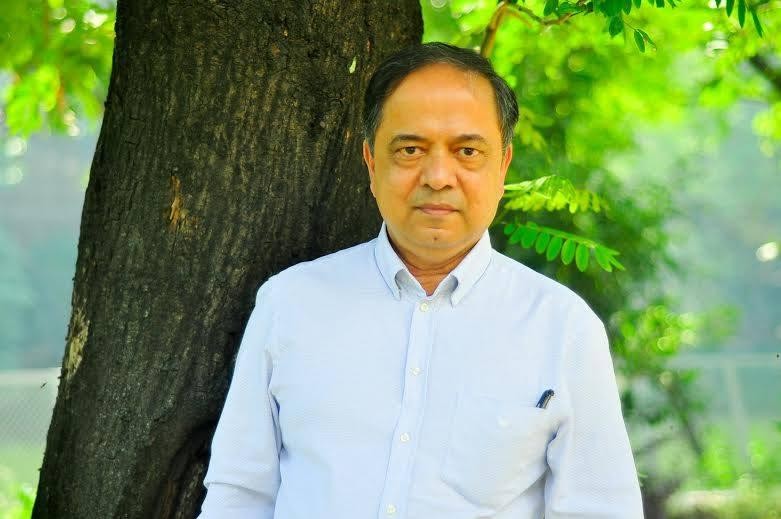
Abed Chaudhury was born in a village called Kanihati in Northern Eastern Bangladesh. As a child studied in a rural primary school, and later studied in Dhaka University, University of Oregon, USA. He did research in molecular Biology and Genetics in Massachusetts Institute of Technology, USA,Ecole Normale Superieure , France and CSIRO, Australia Where he is now senior principle scientist. He has done seminal work in seed Biology and epigenetice, an emerging area of Biology. He lives in Canberra, Australia and Sometimes in Kanihati, Bangladesh.